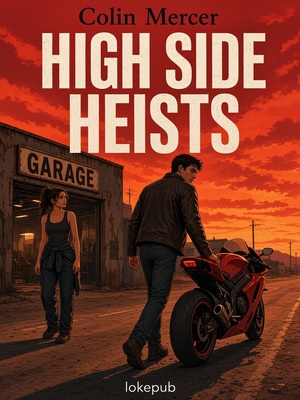
High Side Heists
1
Ahigh side isn’t like any other motorcycle crash.
Most wrecks, you slide. Maybe you roll. But you stay on the ground. You get lucky. A high side? That’s when your rear tire slips, hooks, and launches you over the bars like a slingshot.
You don’t fall.
You fly.
The first high side I ever saw killed a kid named Reyes.
We were seventeen. It was a course qualifier.
He throttled his superbike out of the exit of a left-hander, and the rear tire veered into the paint at the edge of the course, then caught traction too fast on the concrete.
There’s no grace in it. Just force and time and whatever bones break when you land.
In Reyes’s case, he high-sided into a guardrail and was crushed to death when his own bike came rolling into him at 80 mph.
We heard it from the pit. His helmet, neck, and collarbone were splayed out like a smashed watermelon.
I thought of Reyes every time I lined up in the starting grid. How fragile the human body is.
The race that ended it for me was supposed to be my breakout. Local eyes. Scouts. A shot at the AMA Superbike Championships if I placed right.
A shot at a future on my own terms.
I remember tapping my visor twice like I always did.
Superstition. I was fit, fast, wired tight.
The race card was full of big names, but by the last lap, I was in second place, the first-place rider only a half bike ahead of me.
He was known for his defensive riding, boxing me out.
Again and again. Testing my patience, waiting for a mistake.
No matter what angle I chose, he kept beating me to it.
Lower and lower we went. Bikes inches from each other, the kind of riding the crowd loves to see. Each turn closer and closer to the pavement, the sparks from our kneepads continually warning us of impending disaster.
But the rip of my motor drowned out my stupid thinking.
The faster you go, the harder the crash.
Coming out of the chicane I was too hot on the entry, back tire slipped on the paint, just like Reyes. I corrected—reflex. But the tire caught, and the speed wobbles snapped me sideways. The sky spun, the pavement rose to meet me, and then everything went black.
And that was it. My race career. Done.
Woke up in a hospital in El Paso with my shoulder pinned and my left leg swollen like a bag of blood. The doctors said I’d walk again. But another crash could end that.
Either way, I’d forever be burdened by medical debt.
That was years ago.
Now I work the pathetic garage my dad left behind and ride only during my night terrors. Every time I hear a revving engine, my chest gets tight. Not just from fear, but from want.
Because deep down, I still believe if I could have gone faster, I could have changed my life.
They say Alpine, Texas, is where the West forgot to finish the job. A little town wedged between two highways and a sky too big to care. Out here the wind doesn’t blow—it stalks. The sun doesn’t set—it bleeds out.
Cole came back the same day the desert turned black with rain.
I was under the hood of a ’77 Ram, elbow-deep in a busted carb, hating life, listening to the AM radio warn how Y2K was gonna end the world this coming New Year.
“Let it,” I thought. What did I have to lose?
That’s when the headlights of a black Ducati 996 cut through the night.
Not the kind of bike you see ridden by tourists or even weekend cruisers.
This was a superbike. Racing slicks. Custom pipes. Engine tuned to hell and back.
I knew it was my older brother, even before he killed the throttle.
I hadn’t seen Cole in nearly a decade. Not since him and Dad came to blows in the garage.
There was always friction after Mom disappeared. And when Cole stopped winning races . . .
Well . . .
Dad stopped being a dad.
At least to Cole.
The house was just too small for the both of them. Cole took off with a full tank and a cracked visor. I watched him disappear into the dark with everything I wanted trailing behind him.
Closest thing to a role model I ever had. I didn’t understand it at the time, the pressure, the failure he was dealing with. The lack of hope. I was too young at the time. I understood it now.
I understood him now. Or at least I thought I did.
He took off his helmet and grinned like the last words we ever said weren’t shouted. Mist on his jacket. Still smug, with a pair of eyes that could bluff you, if you let them.
“You still ride?” he asked, nodding toward my bike.
I lied. “Not lately.”
He didn’t smile, just looked past me into the mechanics bay, like he was seeing a memory crawl out from under the vehicle lift.
“Dad’s dead?”
He was. Three days in the ground, and the house still smelled like smoked OxyContin and used tires.
I just nodded my head. I didn’t ask Cole where he’d been.
I’d heard rumors of what he was up to. Some I could believe, others I couldn’t.
When a pair of FBI stiffs in Men’s Wearhouse suits knocked on our door asking questions about him . . . we said we knew nothing.
He didn’t ask if I missed him, not that I expected him to. He just ran his finger along the filthy countertop.
“You ever think about doing something more?” he said, pinching the grime, inspecting it with his index finger and thumb, as if reassociating himself with the environment that created him.
I didn’t answer. But I didn’t look away either. We both knew the garage had gone further downhill since the last time he saw it.
“We’re putting together a crew,” he continued. “No amateurs.”
He laid it out like it was nothing. Like bank robbery was just a side gig between track days.
“We need one more rider. Everybody has to be fast. But not just fast. Smart. You.”
I shook my head, conflicted between the shame I felt breaking the law and the satisfaction of hearing him finally acknowledging me as something more than his kid brother.
“I haven’t touched a throttle in years. Not since my accident . . .”
“Doesn’t matter,” he said. “You’re Billy fucking Miller.”
I hated how hearing that made me feel—like maybe I still was.
“Find someone else,” I said.
“There is no one else. Not that I trust.”
He looked around the garage like it offended him. At the hydraulic fluid stains across the ceiling, the sun-faded posters of old pinup girls in out-of-style swimwear, the unpaid invoices pinned like tombstones on a smudged corkboard.
His eyes settled on a framed Polaroid of me, a toddler in a Mickey Mouse sweater, looking up at Cole holding his first real race trophy. Dad was healthy, and actually smiling, his arm around Cole.
“This place is dead, Billy. You’re dying in it.”
“How long you gonna be around?” I asked.
He ignored me, making his way back to his bike.
Out came a thick roll of cash, the rubber band around it a single bill away from bursting.
“I was gonna give this to Dad. But keep it,” he said, tossing it to me.
I’d never felt the weight of that much money. A solid mass of opportunity weighing on my hand and on my conscience. Cole acted like it was nothing, meandering his way through the junk, until he found the one jerry can with gasoline left in it.
“I don’t want it,” I finally said.
“Yes, you do.”
I threw the cash on the ground.
“People know, Cole.”
“Oh yeah? What do they know?”
“People know you rob banks . . .”
He just smiled, doing his best James Dean.
“I’m gone once the storm lets up. You coming? Or you staying?”
That night, I sat on the porch, drinking the last of Dad’s skunky beer, staring at the road. I thought about the way Cole left. About the way I high-sided. About the way Dad used to call me “the careful one.” As if that was ever going to be enough.
In the back of the garage, under a tarp, I found my bike waiting. Chain loose. Tires slightly flat. Crack in the seat. But intact.
And.
Still faster than a cop car.
I touched the throttle. Imagined the rush of shifting gears.
And for the first time in a long time, I wondered what it would feel like to ride again.
I told myself I’d just test it. Just take it out past the dry lake bed, open her up a little, feel the old rhythm come back before the road got too slick.
Cole must have heard the engine scream from inside the house.
The next morning, packed up and ready to roll out, he approached me.
“Let’s go,” he said. “You’re gonna want to meet the others.”
“I’m still not in,” I said.
“You’re not out either.” I wanted to say no.
But something in the way Cole looked at me got under my skin. I used to think riding a bike fast would change everything. We both did. Like speed could erase history. If I was fast enough, maybe I could outrun being poor, outrun Alpine, outrun the weight of not being Cole.
So I left with him.
We rode west. Highway 90 unraveled like a fuse through the desert, the morning heat already rising off the blacktop in mesmerizing, slow waves.
I thought about Dad the whole ride. About how quiet the house felt now, like it was relieved he was gone.
About the funeral we didn’t have and the eulogy I didn’t write.
I should’ve said something. But I didn’t know how to bury a man I barely understood.
All that was behind me now.
We pulled off onto a road that didn’t even have a sign.
Somewhere outside of Marfa. Past a set of rusted cattle gates, the gravel dropped down into a basin with a crop duster runway.
To the side of an abandoned hangar were old double-wide trailers, the closest with two bikes parked beside it—one a chromed-out Kawasaki Ninja ZX-11, the other a Yamaha YZF-R1 that looked like it had been dipped in matte-black paint and bad intentions, both engines still ticking as if they hadn’t been there long.
These weren’t the bikes of just any rider.
These were the fastest bikes in the world.
Cole didn’t say anything. Just nodded toward the trailer like I was supposed to figure it out.