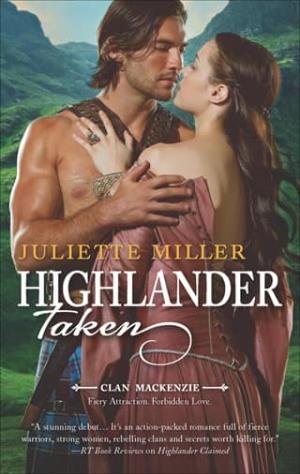
Highlander Taken (Clan Mackenzie #2)
Chapter One
I FELT THE TINGLING, heated sensation of someone watching me.
Turning to see who it was, my heart skipped an uneasy beat as our eyes met across the crowded room.
I quickly looked away, shaken by the unnerving connection.
With some difficulty, I could name the emotions he stirred in me with that one, brief glance.
Fascination, caution and, more than any other: fear.
He was standing at the entrance of the grand hallway of his family’s manor, flanked by his two brothers.
Every pair of eyes at the well-attended gathering couldn’t help but stare.
They were big, imposing men. With their brazen silhouettes dramatically backlit by torchlight, they commanded attention.
Laird Knox Mackenzie, the largest of the three, was known for his well-trained army and his formidable leadership.
Wilkie Mackenzie was said to be more lighthearted in nature, and possessed a near-legendary handsomeness that found many women gasping at his sudden appearance now.
But it was this third brother—Kade Mackenzie—who captured my attention most of all.
He was equally as tall as his black-haired brothers, but slimmer, and somehow more lithe—almost catlike—in his movements.
His long hair was a deep shade of dark brown that caught the gold light of the dancing fire he stood next to, giving him a subtle halo and the aura of a dangerous rogue angel.
All three men looked wholly in control of the scene, a confidence that might have stemmed from their skills with the sword as well as their ownership of some of the richest, most bountiful agricultural lands in all the Highlands.
And while Laird Mackenzie and Wilkie gave a distinct impression of being at ease in their own skin, there was a wandering restlessness to Kade that not only entranced me, but also raised the tiny hairs on my arms in silent, spellbound alarm.
I took comfort from the close presence and incessant gossip of my four sisters and two cousins.
“There he is,” said my sister Maisie, clutching my arm.
“It’s Wilkie. Lord above, he’s magnificent.
None of you are even to speak to him. Not until our marriage is secured beyond doubt.
Even then, you’re to keep your distance. He’s mine.”
Maisie had claimed Wilkie for herself months ago, after he had once visited our manor. Whether he agreed to the match or not was yet to be determined.
“Aye, Maisie,” responded Clementine, my eldest sister. “We’re all aware of your designs on him. You speak of nothing else.”
“You can help yourselves to his brothers,” Maisie allowed.
“Who would dare approach them?” said Bonnie, my younger cousin, eyeing the Mackenzies with trepidation and something akin to awe.
“They’re so intimidating. Laird Mackenzie is displeasingly gruff, I’ve heard it said.
Look at the size of him. And Kade, well, his reputation speaks for itself. He’s as wild as they come.”
“Luckily for you, then,” Maisie replied, “there are many other men in attendance tonight.”
It was true. The Mackenzie clan was hosting, among others, the Macintoshes and Munros, whose highest-ranking family was pleasingly populated by a number of rowdy, good-looking bachelors.
My sisters and cousins were pink-cheeked, primped and plumped into their best and most revealingly cut gowns, and more than ready for the occasion.
I, on the other hand, wanted nothing more than to return to our guest chambers and retire for the night.
Or to flee, or do something completely unexpected of me.
I willed myself not to let my thoughts return, once again, to Caleb, the only boy who had ever shown me kindness, lost to me now.
It had been a fortnight since Caleb had asked for my hand in marriage, only to be promptly banished to Edinburgh by my father, Laird Morrison.
Caleb’s status was low—not fit for the daughter of the laird himself—and his occupation as an apprentice blacksmith gave my father reason to have him trained by experts farther afield.
Urgently. I had not even been allowed to bid him farewell.
The injustice of that hard-hearted act filled me with a sadness that was outlined by what felt remarkably like anger.
It wasn’t fair that my father could pluck my beloved out of my life so callously, and with such finality.
Gone, just like that. The suddenness of Caleb’s absence consumed me to such an extent that I had spent several days heartbroken and bedridden.
I’d felt weakened and empty from all the tears I’d wept, as though my spirit had dripped away along with them.
And then the heartbreak had turned, uprooting a long-buried resentment that was far less accepting.
Our upbringing of abuse and tyranny had conditioned us to submit to the cruel whims of our father, but lately my usual obedience had become disrupted.
I was tired of the beatings and the belittlement.
A part of me wanted to rise up and break free like never before.
I wanted nothing more than to be alone with my thoughts so I could let that seedling of empowerment grow, and lead me where it may.
“Evening, ladies,” said one of the Munro men, sidling up between me and Bonnie, standing so close that a long strand of his hair brushed against my cheek. “My name is Tadgh,” he said, tilting his head low in a bid to draw my eyes up, to his. “And you must be Stella.”
I wasn’t sure why he was singling me out, or even how he knew my name.
It would have been rude to ignore him blatantly, but in my current state, the last thing I felt like doing was engaging one of these Munros, with their reputations as devout merry-makers and instigators of occasional debauchery.
I wildly wished that one of my family members would speak to him instead.
Thankfully, one did. “A pleasure, Tadgh,” said Bonnie.
“’Tis a fine affair, is it not? The manor is so nicely presented.
The Mackenzies are hospitable, and do such a splendid job of decorating, don’t you agree?
” Bonnie had a flirtatious nature, though she had already selected a husband.
It wasn’t time for her to ask for permission yet; she knew, as her hopeful conquest did, that my father would not allow either of his nieces to be married until at least one of his daughters had made a suitable match.
“To be sure,” Tadgh answered blithely, as though he couldn’t care less about the decorating but had his mind on darker, more playful endeavors. And he was still watching me. “So, Stella, what do you think of the decorations? Do the finely woven tapestries please you?”
I didn’t have much experience with the conversations of men, so I couldn’t be entirely sure, but I had the feeling he was teasing me.
A month ago, I would have been too timid to respond to Tadgh Munro; conversing with the wrong man would lead to punishment: this I knew only too well.
Two weeks ago, I would have been too heartbroken.
Tonight, however, my emotions were unruly.
A newfound internal rebellion seemed to be gaining momentum.
In fact, they were beautiful tapestries.
The sight of their rich colors and masterful workmanship made me realize I hadn’t noticed details of this type—of beauty and depth—for too long.
I had a sudden unfamiliar urge to experience and appreciate more of life, and be allowed to do so, on my own terms. But I did not mention any of this to Tadgh.
Instead, I said quietly, “Aye, they do.”
Two more Munro men joined us, armed with a tray of goblets and pitchers of ale, and were introduced as Tosh and Angus.
“Ladies, may I pour you a goblet of ale?” Angus asked.
“The Mackenzies make a fine drop.” He poured ale into a cup and handed it to me, which Tadgh intercepted, completing the exchange.
I took the cup from Tadgh’s hand and almost dropped it when his fingers slid audaciously over mine.
I pulled back quickly, spilling a drop of the ale.
My father and his men would be watching me, as always.
Tadgh, perhaps unaware of this, smiled at my reaction.
Dressed as he was in his bright red Munro tartan, the fiery shades in his hair were all the more illuminated.
Each of the Munros, in fact, glowed with their red-hued aura and their festive, unreserved manner.
The Mackenzies, I couldn’t help contrasting, in their navy blues and forest-greens and with their dark night-lit hair, offered a much more formidable presence.
“The lovely Stella is a mite skittish,” Tadgh commented to his cousins, “although I’ve heard that under that exquisite, demure facade there’s a feisty wee rebel who steals carriages and takes to men with their own weapons. Captivating indeed.”
“Aye,” Tosh Munro responded, chuckling. “Hugh Morrison still wears the bandages. On his right hand, no less. His sword-carrying hand.” As his eyes roved my face and my body, he said, “Already she is famed for her beauty, and now she presents a dangerous challenge all the sweeter to any man who gets past her defenses.”
That the Munros were both entertained and intrigued by my run-in with my father’s men was disturbing enough.
Much more worrisome, however, was that news of my actions had spread.
My father would only be further enraged if my marriage prospects were tainted by a reputation for defiance.
The Munros, however, didn’t seem at all deterred.
Several of them stood close to me, and Tadgh in particular was eagerly attentive.
They, as all the men at the gathering, wore their kilts and their ceremonial garb, including swords and knife belts.
They were big men, warriors each one. I thought again of Caleb, who was gentle and kind in a way that these men could never be, and I missed him greatly in that moment.