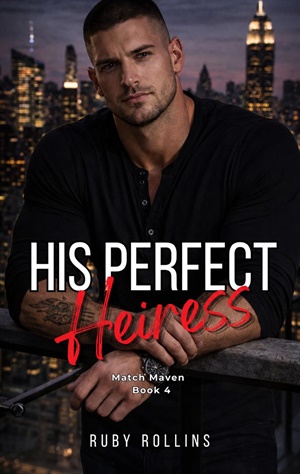
His Perfect Heiress (Match Maven #4)
1. Chapter 1
Isla
Iam sitting in Match Maven's glass-walled conference room in Midtown, reading the term sheet for my own arranged engagement like it is a cable bill, when the door opens and the most infuriating man I have ever seen walks in.
To be fair, I have not yet decided he is infuriating.
That takes another forty-five seconds. But there is something in the way he fills the doorway — not physically, though he does that too, six-foot-something of dark hair and a jaw that looks like it was carved by someone with a grudge — that tells me he has already assessed the room, found it acceptable, and sorted me somewhere under variables to manage.
All of this before he has taken a single step inside.
I smile my biggest, most obnoxious smile.
His expression does not change at all.
I decide, right then, that we are going to have a problem.
Three days ago my father called me into his office.
Conrad Wrenwood does not summon people. He invites them, in the way that hurricanes invite coastal evacuations — technically, there is a choice involved.
I sat across from his desk in the chair that is positioned three inches lower than his own, which I have always assumed is deliberate, and he slid a manila folder across the surface toward me.
Inside was a photograph of my own building lobby. Taken from the street. Recent enough that I could see the dry-cleaning bag I'd dropped off two Tuesdays ago still hanging over the doorman's counter in the background.
"Someone has been watching you," my father said, with the same affect he uses to discuss quarterly projections.
I looked at the photograph for a long moment. Then I looked at my father. "And your solution is?"
He had the next folder ready. He always has the next folder ready.
Inside was a brochure. An actual brochure.
Cream cardstock, embossed lettering — for Match Maven, Celeste Harper-Andrews' matchmaking agency, which I had heard of the way you hear of things that exist at a comfortable distance from your own life.
"A managed engagement," Conrad said. "Six months. High-profile, well-documented, difficult for someone with bad intentions to penetrate. Celeste has a candidate."
"A candidate," I repeated. "You want to find me a fake fiancé."
"I want to keep you safe."
I thought about pointing out that those were not the same thing.
I thought about the photograph, and the lobby, and the fact that my building has a code and a doorman and is not, in theory, accessible to strangers with cameras.
I thought about the restraining order that was apparently not on the table, or the private security detail, or any of the seventeen other options that did not involve engineering a relationship for public consumption.
Then Conrad told me what happened to my trust fund if I said no, and I stopped thinking about alternatives.
So here I am. Reading a term sheet for my own life, line by line, because I am nothing if not thorough, while Celeste Harper-Andrews — polished, precise, cream linen at nine in the morning — sets up at the head of the table and the most infuriating man I have ever seen arranges himself in the chair across from mine like he has already decided exactly how much of the room he is willing to occupy.
Which is: all of it.
"Matthew Beckett," Celeste says, "heads Apex Elite Security Group. He'll be managing the security overlay for the arrangement."
Matthew Beckett nods once, which appears to be his primary mode of communication.
"Isla Wrenwood," Celeste continues, in my direction, "is —"
"I know who she is," Beckett says.
I look at him. He is looking at the term sheet in front of him, not at me, which should make the comment less irritating and somehow makes it worse. "Do you," I say.
His eyes come up. Hazel, which I had not expected, and direct in the way of someone who has decided eye contact is a resource to be deployed rather than a social nicety.
"Wrenwood Hospitality heiress," he says.
"Twenty-six. Tabloids have you at roughly one scandal per quarter — nothing serious, mostly clubs and bad decisions and the occasional quote you probably regret. That's the public version."
I look at him. "You've Googled me. Great."
"I did more than that."
"Oh?"
"The incident at the Meridian last January," he says. "The one that didn't make the papers."
I go very still for exactly one second. The Meridian was a photographer outside a fundraiser who'd been following my mother in and out of her various wellness retreats and decided, when he saw me coming out of the same building, that there was a story in the comparison.
He said it out loud. He had his camera up when he said it.
"God," I say, "are you going to guess my cup size next?"
He holds my stare for a moment. Something moves in his jaw. Then, like the words cost him something: "I also know you're active in several philanthropic organizations. Women's shelters. Free clinics."
"How thorough of you," I say.
He looks back down at the term sheet. "It's my job."
Celeste, to her credit, continues as though neither of us has spoken.
She lays out the framework with the efficiency of someone who has done this before and intends to do it again: six months, staged appearances, coordinated press, full security overlay managed by Apex.
The engagement will be announced through a controlled leak to a society column in four days.
There will be a photographer on retainer for public appearances.
There will be, Celeste says, with a look in my direction that I choose to interpret as solidarity, a code of conduct.
Beckett asks two questions about protocol. Then he signs without reading the full document, which means he negotiated his terms before walking in here. I file this away under things that are annoying because they are also intelligent.
I ask twelve questions. Some of them are genuine. Some of them are because I want to watch the small, controlled tick start in his jaw when I push past what he has decided is the relevant information.
It happens on question seven. I count it as a win.
Celeste steps out to collect the counter-signed copies, and the room becomes, without her, a noticeably different kind of space.
Beckett sets down his pen. "You'll need to adjust your schedule," he says, in the tone of a man reading from a list he has already finalized without input. "Limit unplanned outings. Share your location at all times. I'll need access to your building's security feeds by end of day."
I put my elbow on the table and rest my chin in my hand. "That sounds like a prison sentence with better lighting."
"It sounds like a security protocol."
"Those aren't mutually exclusive."
He looks at me. Not the assessing sweep from earlier — this is something more direct, more patient, like a man who has decided to wait out a weather system. "Ms. Wrenwood."
"Isla."
"The threat is credible," he says. "The measures are proportionate. If you'd like to debate the philosophy of personal autonomy versus personal safety, I'll make time for that. But not while there's an active threat on your building."
I hold his gaze. He doesn't look away, doesn't shift, doesn't offer me anything to push against. Just holds it, steady and impersonal as a wall.
I am the one who looks away first.
I hate that immediately and completely.
"Fine," I say, to the middle distance. "But I'm keeping my Tuesday nights."
He says nothing. I have no idea if that means yes.
Celeste comes back with the third folder before I've finished being annoyed about the eye contact, and slides it across the table with the practiced ease of someone delivering bad news at a comfortable velocity.
"First public appearance," she says. "Four days. The venue is confirmed, the photographer is briefed, and Ivy has your styling notes." She pauses. "There's one more thing."
She opens the folder.
Inside is a single photograph. My lobby again, but different — not the careful, distant surveillance of the first one. This one is close. Taken this morning, the timestamp reads, at 7:52 a.m., while I was sitting in this conference room reading a term sheet for my own life.
"This arrived at your building," Celeste says, "forty minutes ago."
I look at the photograph. I look at the timestamp. I do the math.
Whoever took this knew I wouldn't be home to receive it.
Across the table, Beckett has gone very still in the way of someone who has just received information that confirms a conclusion he'd already reached and doesn't find the confirmation comforting.
His jaw is set. He is looking at the photograph with an expression I cannot read and don't particularly like.
I close the folder.
"Tuesday nights," I say, mostly to myself. "I'm keeping them."
Nobody answers. Outside the glass walls of the conference room, Match Maven's office goes about its business, bright and oblivious and entirely unbothered. I pick up my copy of the term sheet, fold it in half, and put it in my bag.
Six months. I have agreed to six months.
I tell myself it's fine.
The elevator down to the lobby takes forty-five seconds and I spend them doing what I always do when I need to think without looking like I'm thinking: I check my phone.
Lina has texted twice, both messages a variation on call me when you're out, I have opinions about this whole situation.
Cole sent a single question mark, which is his version of I heard something and I'm waiting for you to confirm it before I lose my mind.
I don't call either of them yet. I stand in the lobby of Match Maven's building in my four-inch boots and my best this-is-fine expression and I think about the photograph.
Not the first one — the surveillance shot, the patient, distant documentation of my comings and goings. I've been sitting with that one for three days and I've made a kind of uneasy peace with what it means.
The second one. Taken this morning. Forty minutes ago, while I was upstairs.
I think about the timestamp. I think about the word received, and what it implies about delivery, and what delivery implies about proximity.
I think about the fact that I walked into that building this morning at 8:04 and whoever took that photograph was there before me, knew I was coming, and was gone by the time I arrived.
My phone buzzes. Cole again.
Cole: Isla.
Isla: I'm fine. It's handled. Stop making that face.
His response is immediate.
Cole: I'm not making a face.
Isla: You're absolutely making a face.
A pause.
Cole: Dad called me.
Of course he did. Conrad Wrenwood, who will not discuss his daughter's safety arrangements with his daughter for more than ten minutes without becoming managerial about it, apparently has time to brief his son.
I put my phone in my bag and bite down on the rage scream trying to work its way free as I push through the lobby doors into the noise and indifferent momentum of Midtown on a Tuesday morning and let it carry me half a block before I stop and tip my head back and look up at the slice of sky between the buildings.
Fine. It's fine. I have agreed to a fake engagement with a man who communicates primarily in complete silences and already finds me predictable, and there is someone out there who knows my schedule better than my own housekeeper, and my father has decided that the correct response to all of this is to treat it like a merger negotiation.
Six months.
I flag a cab, because the subway requires a level of zen I do not currently possess, and I give the driver my address, and I sit in the back and watch the city go by and think about Beckett looking at that photograph with his jaw set and his expression unreadable, and the quality of stillness he went into when the third folder landed on the table.
Not surprise. That was not a man being surprised. That was a man receiving confirmation.
He already knew it was escalating. He came into that room already knowing, and he signed the contract anyway, and he looked at me across that table with his hazel eyes and his immovable patience and he said the measures are proportionate like I was a variable he'd already solved for.
The cab stops at a light. A woman on the sidewalk is walking a dog the size of a throw pillow, and the dog stops to investigate something in a crack in the pavement with the focused intensity of a scientist on the edge of a breakthrough, and for some reason this makes me feel slightly better about everything.
Tuesday nights, I told him.
He said nothing.
I have no idea what that means, and I refuse to think about it for more than another thirty seconds. Because Tuesday nights are happening.
I think about it for the entire rest of the ride home.