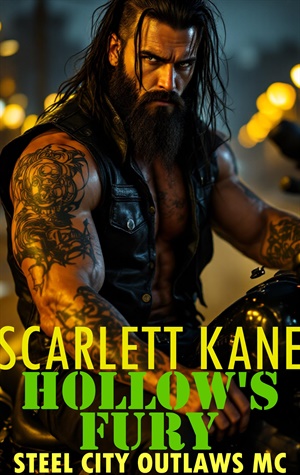
Hollow's Fury (Steel City Outlaws #2)
Chapter 1
The bottle of Knob Creek hit the table between two men who looked ready to kill each other, and Hollow dropped into the chair at the head like he owned the place.
He did, in every way that mattered.
"Sit down," he said. Not a request.
Tony Garza, who ran a concrete crew out of Homestead, had his fists balled on the table and murder in his eyes. Across from him, Pete Loomis—steel supplier, Braddock born and raised—was leaning back with the kind of calm that meant he had a weapon within reach.
Hollow looked between them and cracked his neck. "I said sit down, Pete."
Pete sat.
"Good." Hollow poured three glasses, slid one to each man, and kept the third for himself. "Now somebody tell me why I'm here instead of eating meatloaf."
Tony started talking first. Money owed, deliveries shorted, a whole string of grievances that boiled down to the same thing every business dispute boiled down to—one man felt cheated and the other man felt justified. Hollow let him talk, watched Pete's jaw work, and drank his bourbon slow.
"That true?" Hollow asked when Tony ran out of steam.
Pete spread his hands. "Material costs went up. I adjusted."
"You adjusted after we shook on a number."
"The number didn't account for—"
"Pete." Hollow's voice dropped, and the room got smaller. "Did you shake on a number?"
Silence.
"Did you shake on a number, brother?"
"Yeah."
"Then you honor the number. That's how this works." Hollow turned to Tony. "And you don't let it fester for three months before bringing it to us. You got a problem with a man flying our flag, you come to the club. That's what we're here for."
Tony's fists unclenched. Pete reached for his bourbon.
Hollow laid it out—payment plan, adjusted rates going forward, and the understanding that if either of them let a business dispute threaten Outlaws stability again, Hollow would settle it differently.
He didn't have to specify what differently meant.
Six feet of door-gunner history sitting across from you made the implications pretty clear.
They shook hands. Tony even managed a nod that almost looked like respect. Pete looked relieved, which was smarter than pride.
Hollow finished his bourbon, pocketed the bottle—tax for services rendered—and walked out into a Pittsburgh evening that smelled like river fog and exhaust. His bike was parked at the curb, chrome catching the last of the light off the Monongahela, and he swung a leg over and sat there for a minute, letting the engine idle while he decided what he wanted more—sleep or meatloaf.
Meatloaf won. It always won.
Nowak's Diner sat on a Bloomfield corner like it had grown there, brick and neon and a flickering OPEN 24 HOURS sign that had been flickering since before Hollow ever walked through the door.
The parking lot held three cars and a delivery van, the dinner rush long gone, just the late-night regulars nursing coffee and the glow of the grill through the kitchen window.
He pushed through the front door and the bell jangled overhead.
"Sit anywhere, kitchen's—" Debbie Nowak came around the counter with a coffee pot and stopped when she saw him. "Oh. You."
"Me." Hollow dropped onto his regular stool at the counter and spread his hands on the Formica like he was claiming territory. "Miss me?"
"Like a headache." But she was already reaching for a mug, pouring his coffee without asking. "Meatloaf's almost gone."
"Better not be. I settled a war for that meatloaf."
"You settled a war."
"Business dispute. Same thing." He wrapped both hands around the mug and watched her move behind the counter.
Debbie Nowak was built for work—broad shoulders, quick hands, hair cropped short because function beat fashion when you ran a twenty-four-hour operation solo.
Her voice carried across the diner like she'd been born with a microphone in her chest, and her laugh was louder than his bike.
He'd been coming here for two years. Best meatloaf in Pittsburgh, and the woman who made it didn't take his shit, which made the meatloaf taste even better.
She set a plate in front of him—meatloaf, mashed potatoes, green beans that had been sitting in butter long enough to qualify as a religious experience—and leaned against the back counter with her arms crossed.
"You look like you've been working," she said.
"Always working." He cut into the meatloaf and groaned loud enough to make the old couple in booth four look over. "Debbie. This is a sin."
"It's ground beef and breadcrumbs."
"It's a sin. Marry me."
"You ask me that every week."
"And every week you break my heart." He pointed his fork at her. "One of these days you're going to say yes and I'm going to pass out."
She rolled her eyes, but the corner of her mouth twitched.
That was their rhythm—he flirted, she deflected, and somewhere in the middle they'd built something that felt like friendship with an edge neither of them acknowledged.
He liked her. Liked her backbone, liked her mouth, liked the way she ran her diner like a general running a campaign.
Liked that she looked at him—patches, scars, fists like sledgehammers—and saw a man who needed feeding, not a threat that needed managing.
Tonight, though, something was off.
She poured refills for the couple in booth four and came back to lean on the counter near him, but her hands weren't steady. The coffee pot clinked against the mug when she topped him off, and she pulled it back fast, like she hoped he hadn't noticed.
He noticed everything. Three tours as a door gunner had wired his brain for threat assessment, and Debbie Nowak's hands didn't shake. Not when drunks got handsy at 2 AM, not when the fryer caught fire last winter, not ever.
"What's wrong?" he asked.
She looked at him, and for half a second something cracked open behind her eyes—something that looked like fear, real fear, the kind that lived in your chest and made it hard to breathe. Then she shut it down, smoothed her expression, and waved a hand.
"Long day. Short-staffed again."
"Debbie."
"It's nothing, Hollow. Eat your meatloaf."
He held her gaze for a beat, reading what she wasn't saying. Something was eating at her, something bigger than staffing problems. But she had her jaw set in that way that meant pushing would get him nowhere, so he let it go. Debbie Nowak would talk when she was ready, and not a second before.
"Alright," he said. "But I'm here. You know that."
She softened, just a fraction. "I know."
He finished the meatloaf, mopped up the gravy with a piece of bread, and left cash on the counter—forty on a twelve-dollar tab, because she wouldn't take money she hadn't earned but she couldn't stop him from leaving it on the Formica and walking out before she could argue.
"Hollow," she called after him. "This is too much."
"Inflation." He pushed through the door and let it swing shut behind him, the bell jangling in his wake.
The ride back to the compound took him through South Side, past row houses with porch lights glowing and corner bars spilling noise onto the sidewalk.
His city. His streets. The Outlaws held this territory because men like him made sure nobody else could, and the businesses and families who lived under that protection slept better for it.
The compound rose up on the corner lot—three stories of converted steelworks brick, the garage bays dark, a few bikes parked in the gated lot. Home. He backed his bike into his spot, cut the engine, and sat in the silence for a minute.
The silence was the problem. Always had been.
In the silence he heard rotor wash. Metal screaming. The sound his crew made when the bird went down and he was the only one who—
He swung off the bike and headed inside, boots loud on concrete, drowning it out the way he always did. Noise. Movement. Anything to fill the space where the ghosts lived.
The clubhouse was half-empty, a few brothers shooting pool, the bar lit up with amber light from the mill-timber fixtures.
Ash was perched on a stool taking apart something electronic that was probably going to get them all killed, and Gibbet sat in the corner reading a paperback with the focus of a man defusing a bomb.
"Pitt around?" Hollow asked.
Ash looked up from his project. "Upstairs with Maggie. Said not to bother him unless someone's bleeding."
"Nobody's bleeding."
"Then don't bother him." Ash went back to his wiring. "How'd the Garza thing go?"
"Handled." Hollow grabbed a beer from behind the bar and dropped onto the couch. "Pete was shorting him on deliveries, padding the cost increase. Worked out a payment plan."
"You hit anybody?"
"Didn't have to."
Ash looked genuinely disappointed. "Boring."
Hollow grinned, kicked his boots up on the table, and drank his beer while the clubhouse noise settled around him like armor. Brothers talking, pool balls cracking, Ash muttering about circuits. The sounds of his life, the ones he'd chosen to replace the ones he couldn't unhear.
He thought about Debbie's shaking hands. About the fear she'd tried to hide behind tired eyes and a wave of her hand.
Tomorrow. He'd go back tomorrow, and if she was still rattled, he'd push harder. Because Debbie Nowak didn't scare easy, and whatever had put that look on her face was something worth knowing about.
He finished his beer, crushed the can, and headed upstairs to his room, where the quiet waited like it always did—patient, heavy, full of the sound of falling metal.
He turned the radio on before he hit the pillow.