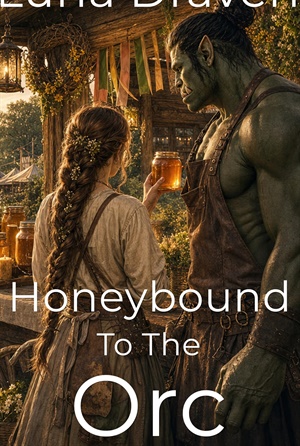
Honeybound To The Orc (Stone And Storm #11)
Chapter 1
Carys
Ismell Thistledown before I see it.
The road has climbed through dust and dry grass for two days.
Then it tips over a low green shoulder of land, the wind turns, and there it is, riding up to meet me on the warm air.
Linden. Whole avenues of it in full flower somewhere down in that valley, clover laid thick under that, a bright thin thread of meadowsweet over the top of both.
My nose sorts it out before my eyes catch up.
That’s the one direction I’ve ever been any good at, the one that runs by smell instead of signposts.
It tells me I’ve found the right town a full mile before I’d trust a map to.
The bees agree with me. The skeps lift their hum half a note on the wagon behind me, that bright greedy rise they do when good forage rolls in on the wind. I laugh out loud on the empty road like a fool.
“I know,” I tell them. “I smell it too. Hold your horses.”
Under the sweetness, though, for one breath, something goes thin.
A low note, next to nothing, like a door somewhere swinging open that ought to have stayed shut.
The hum on the wagon catches it and dips wrong for half a heartbeat, then rights itself and climbs back to greedy and bright, same as before.
“What was that,” I say, to no one, since out here the only company I keep is bees and a goose with opinions instead of words.
Nothing answers me. The clover smell rolls back in, thick and gold and ordinary. I decide it must be a hive gone sour somewhere downwind, or a bad patch of something growing where it shouldn’t. Bad seasons happen even to good bloom country. I’ve smelled worse and slept fine after.
The wagon finds a rut, and something in the back lets go with a crack that jars up through the floorboards and straight into my back teeth.
I close my eyes for one breath. I don’t need to look to know it. The middle hive box, the old ash one with the split I’ve been promising to mend since the heather came in, has given up the road for good. I can hear it riding loose now, board knocking board, every turn of the wheel.
“All right,” I say. “All right. We’re almost there. Do not fall apart on me in front of company.”
The box does not answer. Bramble does.
He comes up out of his nest of straw at the front of the wagon, one wicked orange eye fixing on me.
The empty socket on his off side is puckered and proud.
He lets out the long flat honk that means he has been asleep and someone has had the gall to be awake near him.
He is the ugliest creature I have ever loved.
He hates the whole turning world and everything standing in it, and for reasons known to no one including himself, he has decided I am the single exception.
He has appointed himself my whole personal army, one goose against the road.
“Good morning to you too,” I tell him. “We are at the fair. Best behavior.”
He bites the air in my direction. That is him agreeing.
The valley opens as the road comes down, and Thistledown lays itself out below me, gold in the afternoon light.
Oh, it is a pretty thing. A wide green commons in the middle, the grass already churned to a fairground, ribbon lines strung tree to tree, the bright canvas humps of a hundred stalls.
A slow brown river with one stone bridge over it.
Smoke from cookfires going straight up in the still air.
And people, so many people, flowing in along every road on foot and cart.
A clan-camp of orcs off to the east, banners hung lazy in the heat.
Humans and orcs down the same lanes into the same town, easy as anything, nobody looking twice.
I’ve driven a long way to a lot of fairs. This is a good one. I can tell already, and I haven’t sold a single jar yet.
It takes the better part of an hour to get down and in, the road clotting thicker the closer it comes to the bridge.
By the time I roll the wagon onto the edge of the commons the sun has gone long and orange, and Bramble has insulted nine separate strangers.
I find a steward, a harried woman with a list clutched against her chest. She finds me a stall on the honey row for a copper and a jar of the clover, and tells me the fair runs the better part of a month, right up past the high bloom.
“Bed, though, you’ll not get,” she adds, already looking past me at the next cart rolling in. “Whole town’s stuffed to the eaves this week. Folk are sleeping under their own wagons and glad of the roof.” A glance at mine, the goose, the crooked wheel. “You’ve got a wagon. You’re luckier than most.”
“I have a wagon with a hole in the roof and a goose in it,” I say, but she is already gone, waving the next cart into its space.
The fair swallows me before I have even climbed all the way down.
A ribbon-seller loses three yards of blue silk to Bramble’s beak before I can stop him, and pays for it with a look that could curdle milk.
A boy with a tray of meat pies watches the goose like he has found trouble he would like to make friends with.
Someone’s fiddle is already going, thin and sweet, past the stalls.
The whole green smells of woodsmoke and roasting nuts.
Underneath all of it, gone as soon as I catch it, is that same faint sour thread I found on the road.
I lose it again before I can be sure I found it twice.
There is too much fair around me to go looking for it now.
That is fine. I have slept in worse than my own wagon.
It is the box that worries me. I climb up the back and look.
The bees and clover I painted on the side boards years ago have faded to their first coat under three winters of weather.
It’s worse than the sound promised. The split has run the whole length of the ash board and sprung the joint at the corner, and the frames inside have shifted loose.
I lay my palm along the mesh anyway, out of habit more than need, and listen.
This hive at least is fine, grumbling and busy, the good ordinary temper of bees who have had a long day and want their supper.
It is only the box under them giving out, not the bees themselves, and that is a small mercy I will take.
If I roll another mile on it I will lose comb, and maybe a whole hive with it.
A lost hive in high summer is money out of my own mouth come winter.
It needs a joiner tonight, before I move the bees over, and it needs a bed to sleep near them once that is done.
So I ask around. That part I am good at. I am good with people even when I am good at nothing else that matters here. The honey-seller two stalls down turns out to be exactly the sort I like best. The kind with an opinion about everything, and no shortage of time to share it.
“You want the Skep for a bed,” she says, sorting jars, “though I’d not count on it.
Everyone’s saying full. And you want Madoc for the box, whether there’s a bed in it for you or not.
Best hands for wood this side of the river.
” She looks at Bramble, doing his level best to intimidate a basket of candles.
“He’ll like your goose about as much as everyone else does. ”
“So, not at all.”
“Not even a little.” She grins like it is the best news she has given anyone all day. “North edge, past the tannery. You’ll smell your way there before you see it.”
“That,” I say, “is the only kind of directions I have ever trusted.”
The Gilded Skep sits square on the market green, timber-fronted, a wooden skep the size of a barrel creaking on a post above the door.
Every window is lit gold, and every one of them is full of noise.
I angle the wagon sideways to get near it at all, past two other carts already parked hopeful by the door.
For a moment before I go in I just stand there and look at it.
All that warm crowded light spills out onto the green, laughter and a fiddle and the clatter of cups.
A whole roomful of people who already know where they are sleeping tonight.
I’ve stood outside a great many rooms like that one.
I know the shape of the wanting well enough by now not to let it slow me down.
I go in. The common room is packed shoulder to shoulder. The innkeeper meets me before I am three steps past the door, wiping her hands on her apron, brisk and not unkind about it.
“Not a bed,” she says, before I can ask.
“Not a floor, either. We’ve got three to a room upstairs as it is, and I’ve turned away six of you since noon.
” She looks me over then, at the wagon behind me and the box knocking in it, and something in her face softens.
“You’ve bees back there in trouble, by the sound of it. ”
“A box, mostly,” I say. “It’s given up on me. I need somebody who works wood before I lose the whole hive, and somewhere to put my head down near it tonight.”
“Madoc,” she says, like it settles two problems at once, because it does. “North edge of town, past the tannery, where the trees start. Best joiner in three valleys.” She pauses. “Worst company in all of them. Doesn’t mean the first part any less for it.”
“That sounds like my kind of man.”
She laughs, quick and real. “He’s got a spare room over the shop nobody’s used in years.
He might let you have it, if the work’s good enough he can’t say no and pretend he means it.
” She turns to point, and stops, and frowns.
“Past the tannery, mind. Left at the old one, not the new. Or is it the new one.” She waves a hand like she is shooing the question off.
“You’ll know it when the smell changes.”
“I am very good at smells,” I say, “and useless at everything else. We shall see how that goes.”
She is laughing again as she turns back to the crowded room. I am back out in the last of the daylight now, with a name and half a set of directions. The box still needs a joiner before the light runs out on me.