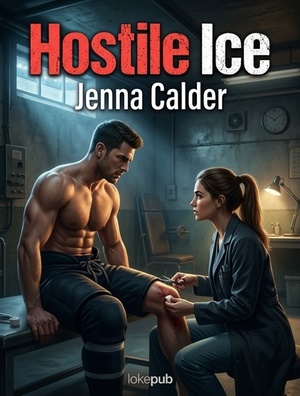
Hostile Ice
Chapter 1
Marie POV
The air inside Sloan Arena sat at a sharp, biting forty-eight degrees, smelling of shaved ice, sulfur, and the sour chemical exhaust of the Zamboni.
High above the glass on the technical catwalk, my fingers were numb inside my fingerless wool gloves.
I kept them pressed to the screen of my tablet, watching the digital telemetry lines flicker across the display.
Fourteen weeks. That was the countdown running along the bottom margin of my master schedule.
Fourteen weeks until the Frozen Four in Lake Placid, twenty-four weeks until the NHL Entry Draft, and eighty-four days until my undergraduate career ended.
Without the United States Olympic Training Center post-graduate fellowship, my post-college reality consisted of four figures of negative bank balance and sixteen thousand dollars in deferred undergraduate loans.
Four months ago, I had an eighteen-thousand-five-hundred-dollar research grant to fund my biomechanical fatigue study.
Then Chosen Black opened his mouth during the pre-season athletic board review.
He told Head Coach Garrison Vance and Athletic Director Reginald Sterling that my joint-load tracking was theoretical waste cooked up by people who had never taken a hit into the boards.
Sterling gutted my funding forty-eight hours later.
Since October, I had paid my tuition by mopping the blood and melted frost off the arena rubber mats at two in the morning.
A roar surged from the eight thousand students packing the aluminum bleachers below, vibrating through the steel soles of my boots.
Down on the ice, Carver was clinging to a 3–2 lead against the Northbrook Reapers with four minutes left in the third period. Chosen Black (#14) took the defensive zone draw.
He was six feet, four inches of ruthless, calculated violence.
He didn't play center like an athlete; he patrolled the ice like an executioner enforcing an eviction.
His posture was low, his broad shoulders squared over the puck, his stick blade planted on the red dot with enough downward force to groove the ice.
When the linesman dropped the rubber, Black didn't bother trying to finesse the draw.
He leaned his two hundred and twenty-eight pounds straight into the opposing center's chest, tying up the stick, using his skate boot to kick the puck back to the blue line.
Then Brett Calhoun came flying in from the blind side.
Calhoun, Northbrook’s captain, didn't play the puck. He angled low, leading with his hip, spearing Black’s right knee in an illegal clipping maneuver along the half-boards.
The sound of the impact traveled up the concrete risers—a dull, wet crunch of plastic armor and cartilage colliding at twenty miles an hour.
On my screen, Black’s live telemetry spiked crimson. The valgus load on his right knee hit four hundred and thirty Newton-meters. The graphic flashed yellow, then flared into diagnostic red.
The arena went dead silent. Black hit the ice hard, his helmet striking the plexiglass before his body folded onto the frozen surface. For three seconds, he didn't move. The referee's whistle shrieked, signaling a major penalty, and Carver's student athletic trainers pushed open the bench gate.
Don't get up, I thought, my fingers tightening against the tablet's casing until the aluminum groaned. Stay down and let them stabilize the joint.
Black didn't stay down.
Before the team physician could touch the ice, Black caught the top of the dasher board with one gloved hand.
The tendons in his neck corded thick as braided steel wire.
His jaw locked, the masseter muscle bulging against his skin as he hauled himself up onto his left blade.
His right skate hovered an inch off the deck, refusing to take weight.
He waved the trainers off with a single, furious slash of his glove. When Calhoun skated toward the penalty box, Black dragged his right skate underneath his center of gravity, forced his weight down through the damaged joint, and skated four deliberate, punishing strides toward the Carver bench.
To the eight thousand fans screaming his name, he looked indestructible.
On my monitor, his right-leg kinetic distribution was running at forty-two percent. He was skating on a severed stabilizer.
* * *
I didn't wait for the final horn. I shoved the diagnostic tablet into my canvas satchel, threw my parka over my shoulders, and took the catwalk service stairs three at a time. The cold draft from the lower tunnels smelled of wet wool, ammonia, and ancient limestone.
My boots hit the rubber-mat flooring of the corridor outside the Carver home locker room just as the buzzer sounded. The noise overhead was deafening—the thunder of stomping feet, the blare of the victory siren. Carver had held on, 3–2.
The double doors at the end of the hall flew open.
Players began filing in, their heavy skate guards clicking sharply against the floor, gear bags slung over their bruised shoulders.
Knox Davies came first, his helmet off, blond hair plastered to his forehead with sweat, shouting over his shoulder at the defensemen.
Behind him came the captain.
Black had his sweater stripped down to his waist, the dark Carver green tied around his hips.
Steam rose off his bare shoulders in faint, ghostly wisps, dissipating against the cold fluorescent fixtures.
His skin was mottled with red impact welts across his ribs, an old surgical scar running along his left collarbone.
He was favoring the right leg, dragging the steel blade a fraction of an inch behind his stride, his teeth clenched so hard I could hear the enamel grind from ten feet away.
I stepped directly into the center of the narrow concrete corridor.
"Stop moving," I said.
Black didn't break stride. His dark eyes flicked to mine, cold and dead as lake ice. "Move, Freeman."
"You took a lateral impact exceeding four hundred Newton-meters at the neutral zone boards," I said, holding my ground.
My voice was level, clipped with the detached clinical cadence I used whenever my heart tried to hammer its way out of my ribs.
"Your medial joint line gave way. If you walk on that leg without an immobility brace, you're going to tear whatever fibers are left. "
He didn't slow down. He closed the distance between us in two heavy, uneven strides, bringing with him a wave of suffocating heat. He smelled of crushed cedar, sweat, ozone, and cold steel.
He didn't stop until his chest was four inches from my face.
The sheer mass of him blocked out the corridor lights.
At six feet, four inches, he towered over my five-foot-six frame, his shadow swallowing me against the concrete block wall.
Droplets of sweat clung to the dark stubble along his jaw; his bottom lip was split in the corner, a dark crust of blood drying against the skin.
"I said move," he repeated, his baritone dropping an octave, thick and gravel-rough.
"Sit on the bench and let me run a valgus stress test," I countered, refusing to step aside.
My fingers found the antique silver signet ring on my left pinky, twisting the cool metal against my skin to steady the adrenaline humming in my hands.
"Or I walk into Vance's office and pull your game log myself. "
A low, humorless sound scraped past his throat. He leaned down, his face dropping until his mouth hovered beside my temple. The heat radiating off his bare collarbone was blistering, shocking against the chill of the unheated hallway.
"You couldn't pull a high school varsity player off the ice, Freeman," he murmured, his breath hot against my cheek, carrying the dark tang of black coffee and adrenaline.
"You're an unpaid student tech who couldn't even keep her own grant funding.
You touch my gear, and I'll have your credential cut in two before midnight. "
"Your medial collateral ligament is compromised, Black," I breathed, my chin tilting up to hold his gaze.
His pupils were blown wide, black swallowing the dark iris, tracking the rapid thud of the pulse jumping at the base of my neck.
"You're not invincible. You're an orthopedic catastrophe waiting for an MRI. "
His left hand moved. His thick, tape-roughened fingers clamped around my upper arm—not enough to bruise, but heavy, unyielding, his grip burning straight through the thick canvas of my parka.
For half a second, his weight shifted toward me, his chest expanding on a ragged inhale that shuddered against his bruised ribs.
The air between us turned thin, compressed into pure kinetic friction.
His eyes dropped to my mouth. A tiny twitch pulled at the corner of his split lip.
"Get out of my way," he whispered, his grip tightening for one fraction of a second before he shoved himself past me, his bare shoulder brushing hard against mine as he limped through the locker room doors and kicked them shut behind him.
* * *
The steel doors slammed with a concussive bang that rang in the empty hallway.
I stood frozen on the rubber matting, my spine pressed against the concrete blocks.
My upper arm still burned where his fingers had gripped me, the sensation lingering under the heavy canvas like a branded patch of skin.
My lungs refused to expand; my pulse was hammering against my trachea so fast my vision tunneled at the edges.
Arrogant, reckless, suicidal bastard.
I forced my hands flat against my thighs, digging my fingernails into my palms until the sharp pain dragged my nervous system back to baseline.
He was terrified. I had spent four years studying human biomechanics and athletic psychology; I knew the signs of an athlete staring down the end of his career.
Chosen Black would let his knee rip entirely off the bone before he admitted he was broken.
My phone buzzed violently in my coat pocket.
I pulled it out, my thumb shaking slightly against the glass.