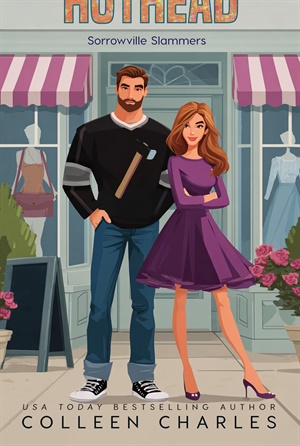
Hothead (Sorrowville Slammers #4)
The Asshole Whisperer
Gisele
People think a town like me runs on routine—coffee at the diner, gossip at the salon, wings at the Power Play.
But what they don’t see is the fault lines underneath it all.
The pressure. The pride. The way we hold each other together until something finally gives.
And today, something’s about to crack right down the middle of Main Street.
Playlist: “Little Lion Man” by Mumford & Sons
The thing about running a salon in a small town is that you become the unofficial therapist, relationship counselor, and gossip clearinghouse whether you signed up for the job or not.
By nine in the morning, I’ve already heard about Martha Miller’s daughter’s engagement (to the wrong twin, apparently), the new menu at Power Play that Beth is testing (brisket nachos—controversial), and exactly how badly the Slammers lost last night.
That last one I already knew. I watched the game on my phone while restocking product, alone in my apartment above the salon because I’m a glutton for punishment, and Bennett Foster has been slowly killing me for years without ever laying a hand on me.
“—and then he just skated off. Didn’t even stay for the handshake line.” Ida Montgomery shakes her head while I section her silver hair for highlights. “That boy’s wound tighter than my grandmother’s girdle, and that’s saying something because Nana could crack walnuts with her—”
“Got it. Thanks for that visual.” I squeeze the foil closed and move to the next section, grateful for the excuse to focus on something other than the knot in my chest that formed around the second period and hasn’t loosened since.
The Slammers are struggling. Everyone knows it.
And we’re running out of games to pretend it’s not a problem.
The whole town’s been holding its breath since the season started, watching Bennett try to hold together a team that’s been underfunded and overlooked for years.
He’s doing it the only way he knows how—by white-knuckling every practice, every game, every interaction until something cracks.
Franklin’s already warned him once this week—get it together or lose the room. Maybe worse.
I’m just waiting to see if it’s the team or him.
“You should talk to him.” Ida meets my eyes in the mirror with that knowing look old ladies in small towns have perfected into an art form. “Everyone knows he listens to you.”
“Bennett doesn’t listen to anyone.” I keep my voice light, easy. “That’s kind of his whole thing.”
“Mmm.” Ida’s not buying it, but she’s polite enough to let it drop.
I just keep working, keep moving, keep my hands busy so they can’t betray me by doing something stupid like reaching for my phone to text him.
The salon hums with its usual morning energy—Dua Lipa crooning through the speakers, the chemical-sweet smell of developer mixing with the lavender diffuser I run to keep things civilized, the low hum of conversation punctuated by hair dryers and laughter.
This is my kingdom. My space. The one thing in my life I built from nothing and control completely.
Except the part where I can’t stop thinking about a man who won’t let me in. Not that I’m chasing him anymore. I retired from that job the moment he became insufferable.
The front door flies open so hard the bell jangles like it’s having a full-on panic attack. Shep Sawyer skids inside, coat half-zipped, face flushed, breathing harder than an Olympic sprinter.
“Gis! Gis! Emergency! Code Red! Code Grumpy! Code we have a prob-lem-o!”
The blow dryer dies in my hand. The entire salon goes pin-drop quiet.
I don’t miss a beat. “Shep, if this is another one of your ‘I accidentally ordered two hundred custom WOOOOO shirts’ emergencies—”
“No, no, no.” He slaps both hands on the desk. “It’s Bennett. He’s… he’s just sitting there. In the middle of Main Street. Statuesque. Cars are going around him. He won’t move. Won’t talk. Just… sitting.”
My stomach drops.
Shep swallows, tries again, gestures vaguely like words are failing him in real time. “Since you’re the… uh… asshole whisperer. I mean—” he winces, “dickhead whisperer. I mean—”
He drags a hand down his face.
“The grumpy-captain-whisperer… we’ve got one. In the street. About to become road kill. And nobody wants to see that.”
Silence.
I set the blow dryer down. “Everyone stay put. I’ve got this.”
My chest tightens. This isn’t like him. Bennett’s control is legendary—it’s the thing that holds him together, the armor he’s worn so long I don’t think he remembers what’s underneath it anymore.
If that armor’s cracking in public, we’ve got a bigger problem than traffic.
“Stay here,” I tell Shep. “Keep everyone calm. I’ll handle it.”
“That’s why I came to get you.” He sags with relief. “You’re the only person he actually—”
“I know.” I cut him off because I can’t hear the end of that sentence right now. Can’t afford to think about what I might be to Bennett Foster when I need to focus on getting him off the asphalt before this becomes the only thing Sorrowville talks about for the next decade.
I push out the door and into the bright October morning, my flat-ironed hair already starting to rebel against the humidity, and head toward the growing cluster of people two blocks down.
Main Street is exactly as chaotic as Shep described.
Traffic has rerouted around the intersection by the old hardware store, and a crowd has gathered on both sidewalks—rubberneckers and concerned citizens and at least three people I can see holding up phones.
In the center of it all, sitting on the faded yellow line like he’s waiting for a bus that’s never coming, is Bennett.
He’s still in his practice gear. Joggers, team hoodie, hair a disaster from running his hands through it.
His back is to me, but I can see the tension in his shoulders, the rigid line of his spine.
He’s not moving. Not reacting to the whispers or the stares or Virgil, who’s standing next to Sleetwood Mac looking genuinely baffled.
I push through the crowd, ignoring the murmurs that follow me like a swarm of concerned bees.
“—someone should call Beth, she always knows what to do with him—”
“—is he drunk? High? Having a stroke? Lord, the poor boy—”
“—knew he’d snap eventually. That temper of his is just like his daddy’s—”
“—thank God Gisele’s here. That girl’s the only one who can talk him down—”
“—should we be filming this? This is going on the town Facebook group for sure—”
I block all of it out. The noise, the speculation, the weight of every pair of eyes tracking me as I step off the curb and walk toward the man who’s been my blind spot since I was fifteen years old and didn’t know enough to protect my own heart.
“Hey, hothead.”
He doesn’t turn. Doesn’t acknowledge me at all.
I circle around until I’m standing in front of him, blocking the sun so his face falls into shadow. His hands are braced on his thighs, knuckles white. His jaw is clenched so tight I can see the muscle jumping. And his eyes—
His eyes are empty.
Not angry. Not sad. Not anything. Just... vacant. Like someone reached inside him and flipped every switch to off. And that’s worse than angry. Angry I know how to handle.
I’ve seen Bennett frustrated. I’ve seen him furious. I’ve seen him barely holding it together after losses that seemed like the end of the world. But I’ve never seen him implode.
It terrifies me.
“Bennett.” I crouch down, getting into his eyeline whether he wants me there or not. “Hey. Look at me.”
Nothing.
“You’re sitting in the street, which I have to say is not your best look. Virgil almost turned you into a speed bump. The aesthetic would’ve been tragic—can you imagine the headlines? ‘Local hockey captain flattened by Zamboni, details at eleven.’”
Still nothing.
“Okay.” I blow out a breath. “We’re doing this the hard way, then. Cool. Cool cool cool.”
I settle onto the pavement next to him, close enough that our shoulders almost touch. The asphalt is cold through my jeans, and I can feel the grit of it against my palms when I brace myself. The watching crowd buzzes, but I don’t turn around.
This isn’t for them.
“You know,” I say conversationally, “I had three appointments booked this morning. Ida Montgomery’s highlights are probably processing into a lovely shade of traffic cone orange as we speak.
Carrie’s good, but she panics under pressure.
So if my client ends up looking like a construction sign, I’m billing you. ”
The faintest flicker. A muscle in his jaw.
“There you are.” I bump my shoulder against his. “Thought I lost you for a second.”
He still doesn’t look at me, but his breathing changes. Gets rougher. Less steady.
“Gisele.” His voice comes out wrecked. Scraped raw.
“Yeah?”
A long silence. The crowd’s still watching—I can feel them at my back like a physical weight—but I don’t move. Don’t rush. Don’t do anything except sit here on the cold street next to a man who’s falling apart and pretending I’m not terrified of what comes next.
“Franklin told me I was turning into my father.”
Everything in me goes cold.
His father. The town’s golden boy turned cautionary tale.
The drunk who destroyed his family in slow motion while everyone watched.
The ghost that’s haunted Bennett every single day of his adult life, driving him to control everything because he’s convinced that if he doesn’t, he’ll end up exactly the same way.
And someone—Franklin Baker, the Slammers’ owner, a man who’s supposed to support him—said that to his face.
“Bennett—”
“He’s right.” The words are flat. Dead. “I can feel it. Every day, I can feel myself becoming—” He cuts off, swallows hard. “I don’t know how to stop it. So maybe Virg should just…”
I want to wrap my arms around him. Want to tell him he’s nothing like his father, that I’ve watched him fight that legacy every single day for years and it’s the bravest thing I’ve ever seen anyone do. Want to shake him until he believes me.
But we’re in the middle of Main Street with half the town watching, and what Bennett needs right now isn’t comfort. Comfort lets him retreat back behind his walls. Comfort gives him permission to file this away and pretend it never happened.
And I’m done watching him pretend.
I stand up. Brush off my jeans. Offer him my hand.
“Get up.”
He finally looks at me. Really looks, those dark eyes finding mine for the first time since I got here. There’s pain in them. Confusion. A desperate kind of hope that makes my chest ache.
“Gisele—”
“I’m serious. Get up. We’re done with this.”
“Done with what?”
“This.” I gesture at him, at the street, at the whole situation. “The shutdown. The silence. The part where you fall apart privately and I pick up the pieces while you pretend nothing happened. We’re not doing it anymore.”
He blinks. “I don’t—”
“You do. You absolutely do. And it ends now.” I keep my hand extended.
“You’re going to get off this street. You’re going to let me help you.
And you’re going to stop acting like asking for support is the same as weakness, because I have watched you white-knuckle your way through years of barely holding it together, and I am done, Bennett. I am so completely done.”
The crowd’s gone quiet. I can feel their attention like a physical thing, pressing against my skin, but I don’t care anymore.
Let them watch. Let the whole town see this.
Let everyone know that Gisele LaRue is officially declaring war on Bennett Foster’s emotional avoidance, because pretending hasn’t worked and distance hasn’t worked and apparently sitting in the middle of the street like a wounded animal is where we’ve landed, so desperate times call for desperate measures.
“You’re not your father,” I say, quiet enough that only he can hear. “And I’m going to prove it to you. But you have to let me. You have to actually participate instead of just surviving. Can you do that?”
His hand finds mine.
His grip is strong, calloused, familiar in a way that makes my stupid heart flip even now. I pull him to his feet, steady him when he sways, and don’t let go even when he’s standing and towering over me and looking at me like I just rearranged his whole understanding of the universe.
“Good,” I say. “Now let’s get out of the road before Virgil actually does run you over. He’s been eyeing you like you insulted Lindsay Buckingham for using Go Your Own Way as a revenge ballad.”
A ghost of something—not a smile, not yet, but close—flickers across his face. “You’re serious about this.”
“Dead serious.” I start walking, tugging him with me toward the sidewalk. The crowd parts like we’re Moses and the Red Sea. “You think I sat on asphalt and ruined these jeans for fun? Do you know how hard it is to get road grime out of white denim?”
“They’re black.”
“It’s a metaphor, keep up.”
We clear the edge of the crowd, and I feel him breathe for what might be the first time since I got here. His hand’s still in mine. I tell myself it doesn’t mean anything.
“What happens now?” he asks.
I look back at him—at this stubborn, infuriating, beautiful disaster of a man who has no idea how much I’ve wanted him, how long I’ve waited for him to let me in.
“Now,” I say, “we fix you.”
His jaw tightens. “I’m not broken.”
“No.” I squeeze his hand once before letting go.
“But your coping mechanisms are trash, your emotional regulation is nonexistent, and if you think you’re turning into your father, then we’re going to prove—publicly, loudly, and with absolutely zero tolerance for your usual deflection—that you’re wrong. ”
“How?”
I smile. It’s not a nice smile.
“Operation Soft Boy starts now, captain. And you’re going to hate every second of it.”
Behind us, the crowd’s already buzzing. Phones are out. Gossip spreading in real time. By lunch, everyone in Sorrowville will know that Gisele LaRue marched into the middle of Main Street and declared herself Bennett Foster’s emotional rehabilitation coach.
Let them talk.
By the time I’m done with him, he’s going to feel things whether he likes it or not.