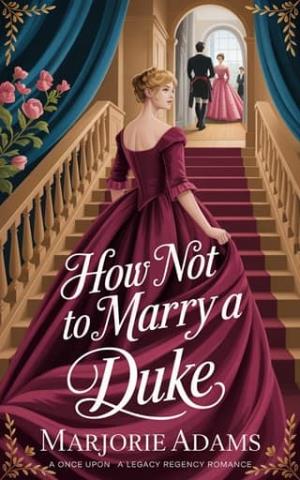
How Not to Marry a Duke (Once Upon a Legacy #3)
The Return
The foil came within an inch of Frederick's throat before he managed to parry.
"You are distracted." Edward lowered his blade, scarcely breathing hard despite the past hour of combat. "That is the third occasion upon which I have very nearly killed you."
"You are the King." Frederick wiped the perspiration from his brow with his sleeve. "Killing me would occasion a diplomatic incident."
"Killing my dearest friend would occasion my wife speaking to me in that disappointed tone she learnt from her stepmother." Edward set his foil in the rack with the ease of long practice. "Far worse than any diplomatic incident, I assure you."
Frederick could not argue the point. He had witnessed the Queen's disappointment precisely once, directed at a footman who had served tepid tea. The man had looked as though he wished to drown himself in the offending pot.
"What has you so preoccupied?" Edward asked, tossing him a towel.
Estate business. Wedding arrangements. The slow suffocation of duty closing about my throat like a well-tailored noose.
"Nothing of consequence."
"You are a dreadful liar." Edward's mouth twitched. "It's rather endearing, actually. Like watching a puppy attempt to conceal a stolen sausage."
"I am a duke. We are not compared to puppies."
"And yet here I stand, comparing you to one." Edward clapped him on the shoulder. "The privileges of royalty. Come—Ella will have my head if I keep you perspiring in the practice room when there is tea to be had."
They walked through the palace corridors, Frederick attending with half an ear to Edward's complaints regarding Parliament whilst his mind turned over the week ahead like a stone he could not stop worrying.
Tomorrow he returned to Carthedge Hall, where Lady Penelope Ashworth and her family awaited.
Dinner on Tuesday. A tour of the grounds on Wednesday.
Discussions of the wedding breakfast on Thursday.
He should feel something about this. He was certain that engaged men typically experienced some emotion regarding their impending nuptials. Anticipation, perhaps. Contentment. A mild fluttering of the pulse when contemplating their intended's face.
Frederick contemplated Lady Penelope's face. It was a perfectly adequate face. Pleasant, even. She had smiled at him during their second meeting, and he had felt...
Nothing.
He felt nothing.
This was, he supposed, perfectly acceptable.
Advantageous marriages were not built upon something so unreliable as feeling.
They were built upon contracts and connections and the satisfactory merging of estates.
His mother approved of the match. Lady Penelope's father had been most enthusiastic about the alliance. Everyone was terribly pleased.
Frederick was certainly not going to be the one to point out that "terribly pleased" was not, in fact, the same thing as "happy."
A child's shriek cut through his thoughts.
Frederick's hand went to his hip before he could prevent it—reaching for the sword that was not there, his body still trained for battlefields even after months of peace.
"Peace." Edward's hand landed upon his shoulder. "That is merely the children. Charlotte has discovered the joy of terrorising her brothers."
"Ah." Frederick forced his hand to his side. "My apologies. Old habits."
"You needn't apologise for surviving a war," Edward said, rather more gently than his usual manner allowed. "Though I do wish you would stop attempting to impale the footmen when they enter rooms unexpectedly."
"It was one footman. And I merely startled."
"He resigned the following day."
"That seems an overreaction."
They rounded the corner into the east garden, and Frederick stopped dead.
A woman stood in the centre of the chaos—two children circling her like small, feral planets whilst she brandished a peacock feather as though it were a cutlass.
Her morning dress was hiked above her knees, the fabric gathered and knotted with what appeared to be hair ribbons, exposing a frankly scandalous length of stocking and petticoat.
Her golden hair had escaped its pins entirely, tumbling down her back and below her waist in wild waves that caught the afternoon sunlight.
And her feet—
Her feet were bare.
Pale and small against the grass, with a smudge of dirt across one arch that ought not to have made Frederick's chest constrict in the manner it did.
"Surrender, villain!" She lunged at the older child—Princess Charlotte, he recognised—with theatrical menace. "Or face the terrible tickle of doom!"
"Never!" Charlotte shrieked with delight, ducking behind a rosebush. "Pirates never surrender!"
The younger boy—Prince James, perhaps four years of age—seized upon the distraction to grasp the woman's knotted skirts. "Aunt Flor! Aunt Flor! I have captured the sea monster!"
"Treachery!" She clutched her heart with magnificent drama. "Betrayed by my own nephew! I am slain!"
She collapsed upon the grass with the children piling atop her, all three of them dissolving into laughter.
Frederick counted the gold threads in her hair.
Fourteen, he thought, before he could stop himself. Fourteen threads catching sunlight like spun treasure.
This was absurd. He did not count things about women. He was an engaged man. He was a duke. Dukes did not stand in gardens cataloguing the precise shade of a woman's hair whilst she was tickled by small children.
And yet here he stood, cataloguing.
Beside him, Edward made a strangled sound.
Frederick glanced over to find the King of England pinching the bridge of his nose, his expression caught somewhere between exasperation and mortification.
"Good God," Edward muttered, low enough that only Frederick could hear. "Wild spinsters. The palace is positively overrun with them."
"I beg your pardon?"
"My sister-in-law." Edward's jaw had tightened.
"Who appears to have forgotten that she is a lady of six and twenty, not a child of six.
And that we have guests. And that her—" He gestured vaguely at the spectacle before them, colour rising in his cheeks.
"Her limbs are on display for all the world to observe. "
Frederick found he could not breathe, though for entirely different reasons than Edward's discomfort.
Florinda.
He had thought of her, in those early years.
The Marquess of Ashbourne's youngest daughter, possessed of sharp wit and a habit of saying precisely the wrong thing at precisely the right moment.
She had been but seventeen the last occasion of their meeting—too young, far too young—and yet he had remembered her nonetheless.
The stable at Carthedge. A summer afternoon. She had marched in whilst he was examining a new foal and announced, with tremendous dignity, that she had come to conduct an experiment.
"I have made a list of one hundred and seven reasons why this is an extraordinarily bad idea," she had informed him. "None of them seemed sufficient."
And then—God help him—she had kissed him. For science, she had said. Scientific inquiry.
It had been awkward at first—noses bumping, angles wrong, nothing like the poetry she had apparently researched extensively.
But then he had cupped her jaw, tilted her face, and for three seconds—perhaps four—the entire world had rearranged itself around the impossible fact of Florinda Ashbourne kissing him in a stable.
She had pulled back with flushed cheeks and said, "Well. That was most informative," and then she had fled. Actually fled, gathering her skirts and running as though pursued by wolves.
He had stood there like a fool, the foal nosing at his hand, his thoughts in absolute disarray.
He should have gone after her. Should have called on her before he left for war. He had told himself he was being noble—sparing her an attachment to a man who might not return. The truth was simpler and uglier: he had been afraid.
War had intervened. War, and cowardice dressed as duty, and the slow burial of want beneath the weight of what a duke ought to do.
Nine years.
Nine years, and she was still the most alive thing he had ever seen.
You are engaged, he reminded himself viciously. You are promised. You are not the sort of man who ogles highborn women whilst their stockings are on display.
He was apparently precisely that sort of man, because he could not make himself look away.
The woman upon the grass—Florinda, his traitorous mind supplied, Florinda with the golden hair and the bare feet and the laugh like summer rain—looked up, laughter still upon her lips.
And saw them.
The transformation was immediate and, Frederick suspected, deeply painful.
The colour drained from her face, then flooded back in a tide of crimson that spread from her cheeks to the tips of her ears.
Her hands flew to her skirts, scrabbling at the knotted ribbons with fingers that had gone clumsy with horror.
She scrambled to her feet so quickly she nearly toppled, her mouth opening and closing in what appeared to be an attempt at coherent speech.
"Your Majesty—I—that is—" The words emerged in a strangled squeak. "The children required exercise and I did not anticipate—I was not aware that you had—"
She was still tugging at the ribbons. They had tangled hopelessly, leaving her hem caught at an angle that continued to display one stockinged calf in all its unfortunate glory.
"Lady Florinda." Edward's voice carried the particular weariness of a man who had witnessed this sort of scene before. "Your skirts."
She looked down, made a sound of pure anguish, and gave the ribbons a desperate yank that only tightened the knot further.
"I am being punished," she muttered, apparently to herself. "I must be. This is divine retribution for—for something, I am certain."
"Perhaps," Edward offered, in tones of excessive helpfulness, "you might wish to make yourself presentable before I am obliged to explain to my ministers why the Queen's sister was discovered in a state of considerable dishabille upon the palace lawn. With a guest present."