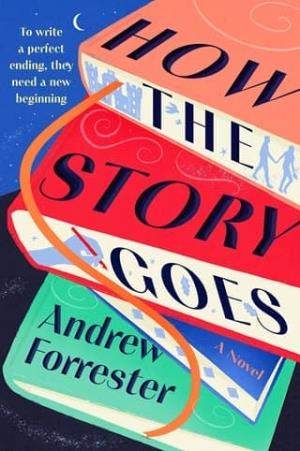
How the Story Goes
Chapter One
If Whit Longacre could have chosen the background music for his current existential crisis, it most likely would have been
something from the sad dad-rock category. He would not have chosen the soundtrack to the latest Disney movie, but that was
where things stood: Annie in the backseat, obliviously belting out every part, changing her voice as she changed roles, and
Whit in the driver’s seat, feeling, as he often felt these days, on the brink of nervous collapse.
His task, always at hand, was colossal. It was usually soul-crushing, and when it wasn’t soul-crushing, it just hung there,
at the edges of his awareness, like a fine, anxiety-inducing mist. Like the technique sound designers use in horror movies,
playing inaudible but unsettling noises that fill theatergoers with a dread they might not even be able to name. In Whit’s
mind, his dread did have a name: the Monumental Task.
“Are you ready for school today?” he asked, shouting over a solo about a family who just doesn’t understand as he glanced
in the rearview mirror.
Annie waited for a break in the lyrics, grinning and dancing, and then yelled back, “Yes!” She jumped in again on the next verse, and Whit’s separate worries seemed momentarily less significant, like a leashed lion.
Still there, but not going to devour him just yet.
Annie was ready for school. That was good.
And he had managed to get her out of the house today with her auburn hair looking less child-of-a-widower chic and more like it had looked when Helen was here.
Annie’s clothes matched; she had what she needed for the day, a healthy lunch packed into her padded lunch box.
Those things were good, and the Monumental Task could be ignored for a time.
The road was wet and black, the trees on either side highlighted with tufts of the first fall foliage. As he rounded the corner,
slowing into the creep of the carpool line, his eyes fell on the brown paper package in the passenger seat. That was another
issue. The Task was almost all-consuming, yes, but there was this, too. One of those small unbearable things, the sort people
make jokes about: I can’t believe I did what I’d been putting off for two months and it only took two minutes. How many minutes, days, had this thing ridden around with him? Someday Annie was going to be big enough to ride in the front
seat, and she was going to say, Hmm, Dad, what is this package with Mom’s handwriting on it, and don’t you think she hoped it would be delivered within a
hundred years of her death?
Whit pulled into the main drop-off lane of the Foothills School, a small private school Helen had liked far more than he had,
though that was out of his hands now: when Helen died, they’d renamed the library after her. She had also asked, toward the
end, that money be put aside for a scholarship fund, so he and Annie were really stuck. Anyway, Annie liked it here. As a
third-grader, she’d been attending the school for a few years already, so the stability was good, especially these days. And
of course, there were so many parents who knew them, knew their story, and were eager to help Whit out with single-dad life.
So many parents.
The door opened for Annie, and she had hardly disappeared amid their duet of goodbyes and I-love-you’s when another head poked into the backseat, mostly bald, with hexagonal glasses and a theatrically wide grin that reeked
of manipulation.
“Knock, knock!”
Whit expelled a laugh, like someone passing a kidney stone. “You didn’t knock,” he said through a strained smile, as if he were making a joke. He wasn’t.
“Oh, ha-ha,” Noel Pendergrass said. He actually enunciated the two ha’s like a robot reading a text message transcript. “I guess I assumed you had an open-door policy.”
Whit was having to contort himself to look back at Noel, and cool air was seeping in from the outside, and while Noel, the
impassioned chairperson of the Carpool Committee, was dressed for carpool duty in New England in October, Whit was dressed
for sitting in the front seat of a warm Range Rover.
“I guess you could say that.” Whit was still smiling like he had a dental cheek retractor in his mouth. “Did you need something,
Noel?”
“Well, as a matter of fact, I do need help. With carpooooool dutyyyyy.”
He said it in that specific Oprah Winfrey way, dragging out the second syllable as if the word were a celebrity or a prize
and not the single least appealing volunteer opportunity Whit could think of. Not because he disliked the cold or early mornings,
but because he disliked Noel, who had, on more than one occasion, uttered sentences that began, “Now that your wife has passed
on to the Great Beyond . . .”
The Great Beyond. Like she was the cat at the end of CATS! and not his wife of ten years.
“I have a proposition,” Noel said, “and I really think it might be good for you, as a way of getting involved again. It’s
been over a year since Helen pa—”
Whit faked a coughing fit, and Noel paused.
“Anyway, mind if we make a quick loop? I can just—”
The man was actually lowering himself into the backseat, making an effort to crawl his way into the warm car, which suddenly
felt to Whit like a very sacred space.
“Oh, I wish,” Whit said, more frantic than he would have liked, “but I can’t talk just now. I’m dropping this off at the library, and Mrs. Pryor has a meeting first thing.”
He held up the package from the front seat, freezing Noel into a position halfway through the “March of Progress” evolutionary
chart, his long-limbed body crouched and curling over Annie’s seat. His eyes, though, were filled with a Homo sapiens yearning to know what the package held.
“Ah,” Noel said, through an even brighter grin. “Well, then, some other time.”
“Mm-hmm.”
Whit released his foot off the brake. The car lurched slightly, and Noel pulled back, startled.
“Whoops,” Whit said, not looking back.
“Ha-ha!” Noel called, closing the door.
A minute later, idling in his parking spot, Whit looked at himself in the rearview mirror.
“Well.”
He looked at the package still in his hand.
“I guess today’s the day.”