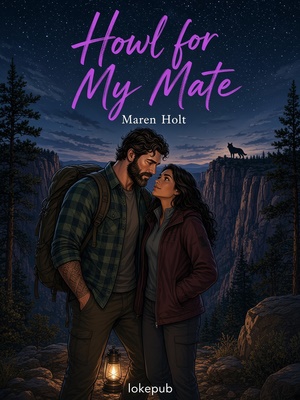
Howl for My Mate
Chapter 1
Gemma
The trailhead parking lot has three cars in it when I pull in—two muddy pickups and a ranger’s SUV—and the man leaning against the bigger of the pickups is not what I was expecting when I booked a backcountry guide service called “Moore Mountain Treks” from a Harlow tourism page.
I was expecting, I don’t know. Someone in their fifties with a sun-damaged face and a lot of opinions about trail mix.
Not this.
He’s enormous. I mean that literally—the truck is a full-size F-250 and he’s close to the same height as the roof.
Full dark beard, dark hair that curls a little at the ears where it’s grown out, wearing a grey long-sleeve base layer that does nothing to hide the fact that he is built like someone assembled him to survive.
His forearms are crossed over his chest. He’s not on his phone.
He’s just standing there, watching me park my rental, like he has all the time in the world and no interest in using it.
I grab my pack from the back seat and nearly fall over because I overestimated how well I packed it. I spent three days reading about weight distribution before this trip. I make my living coordinating other people’s events. Somehow this did not translate.
He doesn’t move to help. He watches.
I get it sorted. I give myself a pep talk. I walk toward him with what I choose to interpret as confidence.
“Gemma Torres,” I say, extending my hand. “I have a four-day booking. Last one before you close the high trails for the season, the website said, which felt like a sign. I’m very excited. I’ve never done backcountry camping before but I’ve watched a lot of videos.”
He looks at my hand, then at my face. Then he shakes it, once, and his hand nearly swallows mine whole. “Decklan Moore.”
That’s it. That’s the whole sentence. He drops my hand and looks past me at my pack.
“Is there something wrong with my pack?” I ask.
He walks around me and lifts it. Not offers to help—just picks it up and puts it next to his gear. “You’ve got the weight distribution wrong. I’ll fix it at the first rest.”
“Okay.” I blink. “Good morning to you too.”
Nothing. He’s already heading toward the trailhead sign, his own pack on his back like it’s full of feathers when it’s clearly full of camping gear and probably a small car.
I follow him because what else am I going to do.
The northern Rockies above Harlow are legitimately beautiful and I’m going to appreciate them as soon as I stop watching Decklan Moore’s shoulders move.
They do things under that base layer. I’m paying extremely close scientific attention to the phenomenon and not at all because I have been in the backcountry for three minutes and have already lost the ability to think about anything else.
“So,” I say to his back, “have you been guiding long? The website said you’ve done this for three years.
I looked at your reviews. Very thorough but there weren’t a lot of them, which I thought was interesting, but the ones that existed all said things like ’best guide, very competent, doesn’t talk much. ’”
He keeps walking.
“That last part was actually in the reviews,” I say. “Multiple of them.”
“I know.” He doesn’t look back. “I wrote the booking page myself.”
“And you left those reviews up.”
“Accurate information is useful.”
I laugh. I can’t help it. The laugh comes out loud—it always does, it’s embarrassing—and a bird takes off from a tree somewhere above us and Decklan glances up at it like he’s checking whether everything’s okay.
“Sorry,” I say. “Loud laugher. It’s a whole thing. Family trait.”
He doesn’t say that’s fine. He doesn’t say it’s not fine. He says nothing and keeps moving. I keep talking—I always do when I’m nervous. Currently very nervous. Not entirely sure why.
That’s a lie. I’m sure why.
I switch to narrating the landscape out loud.
I point out a wildflower I find visually interesting.
I ask if he can hear that bird—the one doing the rising whistle—and what kind it is, and he says “Varied thrush” without breaking stride.
I ask if he knows birds or if he just knows this one and he says “Most of them.”
We walk for forty minutes and I generate enough conversation for both of us and he doesn’t seem to mind.
I’m talking to his back but his back seems present.
Attentive. He keeps pace exactly as fast as I can walk without straining, which means he’s regulating himself to me, which means he’s paying attention.
At a wide point in the trail—a flat rock shelf with a view of the valley—he stops and drops both packs.
“Rest.”
“I’m not tired,” I say, which is mostly true.
“Drink water.” He holds out a canteen. His own. “You haven’t touched yours.”
I look at my pack. He’s right. I take his canteen and drink. “Are you always this bossy?”
He starts repacking my bag. His hands—enormous, precise—pull everything out and redistribute it with a focus that makes clear this matters. “Bossy is when you tell people what to do for no reason. I tell you what to do because the mountain will kill you if you don’t listen.”
“Dramatic.”
“Accurate.” He zips my pack and lifts it, weighs it in his hands, nods once. Sets it down. “You’ve got good boots.”
It is possibly the most generous thing he’s said in an hour and it makes me unreasonably pleased. “Thank you. I did a lot of research.”
He hands my pack back. Our fingers touch on the strap and the contact lands in my sternum, which is stupid and I choose not to analyze it. He’s already shouldering his own pack.
“Step where I step when we cross the creek in twenty minutes. There’s a slippery section.”
“Got it.”
“Stay behind me on the switchback.”
“Sure.”
“Don’t touch the plants on the left side of the north trail.”
“Okay. Why not?”
He glances back. His eyes are the strangest color I’ve ever seen on a person—amber, almost gold, lit up where the sun hits them—and I can’t read his expression because he doesn’t seem to have one he’s showing me. “You’ll be fine if you don’t touch them.”
“Ominous.”
“Good.” He turns back around. “Pay attention.”
I pay attention. His boots land. I put my feet where he puts his.
We hit the creek crossing and the slippery section is right where he said it would be.
Before I’ve processed what’s happening he has one hand around my forearm, walking me through it, sure-footed as an animal that lives up here.
His hand is warm through my jacket. I try not to notice.
We make it across. He lets go. Keeps moving.
I’m quiet for a solid five minutes. This does not happen.
He glances back at the end of those five minutes. Just a look. Quick. Like he’s checking.
“Still here,” I say.
Something shifts in his jaw. It’s the closest thing to a smile I’ve gotten out of him. “Good,” he says.
It’s the same word. But it doesn’t sound the same as when he said it about the plants.
I can’t think what to do with that, so I start talking again. He listens to every word. The mountain rises around us. The air tastes like pine and cold water. Four days up here with a man who barely speaks, and for the first time in a year I’m exactly where I’m supposed to be.
Which is completely insane. But here we are.