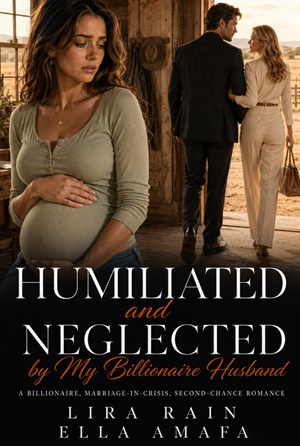
Humiliated and Neglected by My Billionaire Husband (Her Marriage in Crisis #136)
Prologue
Bree
The conference room smelled like old money and new leather.
I walked in three steps behind my father, the way I’d been doing since I learned to walk, and counted the men at the table.
Four lawyers. Two accountants. Warren Grant at the head, silver-haired and smiling.
He’d never lost a negotiation in his life.
And across from my empty chair, the boy from the expo.
Except he wasn’t a boy anymore.
Rafael Grant had grown into a build architecture would envy.
Shoulders that blocked out the window behind him.
Hands folded on the table that could’ve palmed my entire skull.
A jaw so square it looked drafted. He was watching me with pale blue eyes that gave away absolutely nothing, and I remembered, with a jolt that went straight to my knees, the last time I’d seen those eyes.
I was fifteen. He was eighteen. The growers’ expo in Houston, and I’d wandered away from my father’s booth to look at the chick incubators, because I was fifteen and chicks were fuzzy and my dad was boring when he talked profit margins.
Rafael had been standing there in a polo shirt two sizes too small for his shoulders, holding a Rhode Island Red chick in his massive palm, and when I reached for it he’d said, “Cup your hands. Support the feet. If you squeeze, you’ll feel her heartbeat, but don’t squeeze hard or you’ll feel it stop. ”
I’d stared at him.
He’d stared back.
Then he’d launched into a fifteen-minute lecture about nitrogen fixation in poultry manure that I didn’t understand and couldn’t stop listening to, and I’d stood there holding that warm fuzzy heartbeat in my palms while this giant nerd explained soil chemistry with a passion most boys reserved for football.
His father had hauled him away mid-sentence. Salazars and Grants don’t mix, I’d heard Warren say, sharp and final. Rafael had looked back at me once. I’d looked back twice.
That was twelve years ago.
Now he was a mountain in a ten-thousand-dollar suit, and I was walking toward an empty chair that would cost me three years of my life.
“Brianna.” Warren Grant stood, extended his hand. “Thank you for coming.”
“Mr. Grant.” I shook it. Firm, dry, brief. My father had taught me that handshake.
“Sit, sit.” Warren gestured. “We have a lot to discuss.”
I sat. Rafael was still watching me. I made myself meet his eyes, and a flicker crossed them. Recognition, maybe. Or just the polite interest of a man about to buy a very expensive piece of equipment.
My chair was cold. The leather creaked when I shifted my weight.
Across the polished mahogany, Rafael’s hands stayed folded, motionless, but I caught the slight tension in his forearms. The sleeves of his suit jacket pulled tight against muscle that hadn’t been there when he was eighteen and lecturing me about chicken manure.
“Water, Ms. Salazar?” One of the lawyers pushed a crystal glass toward me.
“Thank you.” I didn’t touch it. I didn’t trust my hands not to shake.
The lawyers started talking. I let the words wash over me while I studied the wood grain of the table and thought about the ledgers I’d found in my father’s office three weeks ago.
Debt that never showed up on the public books.
The kind that could swallow four generations of Salazar land in eighteen months if the wrong creditor sneezed.
My father had built an empire out of Texas dirt and stubbornness, and somewhere along the way the empire had started eating itself, and he’d told no one. Not his accountants, not even me.
I’d found out because I couldn’t sleep and went looking for the bourbon he kept in his bottom drawer.
The memory surfaced sharp and unwanted. Three in the morning, my bare feet cold on his office floor, the creak of the drawer, and then the wrong folder in my hands. Numbers that didn’t make sense. Numbers that made too much sense once I started reading.
I’d sat on his floor until dawn, turning pages, watching everything I thought I knew about my family crumble into columns of red ink.
I’d confronted him the next morning. He’d aged ten years in front of me, shoulders caving, voice cracking, and I’d understood what I’d never wanted to understand: my father was human. My father was scared. My father had been carrying this alone for longer than I’d been old enough to carry anything.
“Mija,” he’d said, his voice breaking on the word. “I was going to fix it. I’ve been trying to fix it.”
“How long?”
“Four years. Maybe five.” His hands had shaken when he reached for his coffee. “The drought. The equipment failures. The market shifts. One thing after another, and I kept thinking next season, next harvest, next year.”
I’d watched him shrink in his chair, this man who’d taught me to ride before I could read, who’d never once let me see him falter.
“Why didn’t you tell me?”
“You’re my daughter.” He’d looked up at me with wet eyes. “You’re not supposed to save me. I’m supposed to save you.”
“The terms are straightforward,” one of the lawyers was saying now, pulling me back to the conference room. “A minimum commitment of three years. Dissolution permitted only by mutual consent of the married parties.”
Three years. I could hold my breath for three years. A person could marry a stranger and pretend to love him and smile for cameras and do whatever needed doing, if it only had to last three years.
“And the inheritance clause?” My father’s voice. Steady. Giving away nothing. Only I could hear the tremor underneath.
“The Grants would prefer a male heir to assume future leadership of Grant Foods. The Salazars would prefer a female heir to maintain continuity of the agricultural holdings.” The lawyer shuffled papers. “Should the union produce children, inheritance will be allocated accordingly.”
Produce children. The words landed in my stomach, cold and clinical. They were talking about babies. My babies. Hypothetical children who would be bargaining chips before they drew their first breath.
I kept my face blank. I’d learned that from my mother, who could smile through anything, who had smiled through my father’s late nights and broken promises and the slow erosion of a marriage neither of them knew how to end.
“Rafael.” Warren turned to his son. “You understand the terms?”
Rafael nodded once. His voice was deeper than I remembered. “The marriage clause triggers my appointment as CEO. I understand.”
So that was his price. The corner office and the big chair and his father finally getting out of his way. I filed that away.
I watched him as the lawyers droned on about asset protection and dissolution clauses. He was reading the documents in front of him, actually reading them, his pale eyes moving across the pages with focused attention. His pen hovered over a paragraph, and he frowned.
“Section twelve,” he said, interrupting the lawyer mid-sentence. “The intellectual property clause. It’s too broad.”
Warren’s smile tightened. “Rafael, we can discuss the details later.”
“The details matter.” Rafael tapped the page. “This language would give Grant Foods ownership of any agricultural innovations developed on Salazar land during the marriage. That’s not reasonable.”
I stared at him. He was arguing for my family’s interests. In front of his father. In front of a room full of people who expected him to rubber-stamp whatever Warren wanted.
“It’s standard language,” the lawyer said.
“It’s predatory language.” Rafael crossed out the paragraph with a single stroke of his pen. “Strike it.”
Warren’s jaw tightened. “We’ll revisit this.”
“We’ll strike it.” Rafael met his father’s eyes. “Or we’ll revisit whether this meeting continues at all.”
The silence stretched. I watched the power shift in the room, subtle but unmistakable. Warren Grant might’ve built this empire, but his son was the one who would run it, and everyone at this table knew it.
“Fine.” Warren waved a hand. “Strike it. Move on.”
The lawyers shuffled their papers. Rafael went back to reading. And I sat there, recalculating everything I thought I knew about the man I was about to marry.
“Brianna.” My father’s hand covered mine under the table. Warm. Trembling, just slightly. “You don’t have to do this. If you want to walk away, we walk away. I’ll figure something else out.”
He wouldn’t. There wasn’t anything else. I’d seen the numbers.
I looked at my father’s hand on mine. Forty years of farmwork had callused it, and he still wore his wedding ring on it even though my mother had stopped wearing hers a decade ago. The age spots seemed to have multiplied overnight.
This hand had taught me to hold a bridle. To check soil pH. To shake firmly and look people in the eye and never let them see me sweat.
I looked at Rafael Grant. He was looking back at me with those pale blue eyes, and I thought about the chick in my palms and the heartbeat I’d felt and the boy who’d talked about nitrogen for fifteen minutes without taking a breath.
“I’ll do it,” I said.
The room exhaled.
My father’s hand tightened on mine, then released. When I glanced at him, his eyes were wet, but his face was composed. The Salazar mask, firmly in place.
“Excellent.” Warren was smiling again, the tension of the intellectual property dispute already forgotten. “Then let’s discuss the timeline.”
The next hour passed in a blur of signatures and initials and documents that would legally bind me to a stranger. My hand cramped from writing my name so many times. The lawyers explained clauses I didn’t fully understand, and I nodded and signed anyway, because what choice did I have?
We signed preliminary agreements and shook hands, and a wedding got scheduled for three weeks out, because apparently when billionaires bought brides, they didn’t believe in long engagements.
“Three weeks,” I said, when the date was announced. “That’s not much time.”
“Time for what?” Warren asked.
I didn’t answer, because I wasn’t sure what I’d meant. Time to prepare. Time to mourn. Time to convince myself this wasn’t actually happening.
Rafael walked me to the elevator. His hand on my lower back was professional and impersonal, and I hated that I noticed how warm it was through my blouse. His palm spanned nearly the whole width of my spine. I could feel each individual finger through the thin silk.
The hallway was silent except for our footsteps. His stride was longer than mine, but he’d slowed to match my pace without seeming to notice he was doing it.
“I remember you,” he said, low enough that no one else could hear. “The expo. You were holding my chick.”
“Your chick?”
“I’d named her. Henrietta.” A muscle twitched in his jaw. “She lived eight years. Good layer.”
I had no answer for that. The elevator arrived and the doors opened.
The car was empty. Small mercies. I stepped inside and turned to face him. He stood in the hallway, too large for the space, filling the frame with his shoulders and his silence.
“Three years,” Rafael said. “I’ll try to make it bearable.”
“Bearable,” I repeated. “That’s the goal?”
His face changed, just slightly. Shame, maybe. Or maybe nothing at all. His hands, those massive hands that had held a chick so gently, flexed once at his sides.
“I don’t know what the goal is,” he said. “I’ve never done this before.”
The doors closed.
I stood alone in the descending elevator and watched the numbers count down. Forty-two, forty-one, forty. My reflection stared back at me from the polished metal doors, pale and determined and terrified.
Three weeks later, I married him in a courthouse ceremony that lasted eleven minutes. His kiss landed near my mouth, polite and precise, a business card pressed to skin. My father’s voice echoed in my head as I signed my new name for the first time.
Three years, mija.
I could survive anything for three years.