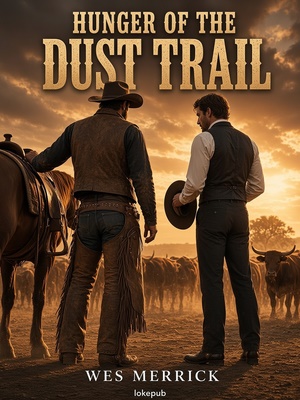
Hunger of the Dust Trail
Chapter One The Man in the Clean Shirt
By sunrise the stockyard had become a country made of dust.
It hung above the pens in a copper-colored veil, thick enough to soften the horns of three thousand restless cattle and turn every man moving among them into a shadow.
Hooves struck the hard Texas earth. Gates groaned.
Somewhere near the chuck wagon, a mule objected to the morning with a series of curses that sounded more human than anything Hank Rourke had heard from his hired men.
Hank stood on the top rail of the largest pen and counted what he had wagered.
Nine hundred and twelve head carried his brand.
The rest belonged to six ranchers who had signed their names beneath his because the banks would not extend them another season.
They had pooled their herds, their savings, and every remaining scrap of credit into one drive north.
If Hank delivered the cattle to Copper Ridge before the buyers closed their books, they would all survive the winter.
If he failed, the banks would take seven ranches before the first hard freeze.
Sam Bell came through the haze below him, hat pushed back from a forehead already shining with sweat. At forty-seven, Sam had a silver-threaded beard, a bad left knee, and the unsettling habit of recognizing trouble before it introduced itself.
“We are short one rider,” Sam called.
“We were short one yesterday.”
“Yesterday the cattle were standing still.”
Hank dropped from the rail. He landed hard, boots throwing up another burst of dust. “Carter can take the swing until we find somebody.”
“Carter will take whatever keeps him closest to the bedrolls and farthest from work.”
“Then he can learn disappointment early.”
Sam glanced toward the gate. “Might not have to.”
A stranger had ridden into the stockyard.
He sat a dark chestnut gelding with the easy balance of a man who had spent years in a saddle, though nothing else about him belonged among trail hands.
His hat was new enough to hold its shape.
His boots had been scuffed deliberately, but the leather beneath the scratches was expensive.
A tan coat concealed most of his clothing until he dismounted, and then the morning breeze opened it just enough to reveal a white shirt far too clean for Red Bluff.
Hank disliked him before the man reached the pens.
Then the stranger raised his head, and dislike became something less useful.
He was perhaps thirty-five, lean through the waist and broad enough across the shoulders to suggest that the elegant clothes were not hiding softness.
Dark blond hair showed beneath his hat. His face was composed and handsome without prettiness, the mouth too knowing, the eyes a cool gray that took in Hank, the herd, and every available exit before settling on Hank again.
He tied his gelding and approached without hurry.
“Rourke?”
Hank did not offer his hand. “Depends who is asking.”
“Drew White.”
The pause before the surname was nearly invisible. Nearly.
“I heard you need another rider.”
“You heard wrong.”
Sam made a thoughtful sound beside him.
Drew’s gaze moved to Sam and back. “Three thousand cattle. Eleven mounted men from what I counted. Two of them young enough to mistake courage for judgment. One with a swollen wrist he is hiding from you. You need another rider.”
Hank looked toward the far pen. Tommy Vale had wrapped his wrist in a strip of brown cloth and tucked the hand close to his body whenever he thought Hank might see.
The stranger noticed Hank noticing.
“I can ride point, swing, or drag,” Drew continued. “I can rope. I can shoot well enough to avoid shooting anyone I did not intend to. I do not drink while I am working.”
“What do you do when you are not working?”
One corner of Drew’s mouth lifted. “That depends on the company.”
The answer moved through Hank like whiskey taken too fast. Heat spread behind his ribs and lower, unwelcome and immediate. He held the man’s gaze until the smile disappeared, though the challenge beneath it remained.
Sam coughed into his fist to hide what was plainly amusement.
Hank said, “A man can claim anything while his shirt is still white.”
“Then dirty it.”
The stockyard noise seemed to recede for one dangerous second.
Hank had spent years learning how to hold his expression still.
He had stood down armed thieves, desperate debtors, and cattle buyers who believed a rancher’s need could be smelled like blood.
None of them had looked at him the way Drew White did now—as if Hank’s resistance were neither warning nor refusal but the beginning of a conversation.
Hank turned toward the small catch pen. “Bring out the blue roan.”
Sam’s amusement vanished. “Hank.”
“You wanted to know if he could ride.”
“I wanted another hand, not a funeral.”
Drew removed his coat and laid it across the rail. The white shirt beneath it was close-fitted, dampening between his shoulder blades as the heat climbed. “The horse have a name?”
“No one has stayed on him long enough to ask.”
The roan came out fighting.
He had one pale eye, a scar across his nose, and a violent dislike of men. Two hands held him between ropes while another wrestled a saddle onto his back. The horse kicked at the fence, struck the dirt, and rolled that white eye toward Drew.
Drew did not reach for him at once.
He stood outside the animal’s range and watched.
When he finally moved, he did so without the shouting and sudden lunges the other men had used.
He spoke too softly for Hank to hear. The roan’s ears flicked.
Drew let the horse smell his palm, then touched the long muscle of its neck as though the violence in it deserved respect rather than punishment.
Hank felt that touch across his own skin.
It made no sense. He resented it anyway.
Drew gathered the reins and mounted in one smooth movement.
The roan exploded.
It came off the ground with all four hooves, landed crooked, and twisted so violently that Drew’s hat flew into the dust. Men scattered from the rails. The horse bucked toward the gate, then doubled back, trying to scrape its rider against the fence.
Drew stayed with him.
He did not ride beautifully. Beautiful riding belonged in exhibition rings and cavalry demonstrations.
He rode with his thighs, his balance, and a ruthless refusal to panic.
His shirt pulled tight across his back. His hips followed every savage movement without fighting it.
When the roan reared, Drew leaned forward and pressed his mouth near the animal’s ear, still speaking in that low private voice.
The horse came down trembling.
Drew guided him in a slow circle. Then another.
By the third, the roan was blowing hard but listening. Drew bent to retrieve his hat without dismounting, settled it on his head, and brought the horse to a stop directly before Hank.
“Point, swing, or drag?” he asked.
Dust clung to his cheek. His white shirt was no longer white.
Hank’s body had noticed every movement Drew made in the saddle. The evidence of it pressed hard and uncomfortable inside his trousers, a physical betrayal as irritating as it was impossible to dismiss. He shifted his stance, grateful for the length of his coat.
“Drag,” Hank said. “Until I decide you are worth moving up.”
Drew looked down at him, chest rising hard from the ride. His gaze flicked once toward Hank’s waist and returned to his face with deliberate innocence.
“As you say, boss.”
Hank wanted to pull him from the saddle.
He wanted several things that had no place in a stockyard with twelve men watching.
Instead, he caught the roan’s bridle and looked at Drew’s hands. The grip was steady, but the skin at the base of his right thumb had split.
“Down.”
“I thought I had the job.”
“You have a horse. I have not decided whether I have a rider.”
Drew dismounted. He stood close enough for Hank to smell clean soap beneath leather, horse, and fresh sweat.
“Hands,” Hank said.
Drew’s eyebrows rose.
“You told me you can rope. Show me.”
For the first time, uncertainty moved through Drew’s expression. Then he removed his gloves and placed both hands palm-up in Hank’s.
The contact silenced something in Hank and awakened everything else.
Drew’s hands were not the hands of a clerk.
There were old calluses beneath the fingers and a harder ridge where reins had rubbed against the skin over years.
A pale scar crossed the left palm. But the nails were clean, and there was no fresh rope burn, no cracked knuckle, none of the small damage collected by a man who earned every meal on horseback.
Hank traced the riding callus with his thumb.
Drew inhaled.
It was a quiet sound, nearly lost beneath the cattle, but Hank felt it in the change of the other man’s body.
Drew’s fingers curled slightly against Hank’s palms. The pose should have looked submissive.
Somehow it did not. It felt like an invitation given with complete confidence that Hank would understand it.
“Old calluses,” Hank said. “You ride often. You do not ride for wages.”
“No.”
“What do you ride for?”
Drew’s eyes dropped to Hank’s mouth. “Until this morning, I would have said pleasure.”
The heat inside Hank sharpened. His thumb continued along the line of Drew’s palm when good sense should have made him release it.
Sam’s voice came from several yards away. “If you two are finished reading each other’s fortunes, the cattle still need moving.”
Hank let go.
Drew closed his hands slowly, as though preserving the feel of Hank’s grip.
“You start at the back,” Hank said. “You follow orders the first time. You do not wander from camp, and you do not touch another man’s gear. If I catch you lying, stealing, or putting this herd at risk, I will leave you where I find you.”
“Understood.”
“I have not told you your pay.”
“I did not ask.”
That answer troubled Hank more than all the others.
He turned away before Drew could read it.
By noon, the yard had become an oven.