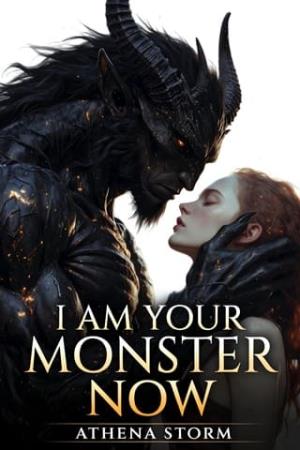
I Am Your Monster Now
Chapter 1
JILLIAN
The ship bucks hard as we breach the upper atmosphere, enough to jerk my head against the seat behind me.
A few gasps echo through the cabin—Carson’s one of them—and someone further back whispers something about the turbulence.
It’s not turbulence. It’s ion friction slamming against our hull like fists from a dying god. My blood fizzes like a shaken soda can.
“God,” Carson mutters beside me, voice tight, breath fogging the edges of his mask. “We shouldn’t be here. This place… it’s all wrong.”
I don’t look at him. “It’s beautiful.”
His laugh is a nervous huff. “That’s one word for it.”
But I mean it. The planet isn’t welcoming, not by a long shot.
It’s hostile, broken, bleeding—but real.
After years of simulations and archived geology footage fed through Novaria’s sanitized learning loops, this is raw and alive.
I press my palm to the cold panel. The radiation sensors crackle faintly in response.
The sky—if you can call it that—is an oily swirl of dark blue and sickly green, rippling with streaks of energy like underwater lightning. It's not just atmospheric. It feels conscious, somehow. Watching.
Our transport dips lower, and the closer we get, the more detail bleeds through the haze.
I see ridgelines of obsidian rising like knives, dust storms crawling across sunless plains, and the flicker of geothermal activity far to the west—plumes of faint fire and something else… crystalline glimmers? Can’t be sure.
The landing protocols engage with a metallic thunk and a gentle shift in inertia.
My gut dips, then rights itself. The vibrations smooth out, the hull cooling with a hiss as we settle into final descent.
Everyone around me shifts, some stretching their limbs, others whispering prayers or muttering complaints.
Carson adjusts the straps on his pack like they’re a lifeline.
I catch his eye. “You packed extra sensors, right?”
He nods, swallowing hard. “Yeah. Yeah, just… Jill, this place is worse than the briefings made it sound.”
“It’s better,” I say, and I mean it. “Those briefings are dead things. Charts and cross-sections. This is alive.”
Professor Ciampa’s voice crackles over the internal comms. “Ladies and gentlemen, we are moments away from touchdown. As a reminder, stay behind the safety perimeter until the Marines clear the immediate area. And welcome to Purgonis Six.”
Carson groans. “I think I left my stomach in orbit.”
“You’ll be fine,” I grin, grabbing his arm in mock comfort. “Unless a sting tail eats you. Then I call dibs on your gear.”
He shudders. “Not funny.”
But it is, a little. The moment we land, I’m up from my seat, heart hammering like I’ve chugged three espresso shots.
The airlock opens with a slow hydraulic exhale, and the first Marine steps out in full gear—visor down, plasma rifle ready.
Behind him, the twin moons of Purgonis reflect pale light across the razor landscape.
I follow in line, boots thudding against the ramp.
Heat wafts in even through the environmental seals—a dry, electric kind of heat, like standing too close to an open circuit.
The scent hits next: sulfur, ozone, and something sharp and mineral-rich, like scorched copper.
I breathe it in through the filter of my helmet. Still smells like adventure.
“Eyes up,” Grady barks. He’s a slab of a man in reinforced armor, one of the few Marines who doesn’t immediately look bored. “This isn’t a tourist stop. You fall behind, you get left behind.”
The students mutter agreement, but I’m not really listening. The terrain spreads out before us in jagged, broken beauty. The dark side of the planet is cooler, survivable—for now. But you can feel the sun just beyond the horizon, waiting. Even the shadows here feel temporary.
I hear another student—Myra, maybe—vomit behind me. Carson makes a face but doesn’t look. I do. Not out of cruelty. Just curiosity. Purgonis is getting to them already, seeping under their skin. I wonder if it’ll get to me too.
Our camp is just ahead—modular domes arranged in a tight cluster near a half-collapsed rock arch that offers some shielding. Solar panels blink dimly in the haze. The Marines sweep the area, motioning us forward with clipped gestures.
Carson leans closer. “Do you think they’ve had trouble here before?”
“They wouldn’t have sent grunts with plasma rifles if they hadn’t,” I say quietly. Then, after a pause, “You remember the briefing. Half a dozen students died last season.”
He nods, lips tight. “I thought that was... I dunno. An exaggeration.”
“Not here.”
Not on Purgonis.
I step through the security gate, boots crunching on crystallized dust. One of the Marines eyes me warily. I give him a nod. He doesn’t return it. Doesn’t matter. I didn’t come for them.
I came for the planet.
And it’s waiting.
The heat haze makes the camp shimmer like it’s barely there—like if I blink too long, it'll disappear back into the planet, swallowed whole. From a distance, it almost looks like a mirage. But up close, it’s a scar.
The structures are prefabs—ugly modular boxes half-sunk into the gritty obsidian soil.
The lower edges are already pitted and scored by the chemical-laced atmosphere.
Acid in the wind, maybe. Purgonis doesn’t wait to rot you out—it gets started the moment you touch down.
The Marines are doing their sweep, but it’s a joke.
I clock three different types of body armor among six men.
One guy’s wearing old-model greaves, the kind that fail pressure seals if you sneeze wrong.
Their movements are lazy, methodical like they’re going through the motions.
Babysitting detail. Definitely not frontliners.
I doubt half of them even know which end of the rifle is supposed to be hot in a real fight.
One of them is standing with his helmet off, leaning on his gun and chewing something. His eyes flick to me as I pass, and I get that flicker of appraisal I’m so damn tired of. I shoot him a look that could fossilize bone. He grins. I keep walking.
Carson’s trudging beside me, silent for once.
His shoulders are hunched like he’s expecting to be yelled at, and maybe he is—by the planet itself.
Every footfall kicks up grit that glitters faintly under the low light, like powdered glass.
It settles on our boots and our cuffs, already trying to become part of us.
Professor Ciampa emerges from the central hub like some kind of ancient desert beetle in academic drag.
His coat is too long, and he sweeps it dramatically like he’s walking a red carpet instead of onto unstable volcanic terrain.
He smiles too wide, like someone told him once that was the trick to leadership.
“Ah, Jillian, Carson—so good to see young minds eager to experience the frontier firsthand.” His voice is rich and oily, like it’s been steeped in brandy and old university halls. “Don’t let the gloom fool you. The air tastes like pennies, but the science is exquisite.”
I raise an eyebrow. “Tastes more like blood and burning wires, sir.”
Carson snorts beside me. Ciampa’s grin flickers for a heartbeat. “A poetic take. Yes, well, the atmospheric composition is a bit aggressive, but nothing we can’t handle. I trust you’ll find your accommodations adequate.”
He sweeps a hand toward the row of dorm units. They look like rusted shipping containers that lost a fight with a sandblaster. I offer a tight smile. “I’ve had worse.”
Ciampa turns to greet another student without acknowledging that. Typical. He’s got that practiced distraction technique down cold. Say something grand, redirect, vanish. It’s not impressive. It’s rehearsed.
We break off toward our assigned quarters, and Carson exhales like he’s been holding it in since orbit. “He’s a lot more… slippery in person.”
“Yeah,” I mutter, stepping up into the bunkhouse. “Watch your footing.”
The floor creaks under my boots. The prefab walls buzz with residual energy from the environment shields, but there’s a delay to it. Like everything here, the tech’s outdated and maybe a little scared of the planet too.
There are six bunks crammed into a space meant for four. My assigned slot is top left, pressed awkwardly into a corner under a vent that wheezes like it’s chain-smoking. The whole room smells like recycled air and chemical sealant. Could be worse. Could be better.
We unpack in silence. I take my time, inventorying my gear with careful fingers. Each tool is familiar—brushed steel, clean lines, simple interfaces. My rock hammer catches the light for a second. My pulse spikes. Not fear. Anticipation. I want to dig into this planet’s bones.
Hours pass in a blur of setup and orientation.
Ciampa does the usual welcoming speech—uninspired but punctuated with vague allusions to “breakthroughs” and “future publication opportunities.” Darwin hovers at his elbow, nodding like an animated shadow.
I catch him pocketing a data slate when he thinks no one’s watching. I file it away. Not my circus yet.
We’re told the first real surveys begin tomorrow. Tonight is for rest, calibration, and acclimatization. I want to say I’ll sleep, but the truth is—I can’t. Not yet.
Later, when the camp quiets and the moons climb higher, I slip out.
The air bites sharper at night. The filters hum against my cheeks.
Beyond the perimeter fence, the world becomes something mythic—jagged silhouettes rising against the haze, shifting under faint magnetic flickers like ghosts in a storm.
The stars struggle to pierce the interference.
Only the brightest manage. The rest drown in static.
I step closer to the edge of the compound, just outside my bunkhouse, where the ground plate ends and the real planet begins. My boots crunch softly on grit. I tilt my head back.
The stars blink down, blurred and shivering. I try to map the constellations, but the patterns shift wrong here. The magnetic distortions warp the sky like heat waves on pavement. Familiar becomes alien with just a twist of angle.
“Why are you out here?” Carson’s voice is quiet behind me. I didn’t hear him approach. He’s holding a heat pack in one hand, already half-crushed.
“Couldn’t sleep,” I say.
He steps up beside me, not quite looking at me. “You always do this. First field trip, first time on Titan, first cave dive—you’re always first one out the door. Aren’t you ever scared?”
“Of what?”
He shrugs. “Of any of it. Dying. Failing. Not being remembered.”
That last one hits harder than it should. I glance at him. His face is pale in the moonlight, drawn tight.
“I’m not scared,” I say. “I’m… aware. That’s different.”
He chews on that in silence. Then: “Something’s weird about this place. Doesn’t feel dead. Doesn’t feel alive either. Like it’s… listening.”
I nod. “I feel it too.”
It’s not malevolent. Not yet. But it’s watching. Not like a predator. More like a sentinel. Waiting to see what we do next.
There’s a weight in the air—not pressure exactly, but density. Like standing at the top of a cliff and knowing the wind could shift any second. Every hair on my arms stands up.
“Come on,” I say eventually. “You’ll freeze your ass off out here.”
He follows, but he keeps glancing over his shoulder like something’s going to crawl out of the dark and whisper its name. I don’t blame him.
As I duck back into my bunk, I glance once more toward the horizon.
Whatever’s out there—it saw me tonight.
And I saw it back.