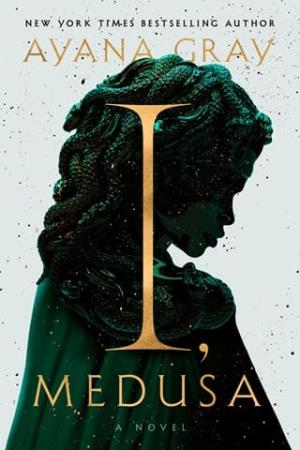
I, Medusa
After
It’s well past midnight when the woman finds the temple.
Her first thought, as her heels sink into the beach’s wet sand, is that the place at which she has arrived is not at all what she was expecting.
The holy sites she is accustomed to are grand and imposing marble complexes staffed by a retinue of dutiful priests or priestesses.
The lone torchlit building that looms before her in the dark, with its crumbling stone ramparts and visibly neglected grounds, is neither grand nor imposing.
The woman notes that the place is, in fact, quite small, half obscured by the surrounding dunes, and unlikely to have other visitors this late in the night.
The woman is not deterred as she diverts from the coastline to draw closer.
Tonight, a temple without visitors is auspicious.
A crude path lined with pebbles and driftwood leads her from the beach to the temple’s only entrance. The moment she crosses its threshold, the smell of myrrh fills her lungs, drawing from her a dull ache, a long-buried grief. She ignores that ache, smothers the grief, then presses on.
Eventually, she finds the old priest alone in the temple’s open courtyard.
He’s holding a broom, locked in fierce battle with the sand that litters the tile.
His olive skin shines with perspiration, his gray tunic is modest and plain.
He is a foreigner in these lands, just as she is.
It takes several seconds before he looks up and notices her.
He has cloudy, albeit kind, brown eyes and a decidedly paternal smile.
That smile makes the woman think of her own father, what he’d think if he knew what she was about to do.
She dismisses that thought quickly. Her father is a god, and if she knows anything about gods, it is that they care little for mortals and less for mortal plights.
Instead, her attention returns to the priest. She offers him a low bow—a lingering habit from her time as a priestess.
Then she speaks. Her voice is petal soft.
“I’ve come to ask for a blessing.”
The priest sets his broom aside and laces his gnarled fingers. Silence stretches between them before he gives his answer.
“What do you offer in exchange?”
The woman bows her head, contrite. “I’ve no coin, nothing of value.”
This is met with more silence.
“Please, I’m…I’m desperate.” The woman waits a beat before lifting her gaze.
When she does, she finds the priest’s expression has changed.
She knows what he sees: a young, dark-skinned woman wearing a simple white tunic and a simpler white head wrap.
She knows that this is a game, that she has already made the first move. Now it is his turn.
“It is no matter,” the priest says gently. “There are always other ways, other kinds of exchanges.” He gives the woman a significant look—a look she has been anticipating—before he beckons. “Come, child.”
The woman obeys, closing the small gap between them to accept his veiny hand. She does not shiver when he traces the pad of his thumb over her palm.
Then his grip tightens.
The woman does not object when the priest pulls her against him, nor when he crushes his wrinkled lips against hers.
She does not protest when he lowers them both to the sand-swept floor, nor when he guides her to clumsily mount him.
His body is bony and frail, but she feels it harden with desire between her thighs.
“I am untouched,” she whispers. “I have never…”
“That is all right,” says the priest. In the flicker of the torchlight, his once-kind eyes have grown wolfish. “I will show you what to do. But first, let me see you.”
The woman hesitates, then unfastens the pins that hold her tunic together at the shoulders, so that the garment falls around her waist. A low, appreciative groan escapes the priest’s lips.
“Tell me your name.” His voice is scraped raw with lust.
A small smile touches the woman’s face. “I could tell you who I am,” she says. “But I think it better to show you what I am.”
The old priest looks up from her bare breasts, confused, but the woman is already loosening her head wrap. She lets it slip to the floor, then blinks with newly yellow eyes. The priest’s grow coin-wide with terror.
“Abomination,” he rasps. “You’re a—” He does not finish his sentence.
Already, his vital organs are calcifying to cold, gray stone, as is the rest of his body.
His fingers curl inward as he claws at the air, grasping at something he’ll never reach.
All the while, the woman sits silently astride him, waiting.
Some distant, detached part of her—the part of her that’s remained human, perhaps—knows that she should feel something. Relief. Vindication. Horror.
The best she can manage is exhaustion.
The woman presses her fingertips to the priest’s stone tunic as his fluttering heartbeat slows, then stills.
Only when she’s certain that he’s dead does she rise.
She reaches up as hissing fills the temple, and the ink-black serpents that sprout from her scalp in place of hair taste the salt air with eager forked tongues while they nuzzle her hand.
Vaguely, the woman wonders how long it will take to drag the statue of the priest down to the shoreline, how many hours might pass before his absence is noticed.
She tallies how many men she has killed thus far and wonders how many more she will kill before the rage within her is sated, before it feels like enough.
As she douses the temple’s torch and surrenders to the dark, Medusa thinks about monsters, and how easily she became one.