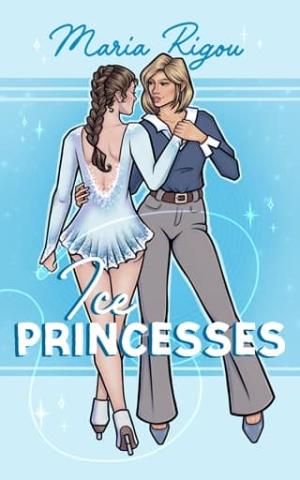
Ice Princesses
Chapter 1
CECILIA
“Try not to look too impressed,” I tell Rodrigo, but I’m the first one doing an absolute shit job at pretending that this here, right before our very own eyes, is not spectacular.
He tilts his head back anyway, slow and unapologetic, taking in the rafters, the banners, the glass that stretches from floor to ceiling at the back of the building.
I hear a small sigh, and then he smiles, almost to himself, as if this whole experience is a wonderful dream and he can’t believe it, either.
Lake Jasper Training Center sits at the eastern edge of the Colorado mountains, just far enough from Denver to feel removed from everything else, like it was carved out of the rock on purpose.
At least two Olympic-sized sheets of ice, altitude conditioning rooms, on-site physical therapy, nutrition labs, video analysis suites—the kind of infrastructure that turns potential into medals if you are able to access it.
Facilities like this don’t run themselves.
Every hour of ice, every off-ice training block, every physio slot is accounted for.
Places like these are built, maintained, and adjusted at a level that can only be explained as elite.
And someone is always in the background moving things around so that skaters like Rodrigo can step onto perfect ice and pretend it was always meant for them.
Lake Jasper Training Center is primarily built for Team USA winter athletes; a pipeline disguised as a campus.
International skaters like Rodrigo are allowed in under certain programs, but they are rare, and never accidental.
There’s a pretty rigorous selection process involving applications, federation endorsements, performance reviews, and funding approvals.
Layers of people deciding whether an athlete is worth the ice time.
We didn’t apply in the traditional sense.
Three weeks after Worlds, Argentina’s federation president called me into her office.
Sandra spoke fast, like she was trying to cram as much information in my head as possible so that I couldn’t say no, outlining a “development opportunity” at Lake Jasper that had opened up for the summer session.
A discretionary spot that was competitive and limited, and obviously a once-in-a-lifetime opportunity for Rodrigo.
I asked her what that meant, and she said that there was interest in Rodrigo and then used a series of words that were supposed to quantify his trajectory, and I stopped listening.
“Funding,” she said, “is partially supported. For him and his coach.”
None of the athletes from Argentina had this. Not at his age or even for those more established in their sports. Not even close.
So I asked what I needed to ask, made sure we still had some sort of say in his development, and then I did the only thing that made sense.
I said yes.
“I am impressed,” he replies, and then grins, like the little kid he still sometimes is, even as a seventeen-year-old figure skater, ranked among the top five in the world.
Rodrigo placed at Worlds and it shifted the ground under him.
Argentina now has an Olympic spot in men’s figure skating for the first time in decades, and immediately his name started circulating in the kind of conversations that usually happen without us.
Doors opened, fast.
Lake Jasper isn’t a reward. It’s a monumental stepping stone.
For Rodrigo, it means access to ice that isn’t shared with recreational skaters and tween birthday parties, to specialists who don’t split their time fifteen ways, to a training environment designed for winning instead of miracles.
It’s everything I ever wanted for my career and never got, so he’s getting it instead. And not by accident.
“Okay,” I sigh. Rodrigo is allowed to be impressed, of course. He’s earned that much. I’m the one who needs constant reminders of why we’re here. “Then try not to look too surprised, though, please.”
Rodrigo is already halfway to the boards, shiny new skate bag banging against his hip, shoulders pitched forward like the ice is pulling him by the collar. He turns around while walking backwards on unlaced sneakers, his version of slowing down and practicing patience.
“Cinco minutos,” I tell him, and I say it like I’m doing him a favor.
“Ceci,” he bemoans, dragging the word out like any of this is negotiable. “It’s open warm-ups. People are out there. I can literally hear blades.”
“I’m aware,” I say. “Tengo oídos.”
He points at me with a gloved finger like I’m the crux of all his problems. “Then why are we standing here?”
“Because,” I say, fishing our badges out of my backpack.
I put them there two nights ago, right after we checked in, and I’ve double checked they were still there every few hours since then, pretending this wasn’t going to feel enormous to both of us.
“This is the part where we need to do things in order.”
He groans. “I don’t think I’ve ever met anyone as superstitious as you.”
“It’s not superstition,” I say, even though I don’t bother sounding convinced. I hold his badge up between us. “It’s routine. Ponetelo. And I think it’s because you haven’t hung out with hockey players enough. They’re much worse.”
He snatches his credential from my hand and tries to clip it to his jacket in one sharp movement, misses the clasp, mutters under his breath, then forces himself to slow down and gets it on the second attempt. I pretend I didn’t notice the failed one.
Rodrigo takes one step towards the door, then pauses like he suddenly remembers I’m not just background noise in his life.
“You good?” he asks, casually.
I roll my eyes to give him something familiar. “I’m great. I’m thrilled. I love fluorescent lighting and overpriced, burnt coffee and the lingering scent of hockey boys.”
He grins, and I know it’s a performance.
His eyebrows are pulled together in a way that’s supposed to look relaxed and instead makes it clear he’s holding himself together by habit alone.
He’s in that in-between stage where he’s not a boy, yet not a full man—tall, still adjusting to his own height, like he grew too fast and hasn’t forgiven his body for it yet.
His excitement makes him reckless, like all teenagers are reckless.
His nerves make him sharper.
With anyone else, it would be hard to tell which is which. With him, I can tell by the slight tap of fingertips on his leg and the way his left shoulder creeps up when his thoughts get ahead of his breath.
“Okay,” I say as a large security guard nods at us from the end of the hallway. “Now you can go be annoying on the ice.”
He smiles, victorious. “Por fin.”
We push through the swinging doors and the cold hits us immediately.
The training rink we are assigned to is still wildly better than our rink back home.
The boards are scuffed, yes, but nothing looks like it’s one hit away from shattering completely.
The hallway smells faintly of rubber mats and old sweat.
Signs taped to the walls mix printed schedules with handwritten warnings, and it’s familiar yet foreign at the same time.
The exhibition rink is next door, connected by a corridor that looks too spotless to be real.
We walked past it yesterday. Rodrigo slowed in front of the glass, eyes going wide at the empty stands, the spotlights, the kind of perfect ice he’s only seen a handful of times in his lifetime, the majority of those this year alone.
He inhaled like he’d been underwater too long.
“Okay,” he murmured, reverent.
Now he’s already pulling his guards off before we reach the boards, and I have to stop and wonder when exactly he even changed into his skates.
“Slow down,” I tell him, because I have to. It’s my job to be the brakes.
“I am slow,” he says, which is a lie delivered with the unshakable confidence of a seventeen-year-old whose frontal lobe is still under massive amounts of construction.
He sets his guards down with more care than his tone suggests, then looks up at me—waiting, without admitting it.
I give him a small nod.
Dale.
Rodrigo steps onto the ice and pushes off, and his body changes immediately. His shoulders drop. His jaw unclenches. His long arms find their place. The noise in him quiets.
So does mine.
It’s always like this. The ice takes him and gives him back to himself.
I take my usual spot near the boards, close enough to see his feet without making him feel watched. It’s a balance I’ve learned to hold over the years, one that shifts as he grows. When he was younger, my eyes were safety. Now my eyes can become pressure if I’m not careful.
On the ice, a handful of skaters are already moving, carving overlapping circles that look chaotic to anyone who doesn’t know what to watch for.
Music bleeds from the speakers in clipped bursts—one chorus colliding with another.
A whistle and a laugh, followed by a dull thud against the boards that makes Rodrigo glance over and then keep going, unbothered.
Good.
He weaves through traffic like he belongs there, polite but not apologetic.
That’s the point. That’s what I’ve been trying to teach him since he was twelve: take up space without asking permission for it.
Five years ago, he used to look at me before every entry, studying my face intently to understand if the jump was good enough, clean enough. Now he looks at the ice like it’s a language and he’s fluent in it.
I should only feel proud. And I do—immensely. But sometimes that’s not enough.
Rodrigo starts marking his run-through, eighty percent power and heart. Arms half-committed. Jumps not fully snapped. Smart. He knows better than to burn his legs on practice ice. He’s learned how to save himself.
Still, I see his shoulder creep up on the approach. I see his timing get fractionally early on the toe. I see his mind sprinting ahead of his body.
“Rodri,” I call when he comes close to the boards.
He glides in, slowing just enough. “What?”
“Breathe earlier,” I say. “Before the entry.”
He nods. He already knows, but the reminder still matters.
I keep my voice light. “You’re already here. Okay?”
His mouth quirks and he gives me a quick thumbs-up before pushing off again.
A few steps down the boards, another coach watches with her arms folded inside a long puffer coat. She isn’t staring at Rodrigo like he’s a curiosity—just paying attention, the way coaches do when they’re bored enough to notice potential.
She shifts and catches my eye. “That’s your skater?”
“Yes,” I say.
“He’s got presence.”
There’s no edge to it. Just an observation, but my instinct is to react, always.
“Thank you,” I reply, because I’m not rude, and because I know how to take a compliment without feeding it too much. Rodrigo doesn’t need inflated expectations on day one of his three-month developmental clinic in a place very far and very different from home.
The coach nods once and looks away.
I exhale—not relief exactly. More like resetting.
Rodrigo comes around again and this time his timing is cleaner. He lands the first jump slightly forward, catches it, recovers without panic. He shakes his arms out and keeps going.
His recovery is one of the things I’m proudest of. Not because it makes him look strong, but because it means he doesn’t collapse when something isn’t perfect.
I didn’t learn that skill until it was too late.
At his age, I thought a fall was the end of the story.
One mistake meant everything. It meant something about me, about what I didn’t have, about what the sport decided I wasn’t worth.
I spent too many years letting skating convince me that my value could be measured in rotations and clean landings.
Back then, I thought every error meant I didn’t want it badly enough.
I didn’t have language yet for what I was missing—how much of this sport is built on who gets access early, who gets seen, who gets shaped before the world is watching.
And once the world is watching, it’s already too late to pretend the playing field was ever level.
I stopped competing at thirty, almost a decade ago now. Coaching wasn’t the plan. I didn’t dream of standing by the boards in an old puffer coat, living on watered-down coffee and scheduled printouts and borrowed Wi-Fi.
I just stayed.
The ice was the only place that ever felt like mine, and when I stepped off it, I didn’t know where to put all that knowledge. All that muscle memory and that wanting.
Then Rodrigo showed up.
Twelve-years old. All knees and stubbornness. A jump technique that was a mess and a way of skating that made adults stop mid-conversation to watch—not because it was technically sound but because it was honest. Because he was having fun.
That honesty is still there, threaded through the drills and the repetitions and the parts of training that are supposed to sand it down. It’s the thing I protect more fiercely than any element.
Because it’s always the first thing the sport tries to take away.
Rodrigo glides towards the boards again and grabs his water bottle, gulping like he’s been running.
“You’re smiling,” he says immediately, suspicious.
“I’m not.”
“You are.”
“I’m thinking.”
“About what?”
I could tell him a hundred things. About his shoulder or his timing. About the way he keeps glancing at the doors like this whole setup might swallow him whole. About how his joy is so obvious, it’s contagious.
Instead, I tap the side of his head. “Your takeoff.”
He groans. “Of course.”
“You’re trying to jump out of your skin,” I say. “Stay in it.”
He watches me for a beat, then his expression shifts into something quieter.
“Okay,” he says.
“Okay,” I echo, because repetition is a spell. Sometimes all I can do is say the calm words until my body believes them.
He pushes off again, then pauses. “Can I do one full run?”
I take him in—the steadier hands, the looser back, the focus settling where it should.
“One,” I say. “Then you’re done.”
His grin flashes. “Deal.”
This time he commits. Arms sharper. Speed cleaner. The program starts to look like itself, not a rehearsal. He hits the first element with a confidence that doesn’t tip into arrogance. He lands and keeps moving, not checking for my reaction and not searching the boards for any type of validation.
Pride hits my chest, fast and fierce. I swallow it down into something manageable.
Rodrigo finishes and glides to the boards, breath quick, cheeks flushed with cold. He looks at me like he wants to ask everything at once: Did it work? Did it matter? Do I belong here? Are people watching me?
I nod once. “That was you.”
His eyes soften. He looks away, not wanting to be seen too directly in his rawest state. “Yeah,” he says, pretending he doesn’t care. “I know.”
He skates off for a loose lap, and I let my gaze follow him without pressing, without bruising the moment by searching for what went wrong.
This is the easy part. The ice is honest.
The rest of this summer won’t be.