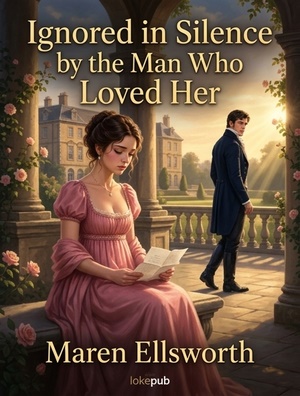
Ignored in Silence by the Man Who Loved Her
Chapter One
Netherfield's ballroom had not changed. The same candles guttered in the same brass sconces, the same Turkish carpet had been rolled back from the same stretch of floor, and the same overwrought garlands of ivy drooped from the same mantel.
Only the guests were different, and only one of them mattered enough to make Elizabeth Bennet's hand tighten on her glass.
Mr. Darcy stood near the window with his back half turned, speaking to Colonel Fitzwilliam in a voice pitched low enough that she caught nothing but its shape. He had arrived an hour ago. He had not once looked at her.
"He is very handsome," said Kitty, following her sister's gaze without any particular subtlety. "Do you think he means to dance tonight?"
"I neither know nor care," said Elizabeth, and drank rather more of the lemonade than the occasion strictly required.
It was, of course, a lie, and Charlotte Lucas caught her eye across the room with the specific expression of a woman who knew it.
Jane came to her a moment later, glowing in a way that made even Elizabeth's sourness soften. "Mr. Bingley has asked me for the next two dances," she said, "and I could not think of a single reason to refuse him."
"You could not think of a reason because there isn't one. Go. Be happy. Someone in this family ought to be."
Jane's smile faltered only slightly. "Lizzy."
"I am perfectly well." Elizabeth kissed her sister's cheek to prove it, and watched her go, and told herself the ache in her chest was for Jane's happiness and nothing else.
She had not expected to see Mr. Darcy again so soon.
Kent had ended badly enough that she had assumed, with something like relief, that their paths need never cross with any regularity.
And then Mr. Bingley had returned to Netherfield in September with his friend in tow, as though the previous November had never happened, as though nothing between any of them required explanation.
Darcy had bowed to her on his arrival. He had inquired, with perfect and infuriating correctness, after her family's health.
He had not danced with her, had not sought her out, had not so much as let his eyes rest on her for longer than politeness demanded.
It was, Elizabeth thought, precisely the behaviour of a man who regretted ever having proposed and wished the whole business quietly buried.
She found she minded this a great deal more than she wished to.
"You are staring," said Charlotte, arriving at her elbow with the particular tact of an old friend. "Everyone will notice."
"I am not staring. I am counting the candles."
"There are forty-one. I counted them at the last ball too." Charlotte's mouth twitched. "He has not stopped looking at you, you know. Only he does it when your back is turned."
"Charlotte."
"I am merely reporting what I observe."
Elizabeth turned, quick enough to catch the tail end of it, that swift withdrawal of a gaze that had, perhaps, been somewhere near her. Darcy was already speaking to his cousin again, his jaw set, his shoulders held with the particular rigidity of a man performing composure rather than feeling it.
It proved nothing. A man might look anywhere in a crowded room and mean nothing by it.
Darcy had counted the minutes since his arrival with the precision of a man defusing something that might, if mishandled, take his hand off.
He had told himself, on the drive from London, that he would manage it better this time.
He would be civil. He would be distant. He would give Elizabeth Bennet no cause to think he harboured any warmer sentiment than common acquaintance required, because to give her that cause was to give Lady Catherine that cause, and to give Lady Catherine that cause was to put Georgiana's future into the hands of a committee that had never once, in his experience, chosen mercy over principle.
He had not accounted for how much it would cost him to watch her laugh at something Charlotte Lucas said, her whole face lit with it, and to feel his own hands curl at his sides with the effort of not crossing the room.
"You are doing an excellent impression of a man who has swallowed a poker," said Colonel Fitzwilliam, not quietly enough. "Would it kill you to ask her to dance?"
"It might kill considerably more than me."
"Ah." Fitzwilliam's amusement dimmed. "The trust."
"The trust." Darcy did not elaborate. He rarely did, even with his cousin, though Fitzwilliam knew the shape of it well enough: his father's will, drawn up in the last grim months of his illness, had settled Georgiana's dowry and the whole of the Pemberley tenant fund into a trust that would only vest cleanly if Darcy married, before his thirtieth birthday, with the documented approval of three guardians.
Lady Catherine was one. Fitzwilliam's own father, the Earl, was another.
The third was a solicitor named Hargreave who had never in his professional life approved of anything that had not first been vetted twice.
Should Darcy marry without their sanction, or fail to marry at all within the window, the whole of it reverted to a cousin in Ireland whom none of them had met above twice, and Georgiana would come into her majority with a fraction of what she was owed.
His father had meant it, Darcy believed, as protection.
A dying man's attempt to ensure his heir did not squander an inheritance on some fortune-hunting adventuress, the way his own younger brother nearly had, decades before.
What it had become, in practice, was a cage with his sister's security for a lock.
"You cannot go on ignoring her," Fitzwilliam said. "She will think you despise her."
"Better that than the alternative."
"Is it?" Fitzwilliam studied him with an expression Darcy did not care for. "You looked, three months ago, like a man who had been struck by lightning and rather enjoyed it. Now you look like a man attending his own funeral. I begin to think the lightning would serve you better."
Darcy did not answer. Across the room, Elizabeth had turned back to her sister, her profile caught in candlelight, and something in his chest pulled so hard it was very nearly pain.
He thought of the letter he had written her in Kent, the one that had, against every reasonable expectation, done some good.
He thought of writing another. He dismissed the thought before it could take root, because a second letter meant a second confession, and a second confession meant risk he had no right to take with Georgiana's future as the stake.
Better, he told himself, to be thought cold. Better a woman's low opinion than a sister's diminished inheritance.
He believed this, mostly, until Elizabeth glanced up and caught him watching after all, and he saw something flicker across her face before she looked away, quick and closed, like a door shutting.
The music started again before Elizabeth had entirely recovered her composure.
She danced twice with a young lieutenant whose name she promptly forgot and once with Mr. Bingley's brother-in-law, Mr. Hurst, who spoke of nothing but the excellence of the supper he anticipated and required no conversation from her at all, which was, on the whole, a mercy.
She did not dance with Mr. Darcy. He did not ask.
Near midnight, when the older guests had retreated to cards and the younger ones had grown loud with wine and dancing, Elizabeth slipped out to the terrace for air, and found, with the particular ill luck that seemed to govern every interaction she had ever had with the man, that Mr. Darcy had had the same idea some minutes before her.
He straightened when he saw her, as though caught at something.
"Miss Bennet."
"Mr. Darcy." She considered retreating. Pride, or something very like it, kept her feet where they were. "I did not mean to intrude."
"You do not." He said it too quickly, and then seemed to regret the speed of it, his jaw tightening. "The room grew close."
"So I gathered." She let a beat pass, the silence stretching taut between them, the garden dark and full of the last of the autumn crickets. "You have been very quiet this evening."
"Have I."
"You have barely spoken ten words to me since your arrival, and I believe I heard six of them just now."
Something moved in his face, quick and unguarded, gone before she could name it. "I did not think my conversation was much wanted."
"That is a convenient assumption for a man who has made no effort to test it."
He looked at her then, properly, for the first time all evening, and the intensity of it startled her into stillness. There was something in his expression that did not match his careful distance all night, something hungrier and more helpless than she had ever seen him permit himself.
"Miss Bennet," he said, low, "there are things I cannot explain to you. Not tonight. Perhaps not for some time yet."
"That is not an explanation. It is merely a more elegant way of saying nothing."
"I am aware."
"Then why say it at all?"
He did not answer. His hand had come up, some inch of motion toward her before he caught himself and let it fall again, and Elizabeth felt the whole of her body go very still, waiting to see what he would do with the wanting so plainly written across his face.
He bowed instead. "Good night, Miss Bennet."
And left her standing in the cold with her pulse going hard and confused, and no answer at all to carry back inside with her.
She told Jane about it the next morning, in the privacy of their shared room, with rather more heat than the small exchange strictly warranted.
"He looked at me," she said, pacing, "as though he wanted to say something enormous, and then he said good night and walked away. What manner of man does that?"
"Perhaps he is shy."
"Darcy is not shy. Darcy is many unflattering things, but shy has never been among them."
Jane, brushing out her hair at the little mirror, met her sister's eyes in the reflection. "You sound very invested for a man whose company you claim not to want."
"I am invested in the puzzle of him, nothing more."
"Mm." Jane did not look convinced, and Elizabeth did not entirely blame her.
The truth, which she was not yet ready to examine too closely, was this: in Kent, she had believed him proud and unfeeling, and his letter had corrected that belief so thoroughly that she had spent months since half expecting, half hoping, that his manner toward her would soften into something warmer.
Instead she had gotten silence, dressed up in perfect civility, worn like armour.
It would have been easier, she thought, if he had simply stayed proud. She knew how to despise pride. She had no idea at all what to do with a man who looked at her as though she were the only person in a crowded room, and then said nothing, and walked away.
Two days later, Wickham left Meryton without warning, his gambling debts paid in full by some unnamed benefactor, and no one in the town could account for how it had happened.
Elizabeth heard the news from her aunt Phillips, who heard it from the tradesmen, who had all been quietly and completely satisfied within the space of a single week.
"Someone has been very generous," her aunt said, delighted by the mystery of it. "Colonel Forster says he has never seen a debt cleared so quietly nor so completely. Do you suppose it was Mr. Bingley? He is generous, and he was fond of Wickham when they first met."
"Perhaps," said Elizabeth, though something in her did not quite believe it. Bingley was generous, yes, but he was also transparent as glass, and would surely have mentioned it, even in passing, even in confidence to Jane.
She thought of Darcy's face on the terrace. She thought of the letter in Kent, and what it had told her of a man who acted in secret and asked for nothing in return.
She dismissed the thought as fancy, because to entertain it seriously was to admit that she had begun, against every resolution she had made, to hope again.