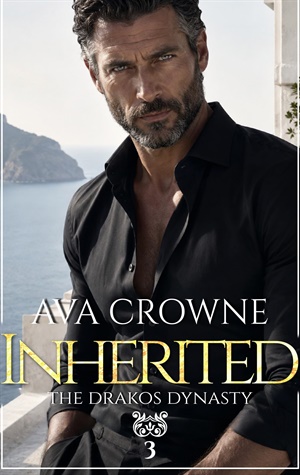
Inherited (The Drakos Dynasty #3)
1. Isadora
CHAPTER ONE
ISADORA
The black car stops at the top of the cliff and the driver does not open my door.
My brothers’ men dropped me at the dock and turned the boat back to Athens without speaking. They did not speak on the water either. Not to me, not to each other. Men do not talk around a woman they have been told is a payment, in case some of what is owed rubs off on them.
The car at the dock had a single driver who did not look at me in the mirror once during the climb. He has been told something about me that has made him careful. He has been told, I suspect, that I have a year, perhaps two, before I am dead.
I open my own door and I step out.
The light is the hard white light of late afternoon, and the wind comes off the sea carrying thyme and salt. The island is warm, but I am not.
Somewhere beyond the wall a party is going on.
I can hear it before I can see any of it, glasses, a child’s laugh, a man’s voice lifting into a toast in Greek and the low answer of a table agreeing with him.
Music, once, then gone. It is the sound of a family celebrating, and I have been delivered into the middle of it like a crate landed on a wedding morning.
No one told me. No one tells the payment anything.
I am in my father’s coat, wool, black, cut for a man broader than I will ever be.
It is too heavy for autumn on Kalydon. I was wearing it when my brothers came to my room three days ago to tell me they had reached an arrangement with the Drakos.
Vassilios did the telling. He stood at the window with his back to me and said it in the formal mode our father required at every dinner of our lives: The war is over, sister.
You are the terms. He could not say it to my face, so he said it to the glass.
I have not taken the coat off since. There is a small cigarette burn on the left cuff that my father never had repaired.
That is the entire inheritance I was permitted to carry onto the boat, and no one thought to search me for it.
I am Isadora Kallis. I am twenty-two years old.
My father has been dead six weeks. My mother has been dead three years.
I have an older sister who has been at a convent in northern Italy since she was nineteen, and two older brothers who have run the family’s business since before I was allowed to know what the business was.
My family’s business, until six weeks ago, was the import-export work of the Kallis house.
My family’s business, until last night, included a forty-year war with the family I have just been delivered to.
The war is over.
I am the closing line of the war.
I walk across the gravel of the Drakos compound. The compound is white stone, dry grass, the long line of an old south wall, larger than any photograph made it.
The gravel forks. One path bends toward the noise and the long tables I cannot quite see, olive branches, white cloth, the flash of a woman’s pale dress crossing a doorway. The other path is empty and leads to where they are waiting for me.
In the arrival courtyard there are five men.
The first is the oldest. He is in a chair, in a blanket, with a younger man’s hand at his shoulder. He is the Patriarch. I know him from photographs. I have spent years studying every man my father considered an enemy.
The second man is tall and lean, silver at the temples, in a black suit. The lawyer, Theron. In my father’s files he was the one marked do not negotiate.
The third is broader, scarred along the forearms, missing the last joint of his left ring finger. The security head, Nikos. His file was the thickest, most of it blank pages standing in for the things no one could prove.
The fourth is golden-skinned and charming, with an expensive mouth. The hospitality arm. Adrian. There was almost nothing in his file, which my father said made him the most dangerous of the four. My father was wrong about many things. Perhaps not that.
The fifth is at the front of them.
He is in shirtsleeves, taller than I expected. His hair is fully silver at the temples and dark elsewhere. His eyes are pale, the color of the harbor at six in the morning before the boats are out, and he is looking at me.
Konstantine Drakos.
The head of the dark cargo arm. The widower. His file was the one I read most often, and it was the one that told me the least.
I cross the courtyard.
He does not come to meet me. He stands where he is, lets me close the distance, and I understand that in this family the standing still is a language.
I stop two meters from him. The careful distance.
My father taught it to me when I was four years old: close enough that no one can say you flinched, far enough that a hand cannot reach you on the first movement.
I have kept it in every room since. This is the first time I have kept it in a courtyard full of the men my father taught me to keep it for.
I do not weep. I do not look at my hands. I lift my chin and I look at his pale eyes.
He speaks.
His voice is the lowest voice I have heard in my life.
It does not carry, and it does not need to, because a man with this much silence around him has trained everyone he knows to come to the sound.
I have to step closer to hear him, but I don’t.
I lean forward instead, by the smallest fraction my training will allow, and he says, in Greek:
“You are mine now. Sit.”
There is a chair behind me I had not noticed. Someone placed it on the gravel while I was crossing, quietly, exactly where I would want it, and that frightens me more than the sentence did. The sentence is only ownership. The chair means this house learned me before I arrived.
I sit.
I hold his pale eyes, and I say, in Greek, in the formal mode my father required of: “Then explain to me, Konstantine Drakos, what your ownership of me means.”
The Patriarch, in his chair, laughs once. He says, in the same formal mode: “The lady speaks well, nephew.”
Konstantine does not laugh.
He does not break the look. He does not answer my question.
He turns to the cousins.
He says, in the same low voice: “Leave us. Go back to the wedding.”
The cousins file out toward the noise and the white cloth. The Patriarch is wheeled away by Adrian, gently, with a hand at the old man’s shoulder.
There is no one behind me. Between me and the south wall, nothing. Between Konstantine Drakos and me, two meters of gravel.
He does not move. Neither do I.
I note, out of years of habit, that there is no guard at the south gate, that the wall is low enough to climb even in this coat, and that none of it matters. Kalydon is an island. The sea is the lock. He does not need to hold me. He needs only to stand here and let the water do it.
After the count of fifteen, he speaks again.
“Your room is in the south wing. There is a bath, a wardrobe, food on a tray. Yia-Yia Despina will show you. Eat. Wash. Sleep. We will speak tomorrow.”
“What does your ownership mean?” I ask again.
“I will not answer that question tonight, Isadora Kallis. I will answer it in the morning.”
I stand and cross to him. I stop one meter from him, the distance I gave him on entry, divided by half, so that he will know the training is mine to spend and not only to obey.
And then I do the thing I decided to do on the boat, somewhere in the third hour, watching the water.
It was the only thing left to decide about a day other people had decided.
I lift my hands and take the wool of my father’s coat at the collar. I unbutton it, one button at a time, the buttons my father’s hands wore smooth, and let the coat fall.
It pools on the gravel at my feet.
I am in the black dress I have worn for six weeks. The dress hangs on me the way a flag hangs on a windless day.
He looks at the coat on the gravel. His pale eyes do not move. Nothing in that face, I would guess, has moved in years. I stand in the wind and let him not react for as long as he needs.
He bends and picks up the coat, beats the dust from it with the flat of his hand, twice. He folds it once, lengthwise, and he lays the folded coat on the chair.
He says, in his low voice: “We will speak tomorrow.”
He walks away across the courtyard.
I stand in the wind and look at the folded coat on the chair, and I have one thought, very clear, very unwanted.
I was sent here as a punishment, and the man who owns me has just lifted my dead father’s coat out of the dust. I do not have a name yet for what that makes him.
I have been given a room I have not seen, a tomorrow I did not ask for.
The only thing in this courtyard that has been handled gently is the coat.
Yia-Yia Despina is at the door of the south wing. She is small and gray, and looks at me the way the grandmothers of my own islands look at girls who arrive somewhere with one bag, which is to say completely, without one word of comment.
As I cross to her, something moves in an upstairs window of the south wing. A small pale face, dark hair wild around it, there and gone before I can be sure of it. A child. No one has said anything to me about a child.
I follow Yia-Yia Despina into the south wing.
I do not look back.