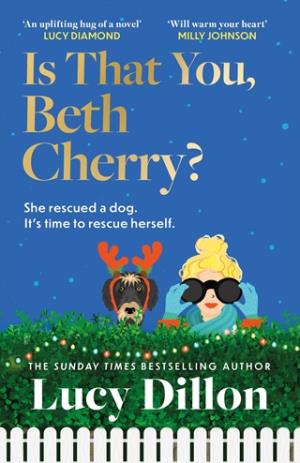
Is That You, Beth Cherry?
Chapter My Flatmate, Ashley
Tell me about a time you made a snap decision that worked out . . .
Adopting my dog. I didn’t intend to get a dog.
Like everyone in those surreal days before lockdown, I was spending hours every day doomscrolling through social media to stop my brain from engaging with anything other than the most soothing content – cookie decoration, sand scooping – but once I saw Tomsk I stopped. Instantly.
He looked so scared. Two fearful brown eyes staring out through a matted veil of hair, backed up in the corner of a concrete cell, with the message please take me home over the top.
Something scratched in my chest. His fear, his submission connected with something in my own heart, and I knew, in that instant, it was my home he needed.
The fact that I was even following Four Oaks Rescue Kennel was a bit masochistic.
In my previous, happy, life, Fraser and I had driven over to Longhampton, where his parents lived, to a charity dog show that his mother Martine was judging in her official capacity as the mayor’s wife.
We only went to support her and Ray, the mayor – Fraser and I weren’t in the market for a dog, since we both had demanding office jobs, regular spontaneous weekends away and lived in a no-pets second-floor flat.
But we’d talked about it, in that testing-the-water-about-kids-without-mentioning-the-word-kids way you do, after you’ve been together a few years.
Tomsk was one of ten strays the rescue owners were desperately trying to move into foster homes before they had to close.
He was the biggest, and the hairiest, and the caption was very brief, but something about him already felt familiar.
He reminded me of the Womble toy my mum had given me, with his long pointed nose and matted grey fur.
Without thinking, I was hunting for my outdoor shoes for the first time in days.
The poor creature looked bewildered, as if he’d woken up in the wrong life.
That, I could absolutely identify with. Right down to the matted hair and confused expression.
My flatmate, Ashley, told me later that when I dashed out of the house with the car keys she was worried I was going to, in her words, ‘Do something stupid’ – which I kind of was, but not the way she thought.
I hadn’t left the house for three weeks at this point, and that was before lockdown: Ash and I were both in the grip of Post-Relationship-Paralysis, which manifested itself in tea- and tear-stained leisurewear, fear of hearing certain songs on the radio, and heavy reliance on food delivery.
Four Oaks Rescue Kennel was, an hour’s drive away, but I was pulling up outside before I knew it. I didn’t have a single thought, all the way there, other than: I need to bring that dog home.
I must have looked a bit of a sight when I arrived, because the woman in charge, Rachel, went through the adoption questionnaire very slowly, as if she thought I might change my mind by the time we got to the end.
‘Do you have a garden? Can you commit to walking a large-breed dog? Have you owned a dog before?’
I nodded. Ash’s house had a garden. And my dad had had a Jack Russell called Ned, a classic publican’s dog – patch over one eye, existed largely on crisps – which Dad had taken with him when he moved to London, leaving me and Mum behind, so I’d had a clear lesson about where dogs were supposed to come in your priorities.
But I must have convinced Rachel that I was serious, and eventually she got up and found a spare slip lead.
‘We don’t know much about Scruffy other than that he’s some kind of hound cross and he’s been living rough for a while,’ she warned me as we headed towards the sound of discordant barking. ‘He’s a sweet boy, though, and tries to be clean in his run, so someone must have loved him once.’
She paused at the door into the kennel area. ‘That’s what breaks my heart. When they know what love is, then it’s taken away, and they don’t know what they’ve done.’
I bit my lip.
He was hunched in the furthest corner of the concrete run, trying to make himself as small and invisible as possible in the cacophony of barking going on.
They’d cleaned him up from his initial photo but there was still the tangy whiff of fear about him.
Rachel unlatched the gate and clipped a lead on to his collar, gently leading him out into the main area.
It’s still really hard to write about this without crying. Even though I know how it ends.
He allowed Rachel to bring him over, although his wiry tail was tucked right between his legs, and when I stretched my hand out, he cowered. Then I sat down on the floor, cross-legged. I don’t know why, I just had an instinct to sit down.
Rachel sat down too. ‘Ignore him,’ she said. ‘Give him space.’
We ignored him.
She asked me what I did for a living – bland talk, the sort you normally do at parties, not on a concrete floor that smells of bleach – and I told her I was an accountant, that I’d recently split up from my boyfriend of five years, that I had plenty of spare time, that my sort-of-mother-in-law, no, my ex-sort-of-mother-in-law, had judged that charity dog show.
‘Ah!’ she said, raising an eyebrow. ‘Martine!’
Which was what everyone said when I mentioned Fraser’s mother.
I asked her about the other dogs, since the mention of Martine reminded me of happier, more Henderson times, and I didn’t trust myself not to start crying or launching into the Fraser break-up story.
Rachel told me about the dogs she’d rehomed that morning – a stray collie, a saggy ex-breeding spaniel.
A bonded pair of timid dachshunds whose elderly owner had died, suddenly, with no relatives to take them in.
Some had sad stories; some, like my shaggy hound, had none.
‘It makes it easier to find new homes if we know their background,’ Rachel explained. ‘But some . . .’ She sighed. ‘Some we’ll never know what’s happened to make them the way they are. What they’re living with, what they can’t tell us.’
That made my eyes fill up. It still does.
Then I sensed something move behind me. A tentative click of long claws on stone, a rustle. Despite its fear, the dog was inching nearer.
‘All we can do is help them start a new story,’ said Rachel. ‘I’ve seen some poor things come in, like bags of bones, too traumatised to look at you. But if you’re patient, and lucky, and we find them the right people, then . . .’
She paused, because something was moving behind me again, something coming closer. And closer. She could see what was happening, and from the cautious smile I guessed it wasn’t something she’d seen yet from this particular dog.
I held my breath.
There was a silent slump behind me, the whisper of tired legs folding under a mass of unwashed coat. I felt the point of a long nose almost – but not quite – touching my leg, not yet bold enough to make eye contact, but brave enough to creep closer.
Rachel tilted her head and I got the impression she was sizing me up the same way she assessed the wretched dogs handed in.
I knew I looked a wreck. She touched my arm.
‘Same goes for humans too,’ she said, as if she understood the long nights behind my unwashed hair, the dark shadows under my eyes. ‘We can start again.’
I reached behind me, placing my hand flat on the floor, not touching the dog, but offering him my skin to sniff.
After a while, a few long moments, I felt the faintest breath on my arm.
The sigh of a dog who was starting his story again. A good boy. A brave boy.
My eyes filled up. We’re going to be OK, I promised him, in my heart. Both of us.
We’re both going to be OK.