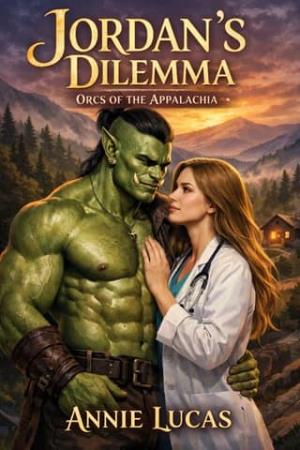
Jordan’s Dilemma (Orcs of the Appalachia #1)
Chapter 1
Jordan
I leaned against the counter at the nurses' station, half-watching the flatscreen mounted above the coffee maker.
The emergency department at Franklin Memorial Hospital had settled into that peculiar Tuesday night stillness—the kind where you could hear the ice machine cycling three rooms away and count the flickers in the fluorescent lights overhead.
Franklin, North Carolina wasn't exactly a hotbed of excitement on the best of days.
Most shifts brought a steady trickle of the usual suspects: twisted ankles, elderly falls, the occasional drunk driver weaving their way off the mountain roads on weekends.
But Tuesday nights? Tuesday nights were reliably, almost aggressively uneventful.
On the screen, another rose ceremony unfolded in a haze of champagne flutes and strategic lighting.
Tammy, one of the night nurses, had commandeered a rolling stool and planted herself directly in front of the TV, her chin propped on her hand, mesmerized.
I'd never gotten into The Bachelor—couldn't tell you which season this was or which interchangeable contestant was fighting for which interchangeable heart—but I'd absorbed enough through cultural osmosis to recognize the beats.
Tearful confessions in candlelit gazebos.
Swelling Orchestral stings. Someone's mascara running as they climbed into the rejection limousine.
Then the breaking news banner slid across the bottom of the screen.
brEAKING: Armed group arrested near Clingman's Dome, TN. Authorities say suspects planned coordinated attack on Orc settlement. Federal investigation ongoing.
My hands stilled on the clipboard. I watched the chyron scroll past once, then loop back around, the words identical the second time. Tammy didn't even glance down. She was too busy whispering about someone named Brayden who was "clearly just here for Instagram followers."
Orcs.
Five years ago, that word meant nothing beyond fantasy novels and late-night gaming sessions. Now it was just another line item on intake forms, right between "insurance provider" and "known allergies."
The Jim Walter Resources Coal Mine #7 in Alabama changed everything. Miners drilling past 2,000 feet, chasing a promising vein, broke through into something that shouldn't have existed. Not a cave. Not some geological anomaly.
A city.
Stone architecture that put our greatest cathedrals to shame, carved with precision that made modern engineering look clumsy.
Infrastructure sprawling through chambers so vast our equipment couldn't find the edges.
And beings. Hundreds of thousands of them, maybe millions.
An entire civilization that had been living beneath our feet while we went about our surface lives, completely oblivious.
They called themselves Orcs, though the word carried none of the baggage our fantasy authors had loaded onto it.
They weren't monsters. They were people—taller than us, broader, with skin in every shade of green from spring leaves to deep forest moss and tusks jutting up from their lower canines.
Their eyes were the most striking feature.
Solid black sclera with a single vertical pupil of molten gold, evolved for navigating absolute darkness.
The Jim Walter breach wasn't isolated. Within weeks, similar incidents erupted across Appalachia, the Rockies, even a mine in Wales. We'd been drilling toward them for decades, our machinery grinding closer and closer to their world.
The first contact went about as well as you'd expect. National Guard showed up to the Alabama mine with enough firepower to level a small country, expecting to contain what they assumed was a threat.
The Orcs walked out anyway.
Bullets ricocheted off their skin like rain off pavement.
The few rounds that penetrated barely registered—their bodies were denser than ours, built for pressures and depths that would crush human bones to powder.
And when the shooting started in earnest, when some trigger-happy corporal decided to escalate, the Orcs demonstrated exactly why they'd survived centuries in the dark.
They moved like they could read violence before it happened. Every punch telegraphed and countered. Every tactical advantage turned against us. They weren't just strong—they were trained, with a fluidity that spoke to generations of combat knowledge.
The president, to his credit, called off the attack before it became a massacre. Switched tactics from bullets to negotiation.
It worked, mostly because the Orcs wanted to talk.
They spoke English, though threaded through with words that made linguists sit up straight—Cherokee, Choctaw, Creek.
Languages we'd buried in textbooks and marked as dead.
A history professor at Emory eventually unearthed a document.
A Cherokee account from the 1500s, ink faded to ghost-whispers on parchment, telling a story that rewrote everything we thought we knew.
The Orcs hadn't crawled up from some primordial deep.
They'd been driven down into it. European colonization hadn't just displaced them—it had erased them from the surface entirely, Forced them into the crushing dark where they'd built their civilization in the spaces between stone and shadow.
Five hundred years of evolution we never saw coming. Five hundred years of a civilization thriving in a world that would kill us in minutes.
The negotiations stretched across eleven months.
The Orcs' demands were simple, almost painfully so: recognition, sovereignty, the basic dignity of legal existence.
They wanted access to the surface—not to conquer it, just to breathe it again.
In exchange, they offered mining rights to resources our geologists couldn't even classify yet.
Rare earth metals that made our tech look primitive.
Gems formed under pressures that shouldn't exist outside a planet's core.
We said yes. Not entirely out of altruism—though some tried to pretend otherwise. The Orcs were sitting on wealth that made our richest oligarchs look like children playing with Monopoly money, and everyone knew it.
The land deal carved new borders across the continent.
Massive chunks of the Appalachians and Rockies became sovereign Orc territories overnight.
Most of the human population in those regions was sparse enough that relocation didn't spark riots, and the Orcs sweetened the deal with compensation in actual, physical gold—enough to make even the most stubborn holdouts reconsider.
Some humans stayed anyway, drawn by curiosity or something harder to name.
Six months after the treaty signatures dried, the national debt plummeted by 47%.
Wall Street went apeshit. Trading floors erupted in chaos as the dollar surged against every major currency.
International markets stabilized in patterns economists swore were theoretically impossible.
America's rivals went conspicuously silent on their geopolitical posturing once they realized we'd stumbled into an alliance with a species controlling mineral wealth that dwarfed the GDP of entire nations.
Their villages emerged from Appalachian bedrock in mere months—towering structures of wood and stone that somehow looked both ancient and impossibly futuristic, engineered to laugh at earthquakes, floods, whatever fury nature could muster.
They didn't touch steel. Had no use for it. Their architecture defied conventional physics—all compression, weight distribution, and stone-shaping techniques that left our best engineers scratching their heads.
By year two, Orc settlements had taken root primarily in the Rockies and along the Appalachian spine—near Mount Mitchell in North Carolina, Clingman's Dome in Tennessee—terrain so unforgiving most humans wouldn't dream of building there.
They steered clear of major cities but became fixtures in the small mountain towns. Most locals accepted them with a shrug and a nod. Others muttered darkly about sending them back underground. Or worse.
Boone, North Carolina transformed into a bustling trade hub practically overnight.
Orcs descended from the high peaks bearing raw gemstones, exotic minerals, and metalwork that made our finest smiths weep with envy.
They traded for food, books, electronics—smartphones especially, which they embraced with surprising enthusiasm, despite most living outside the range of cell towers.
Asheville evolved into an unexpected cultural crossroads.
Turned out Orcs had a thing for live music.
Bluegrass, particularly. Something about those old mountain melodies struck a chord deep in them, as if the songs awakened memories from before the long darkness.
You'd spot them in dimly lit bars, nursing drinks potent enough to hospitalize a human, thick fingers drumming tabletops in flawless rhythm.
But not every town rolled out the welcome mat.
I'd never actually met one up close.
The Orcs kept to their own healers—shamans, medicine workers, whatever ancient tradition they'd carried up from the depths.
They had techniques passed down through countless generations, herbal compounds baffled our best pharmacologists, and a constitution that bordered on the miraculous.
Emergency departments, CT scanners, surgical suites—they had no use for any of it.
But I'd seen them around Franklin. You couldn't miss them if you tried.
They'd cruise through town in Hummers or Land Rovers—massive vehicles with reinforced suspensions groaning under custom seats built for frames that averaged seven feet and three hundred pounds of pure muscle. The smaller ones, anyway. Rumor had it some of the males topped eight feet easy.