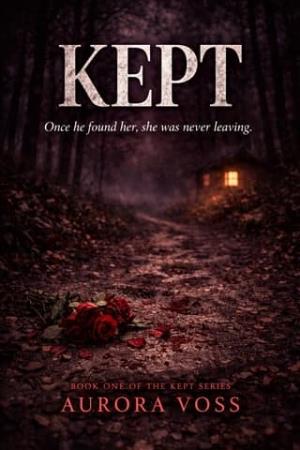
Kept (Kept #1)
Chapter One
Leona
I prefer animals to people.
Animals do not lie about what they are. A wolf shows its teeth before it bites.
A hawk warns with its wings. Even the more delicate creatures, the nervous fennec foxes with their oversized ears, the serval with its elegant stride, the rescued deer with one bad leg and a permanent distrust of sudden movement, make sense to me in a way people never have.
Fear looks like fear. Hunger looks like hunger. Pain looks like pain.
People disguise things. They smile when they are cruel. They praise when they want something. They say trust me as if trust were a switch someone could flip, not a living thing that bruises when it is handled carelessly. I learned all of that young. Maybe too young.
By twenty eight, I had built a life around creatures that did not pretend.
My farm sits just outside the edge of Rook Hollow, a fading mountain town tucked deep in the Catskills, where the roads narrow and the trees crowd closer to the fence lines, where fog hangs low over the fields in the morning and the world feels just removed enough to be bearable.
I moved here two years ago with more stubbornness than certainty, trading a life that had never fit for one no sane person would have chosen without a backup plan.
Rook Hollow looked like the sort of place a person could disappear into if she worked hard enough and kept to herself.
Small enough to be forgotten by the rest of the world.
Old enough to be set in its ways. The kind of town where people remembered old names, old feuds, old sins, and noticed anything new even when they were polite enough not to say so aloud.
At first, I rented a drafty little house closer to town and took whatever work I could find with animals.
Transport jobs. Rehabilitation help. Farm calls.
Consults for people who had bought things they should never have owned in the first place and only seemed surprised when those animals acted like animals.
The work paid badly. It was exhausting. It left me smelling like hay, bleach, and wet fur most nights. I loved it anyway.
A year ago, I bought the farm.
Even now, the thought still catches me off guard.
The place had been half falling apart when I found it.
Bad fencing. A sagging barn roof. Too much land for one person and not enough money to make any of it sensible.
Which, naturally, meant it was perfect. I poured everything I had into it.
Savings. Loans. Favors I hated asking for.
Every hour of labor my body could survive.
Some days I think I built Briar Hollow out of equal parts devotion and spite.
The wooden sign at the front gate reads:
brIAR HOLLOW EXOTICS
Rescue. Rehabilitation. Respect.
The paint has chipped near the bottom from weather and time, and one of the screws leans slightly crooked because I keep meaning to fix it and never do.
Still, I love that sign. I love what it means.
And even now, a year after taking over the farm, I still love that the land beyond it is mine.
Every muddy boot print. Every creak of barn wood.
Every enclosure I have built with scraped knuckles, borrowed money, and sheer stubbornness.
It is not a zoo. I hate it when people call it that.
Briar Hollow is a sanctuary first, a working exotic animal farm second, and a place of healing above all else.
Some animals stay forever because they cannot safely return anywhere else.
Some heal and move on. Some arrive wild-eyed and half-broken, teaching me all over again that survival often looks ugly before it looks noble.
I understand that too.
I do not have many people in Rook Hollow.
Not real ones. I know the feed store owner.
The vet. A few volunteers. The woman at the gas station who always gives me the look people reserve for women they have decided are strange but harmless.
But friends are harder. Friends require time and trust and a kind of ease I have never been especially good at offering.
Nora is the exception.
She runs the local veterinary clinic and rescue, and somehow knows everything there is to know about Rook Hollow and every place surrounding it.
Who is sleeping with who. Who got arrested.
Who is losing land. Who is suddenly flush with money they definitely did not earn honestly.
She never seems to go looking for information.
It just lands in her lap like it was always meant to.
When I first moved here, she was one of the only people who did not treat me like a curiosity to be solved. One day she dropped off an injured owl. The next she was on my porch with coffee and local gossip I pretended not to care about. Somewhere in between, she became my only real friend in town.
The morning starts before sunrise, as it always does.
By five thirty I am already outside in worn jeans, a moss green thermal, and old boots dusted with hay and dirt.
My blonde hair is braided loosely over one shoulder, though strands have already escaped and curl around my face in the damp early chill.
The air smells like wet earth, pine, feed grain, and the faint metallic bite of coming rain.
I carry two buckets and a clipboard tucked awkwardly beneath one arm, moving down the familiar path between enclosures with the quiet efficiency of habit.
“Do not start with me today,” I warn before I even reach the gate.
A scarlet macaw shrieks in response from its perch and flaps once in theatrical outrage.
I snort. “That is exactly what I thought.”
The bird, Diego, sidesteps along the branch with offended dignity.
I check his water, make a note about his appetite, and move on to the smaller rehabilitation pens near the back.
A rescued coatimundi paces restlessly until I crouch and speak to it in a low voice.
A pair of ring tailed lemurs accept breakfast with the solemn judgment of tiny aristocrats.
In quarantine, the serval watches me from the corner with unblinking golden eyes.
“You still hate me?”
One of the cat’s ears twitches.
“Fair enough.”
I set the dish down and back away slowly. Trust with wild things is never won by force. It is earned in inches, in routine, in showing up over and over again until fear gets bored enough to soften.
My favorite part of the property is the far enclosure line where the wolves are kept. They are not fully wild. None of the animals at Briar Hollow are simple cases. But they are close enough to remind me not to romanticize anything with teeth.
A white female lifts her head as I approach, pale eyes steady and intelligent, her posture loose but alert.
“Morning, Freya.”
Freya rises and paces the fence once before settling close enough for me to crouch outside the barrier. Not touching. Just existing beside each other.
That is another thing I prefer about animals.
Silence is not awkward with them.
Silence can be company.
By eight o’clock, the sun has climbed higher, muted behind a veil of gray cloud.
I have already mucked stalls, prepped medications, responded to three texts from volunteers, and ignored two calls from an unknown number.
I stand in the barn aisle with a coffee gone lukewarm in my hand, scanning supply inventory and mentally rearranging the afternoon.
A feed truck from Kingston is supposed to deliver tomorrow.
The hawk in rehabilitation needs another wing check.
One of the kinkajous has figured out how to unlatch a secondary door again, which is becoming less charming by the day.
And at some point, I need to eat something that is not coffee or the edge of my own patience.
My phone buzzes again. I glance at the screen and sigh.
Nora.
I answer on the third ring, tucking the phone between my shoulder and ear as I secure a bin lid. “You are calling early. Is it bad?”
“Not bad,” Nora says. “Annoying.”
I smile despite myself. “What is it this time?”
“Raccoon. Attic. Alive, furious, and somehow covered in blue paint.”
I laugh under my breath. “You want me to take it?”
“I want you to stop being the only competent person I know, because it is making me look bad.”
“Impossible.”
“Can you come by tomorrow afternoon?”
I look out the barn doors toward the long stretch of pasture beyond, where the wind bends the grass in soft silver green waves beneath the mountain mist. “Yeah. I can do that.”
“You are a saint.”
“No. I just have bad boundaries.”
“That too.” She pauses. “You okay?”
The question is casual, but Nora knows me too well.
I shift my weight. “I am fine.”
A soft hum answers me. Unconvinced.
“That sounded judgmental.”
“It sounded accurate.”
I smile faintly and stare out at the overcast morning.
The truth is, I do not know how to explain the strange restlessness that has followed me for the last few days. Nothing specific is wrong. No disaster. No looming emergency. Just a feeling under my skin, like the world has tilted one degree off center and only I have noticed.
“I am just tired,” I say.
“That, I believe.”
After the call ends, I slip my phone into my back pocket and stand there for a moment in the barn’s cool dimness.
Tired is not the whole truth.
I love Briar Hollow with a kind of fierce, marrow-deep devotion, but the work is relentless. Beautiful, meaningful, necessary, and relentless. Animals get sick on holidays. Fences break in storms. Rescue calls come at midnight. Bills arrive no matter how noble the mission is.
There are days when this place feels less like a dream I built and more like something I am holding upright by sheer force of will.
And yet I have never once considered leaving. Because this is the only life that has ever felt honest.
I was never built for polished offices or easy small talk or the soft dishonesty of people who say one thing and mean another. I am too quiet for most rooms. Too watchful. Too aware of every subtle shift in tone and expression.
Around animals, that vigilance is a gift. Around people, it too often becomes a wound.
By noon, a thin rain has started. I work through it anyway.
I always do. By late afternoon, the property glistens under a slate colored sky, every fence rail darkened by wet, every patch of grass jeweled with rain.
I pull a hooded canvas jacket over my thermal and cross the yard with a crate of supplies balanced against my hip, boots sinking slightly into the softened ground.
From the outside, Briar Hollow probably looks half enchanted and half feral.
The farmhouse is old but sturdy, with a deep porch and warm amber lights in the windows by evening.
The barns lean, weathered, and practical.
The enclosures stretch across several acres, carefully spaced and reinforced, tucked among stands of pine, hemlock, and maple at the edge of the mountain woods.
There are wind chimes near the back garden that only ring when storms are close, and a line of sun-faded prayer ribbons tied to one fence post by a volunteer who swears they bring luck to healing animals.
I do not believe in luck.
I believe in work.
Still, I have never taken the ribbons down.
Rook Hollow sits a few winding miles away, tucked low between the mountains like a secret with bad intentions.
The town still carries the bones of what it used to be.
Brick storefronts with tired windows. Old boarding houses turned into apartments.
A diner where everyone seems to know everyone else’s breakfast order.
Church steeples. Rusting rail lines swallowed by weeds.
Roads that curve with the land instead of cutting through it.
It is the kind of place where old names still matter and strangers are noticed even when people are polite enough not to say so aloud.
I noticed that when I first came here. I still notice it now.
As dusk approaches, I make my final rounds. The sky deepens into smoky violet. The rain eases into mist. The wolves grow quieter. The birds settle. One by one, the familiar sounds of the farm shift toward night.
This is the hour I love best. The in between. Not day, not dark. Just a held breath in the middle of both. I pause at the front pasture gate and look out over my land.
My land.
The thought still surprises me sometimes.
I fought for this place. Bled for it in all the small, unglamorous ways people bleed for dreams. Extra shifts. Denied comforts. Sleepless nights. Patched roofs. Deferred repairs. Constant sacrifice. Briar Hollow exists because I refused to let it die before it had the chance to live.
A breeze lifts the end of my braid.
Somewhere behind me, Diego gives a low, unsettled click instead of his usual evening racket.
I turn. The horses in the side pasture are restless.
Not panicked. Just alert. The serval has gone still in its enclosure, body low and gaze fixed toward the tree line.
Even Freya stands at the far fence, ears pricked forward, every line of her pale body sharpened toward the road.
I frown. That feeling comes back at once. That quiet wrongness. That strange tautness in the air. I set down the feed scoop in my hand and listen. At first, nothing. Then the distant crunch of tires on gravel.
My spine goes rigid. No one is expected.
Headlights appear through the trees beyond the gate, cutting pale gold through the mist as a black SUV rolls slowly down the long drive toward Briar Hollow.
I stand motionless in the deepening dark, one hand tightening around the fence post.
The vehicle moves with deliberate slowness, as if whoever is behind the wheel has all the time in the world and expects to be welcomed when they arrive.
It stops in front of the main barn. The engine idles.
Rain whispers off the roofline. Then the driver’s door opens.
The man who steps out looks like something the old world has sent to collect a debt.
Tall. Massive through the shoulders. Pale hair swept back from a hard, striking face that looks carved from winter itself.
He wears dark clothes and a long coat that does nothing to soften him.
Even at a distance, there is something brutal in the stillness of him.
Controlled. Dangerous. Unhurried in the way powerful men often are.
I have never seen him before. But when he lifts his gaze and finds mine across the rain damp yard, something deep in me goes cold.
Then hot. Predator, something inside me whispers. Not animal. Worse.
He shuts the car door softly behind him and starts walking toward me.