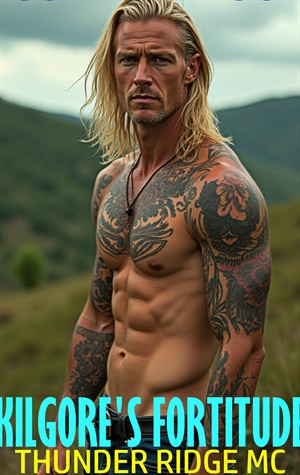
Kilgore's Fortitude (Thunder Ridge MC #30)
Chapter 1
The darkness didn't bother Kilgore anymore.
Hadn't for years. Not since he'd learned that the mountain's belly was just another kind of quiet—the kind that swallowed screams and secrets with equal appetite.
He moved through the abandoned shaft without a light, one hand trailing the timber supports, reading the tunnel the way other men read road signs.
Sixty feet down. Turn left at the collapsed crosscut.
Duck under the sagging header where water had rotted the wood to pulp.
The body over his shoulder had stopped being heavy two miles back.
Some men would've used a light. Would've stumbled and cursed and fought the black like it was an enemy.
Kilgore just walked, his boots finding solid ground by instinct, his breath steady despite the weight and the close air that tasted like iron and old coal.
The mines had taught him patience. Had taught him that panic killed faster than any collapse.
The vertical shaft opened up ahead—he felt it before he saw it, the way the air moved different where the floor dropped away into nothing.
Three hundred feet straight down into black water that hadn't seen daylight since his grandfather's generation.
Things went into that water and they stayed there. The mountain kept its secrets.
Kilgore stopped at the edge, adjusted the weight on his shoulder, and listened.
Nothing. Just the distant drip of groundwater and the settling sounds of a mountain that had been dying since before he was born.
"End of the line," he said to the body. Not because it could hear him. Because the silence down here got heavy if you let it, and a man's voice was the only thing that proved he was still alive.
He rolled the corpse off his shoulder and let gravity do the rest. The sound it made hitting the water far below was like a period at the end of a sentence. Final. Absolute.
Kilgore stood there a moment longer, coal dust grinding between his teeth, the permanent stains in his knuckles invisible in the dark but present all the same.
The man falling into that black water had been a problem—somebody who'd seen something he shouldn't have, talked to people he shouldn't have talked to, threatened things that Thunder Ridge couldn't allow to be threatened.
Now he wasn't a problem anymore.
The climb back up took longer than the descent.
Always did. Gravity was a bitch when you had to fight it, and the shaft's ladder had been suspect twenty years ago.
Kilgore tested each rung before committing his weight, moving with the careful efficiency of a man who'd seen too many brothers trust equipment that companies were too cheap to maintain.
He reached the surface an hour before dawn, pulling himself through the narrow entrance they'd widened just enough to fit a body.
The open air hit his lungs like cold water—clean, pine-sharp, nothing like the dead air below.
He breathed deep, let his eyes adjust to the gray pre-dawn light filtering through the trees, and got to work on the entrance.
Sealing a mine shaft was something they'd taught him when he was eighteen.
Controlled collapse. Enough debris to look natural, enough depth to discourage curious hikers.
He worked fast, setting charges in patterns the mining companies had drilled into him before they'd taken everything and left these mountains hollow.
The explosion was small, contained. Just enough to bring down the weak section of ceiling he'd identified on the way in.
Dust billowed from the entrance, then settled.
Within a year, the forest would finish the job—vines and fallen leaves and the patient work of roots that could split stone given enough time.
Another grave the mountain would keep.
Kilgore walked back to his bike through the pre-dawn gray, his boots leaving tracks in the dew-wet leaves that would disappear by noon.
The Harley was where he'd left it, hidden in a thicket of rhododendron a quarter mile from the shaft entrance.
He ran a hand over the tank—habit, ritual, the closest thing to affection he allowed himself—and threw a leg over.
The engine rumbled to life, breaking the stillness with a growl that echoed off the ridges. Kilgore sat there a moment, letting the vibration settle into his bones, letting the familiar rhythm of the bike remind him which world he belonged to now.
Not the world below. Not anymore.
The ride back to Thunder Ridge territory took him through Letcher County's back roads—routes he could navigate blind, every curve and switchback mapped in his memory from years of running these mountains.
The sun crept over the eastern ridges as he rode, painting the fog gold and pink in the hollers below.
Beautiful, if you had eyes for that kind of thing.
Kilgore didn't. Not today.
Because the route home took him past the Blackwood Number Seven mine. The one that had been closed for eleven years now. The one where the ceiling had come down on Shift Three because the company had ignored six months of warnings about faulty supports.
The one where his brother Danny had died with fifteen other men while executives in offices three states away had calculated that lawsuits were cheaper than repairs.
He didn't slow down as he passed the chain-link fence, the warning signs rusted to illegibility, the entrance sealed with concrete that was already cracking. Didn't speed up either. Just held his line through the curve, eyes forward, hands steady on the grips.
But he looked. He always looked.
The memorial markers were still there—fifteen white crosses that someone kept painting fresh every spring.
Danny's was third from the left. Their father had put it up three months before the black lung finally finished what the mines had started, coughing blood into a handkerchief while he hammered the cross into ground too hard for proper graves.
Four generations of Ruebens men had gone into these mountains. Kilgore was the only one who'd come back out.
His phone buzzed against his chest—the burner he kept for club business, the number only six men in the world had. He pulled off at a wide spot overlooking the valley, killed the engine, and checked the message.
Clean? Hacksaw. The president didn't waste words.
Kilgore typed back with one thumb. Clean. Mountain's keeping another secret.
The response came fast. Church tonight. 8. Something brewing in Perry County.
He didn't ask what. Hacksaw would tell them when he was ready, and Kilgore had learned that questions before their time just made a man look eager.
He pocketed the phone and sat there a while longer, watching the fog burn off the hollers below, the small houses emerging from the mist like ghosts gaining substance.
Mountain families down there. People who worked jobs that would kill them slow, if the jobs existed at all anymore.
People who drank water from wells they didn't know were poisoned, breathed air full of coal dust and chemical runoff, buried their own in cemeteries that grew faster than the towns they served.
His people. Even if he'd never admit it out loud, even if the bitterness had calcified into something that looked like not giving a damn.
Thunder Ridge had given him a purpose when the mines closed and the anger had nowhere to go.
Hacksaw had looked at a fourth-generation miner with hands that knew how to make tunnels and problems disappear, and he'd seen someone useful.
Someone who understood that these mountains had been giving and giving and giving, and the people who took from them never paid the price.
Four years now since he'd traded a hard hat for a cut.
Four years of handling the club's underground work—the jobs that needed someone comfortable in darkness, the problems that required knowledge of where bodies could vanish.
Four years of finding something like brotherhood among men who'd also come back from wars and found nothing waiting but poverty and exploitation.
It wasn't redemption. Kilgore didn't believe in redemption—not for himself, not for the companies that had killed his family, not for a God who'd watched it all happen and done nothing.
But it was purpose. And purpose was enough to get out of bed, enough to keep the bike running, enough to put problems in the ground where they belonged.
The sun cleared the ridge, and Kilgore squinted against the sudden brightness. Time to move. The compound was another hour's ride, and he needed a shower before church—washing the mine dust off was one thing, but showing up to a meeting smelling like underground death was poor form.
He kicked the bike back to life, pulled onto the road, and let the wind strip away the last of the shaft's stillness. The curves came fast and familiar, his body leaning into them without conscious thought, the engine's growl the only conversation he needed.
Behind him, the Blackwood Number Seven grew smaller in his mirrors. Ahead, the road wound through mountains that had been killing his family for a hundred years.
Kilgore rode on.
Whatever Hacksaw had brewing in Perry County would be another problem for Thunder Ridge to handle, another mess requiring men who weren't afraid of getting their hands dirty.
And Kilgore's hands had been dirty since he was eighteen years old, kneeling in a coal seam three miles under the earth, learning that the underground wasn't something to fear.
It was something to use.
He hit the throttle and let the mountain roads carry him home, the rising sun warming his back and the engine's rhythm drowning out everything except the next curve, the next mile, the next job waiting to be done.