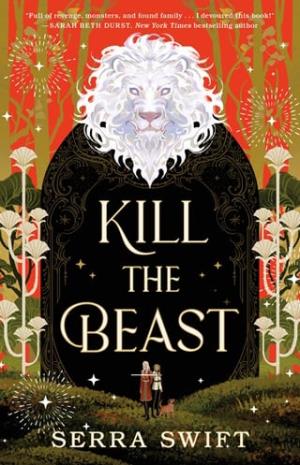
Kill the Beast
Chapter One
CHAPTER
ONE
LYSSA HEFTED THE bloodstained burlap sack and shoved her way through the door of the Kingmaker, tracking sooty slush on the expensive carpet.
She bypassed the line of patrons waiting to be seated, ignoring the ripple of protests that followed in her wake, and made her way to where a pinch-faced headwaiter stood by the entrance to the main dining room.
He glanced her way with an automatic, “I’m sorry, miss, you’ll have to…
” then faltered, his expression landing somewhere between disgust and horror as the sight of her sank in.
The trio of ladies he had been speaking to turned—as well as they could in forty pounds of petticoats, layered skirts, steel-boned corsets, and starched collars, anyway—and glared at her.
Their eyes skated right over the bloody bag in Lyssa’s arms, seeming to find her mud-spattered pants and unkempt braids far more objectionable.
It was too bad no one had ever figured out how to feed off the disdain of the rich; the downtrodden would never go hungry again.
“Servants’ entrance is ’round back,” the headwaiter barked at her before apologizing profusely to the women. “I am dreadfully sorry about that, they never seem to learn…”
Lyssa trudged back out into the frigid air, where her bullmastiff, Brandy, was waiting. His tail started up like a metronome when he saw her.
“Around back, I guess,” she told him, and together they picked their way carefully down the dark side alley, the pavement made treacherous with ice, until they reached the servants’ entrance.
Lyssa rapped on the door and waited until it was thrown open by a harassed-looking cook with a startlingly familiar face.
Richard Miller, one of the city’s innumerable orphans, and a member of Lyssa’s childhood gang.
He was all grown up now—as was she—but she would have recognized that crooked nose splashed with freckles anywhere.
“Dickie?” Lyssa shoved his shoulder with mock playfulness, trying to hide the shock of seeing him again after so long. “I didn’t know you worked here!” If she had, she would have chosen somewhere else to do this.
“Lyssa?!” He wrapped her in an awkward one-armed hug, carefully avoiding the sack she was carrying.
He didn’t seem to notice the gore, or maybe he just didn’t care.
That was cooks for you, completely unfazed when it came to blood and animal parts.
“It’s been an age! The boys and I all wondered what happened to you, after…
” His grin faded. “Listen, I’m really sorry about Eddie. We all were.”
Hearing her brother’s name on someone else’s lips, after more than a decade of mourning him alone, was like an unexpected punch to the gut. She sucked in a sharp breath, suddenly nauseous.
“Thanks, Dickie,” she said, forcing the words past the lump in her throat. “That means a lot. Hey—I’m here to see Mary. She in?”
“Sure, she’s here.” He opened the door wider to let her into the chaos of the kitchens.
Lyssa scraped the soles of her boots on the stoop before stepping into the heat, her face prickling with pain as the feeling returned to her nose.
Brandy followed her inside, raising his snout to sniff appreciatively at all of the tantalizing smells clinging to the air.
“That the same dog?” Dickie asked, shutting the door behind them.
“Same dog.”
He let out a low whistle. “He’s got to be—what? Going on seventeen?”
“Fifteen.” She clapped him on the shoulder. “But counting never was your strong suit, was it?”
Dickie grinned. “Feels like longer since I’ve seen you. How’s that even possible, though? I thought dogs that big … you know.” He thumped his heart with a fist. “Gave out early.”
Lyssa made herself smile back. “He’s like me—hard to kill.
” She wrestled the burlap sack into a more comfortable position, adding a fresh smear to her already-filthy shirt in the process.
The bottom of the bag was blooming with fresh damp, which meant the bundle inside must have soaked through its wrappings again.
She always forgot just how juicy these things were, even weeks after they were dead.
“Can you go get Mary? I’ve got something needs doing, and soon. ”
“Hey, Turnip!” Dickie shouted, cupping his hands around his mouth so that his voice would carry over the clatter of pans and the shouts of the other cooks.
“Go fetch Mary, will you? And hurry up!” One of the kitchen boys saluted him and dashed out.
Dickie turned back to Lyssa, nose wrinkling as he nodded at the sack in her arms. “What is that, anyway?”
Lyssa rocked on her heels. “Beets.”
“Bullshit. You think I don’t know what beets smell like? Come on, tell me what you’re up to. Or is Lyssa Cadogan too good for her old pal Dickie now?”
It took an effort to keep the stupid grin plastered on her face, so that he wouldn’t sense the hurt he had caused.
She hadn’t heard Cadogan in a long, long time.
Not since her brother had died and she’d started using Carnifex instead—which simply meant “butcher” in the old scholar’s tongue.
“You know William Clarke? Of Clarke and Sons?”
Dickie spat on the floor and ground the gob with the toe of his boot. “Yeah, I know him. What do you want with the bastard?”
“He owes me money. And I’m going to make him pay.”
Her old friend eyed her, and she could see the assessment in his gaze.
That skinny-but-vicious child he had known, almost feral in her rage, was now nearing six feet, her biceps straining the fabric of her shirtsleeves, her shoulders broad and thick with muscle.
And then there was the double-barreled percussion pistol at her hip, and the enormous bullmastiff by her side.
“I don’t doubt that for a second,” he said with a wink, though it quickly turned into a grimace when he noticed the rusty brown fluid now dripping from Lyssa’s burlap sack onto the floor. “And afterwards, maybe you could help me mop up.”
The doors from the main dining hall burst open, and Mary came bustling in on the heels of the kitchen boy, her cheeks flushed and her starched cap askew, straw-colored hair escaping in wild curls. Her face brightened when she saw Lyssa.
“Perfect timing. He’s being especially awful today.” She grabbed an empty serving cart and wheeled it over, dodging a cook wrestling with a live chicken and a boy struggling to carry a tray bigger than he was. “Dickie, love, hand me a tablecloth and a covered platter—yes, that big one.”
Lyssa nudged the bottom shelf of the cart with her boot. “Brandy, up.” The bullmastiff obeyed, squeezing his bulk onto the metal shelf with a grunt and curling up with his head on his paws. “Good boy.”
Mary covered the cart with a white cloth, hiding the dog from view, and placed the platter in the center.
Meanwhile, Lyssa set down her burlap sack with a wet squelch, lifting out the bloodstained bundle inside.
The kitchen staff had gathered around in a loose ring by now, and watched her unwrap the severed head of the troll she had killed last week.
Death had only made it slimier and more putrid; it smelled like rotting fish shoved into a barrel of brine and left out in the sun to bake for days.
The treated cloth she had wound around it had been the only thing keeping the worst of the odor at bay, and the staff made a collective sound of disgust as the stench escaped.
Dickie’s face turned the pale gray of workhouse gruel. “What in the Blessed Lady’s name is that?” he asked as Lyssa set the head down on the platter and arranged some lettuce leaves and lemon wedges around it artfully.
Surefire way to spot a city boy: he’d never seen a faerie with his own eyes before.
There was too much iron—poison to their kind—in a place like Warham.
What few of them remained kept to the gnarled forests and ancient lakes, a problem for the shepherds and farmers, mostly.
But with the cities expanding farther into the countryside every year because of industrialists like William Clarke, they would soon be wiped out altogether. Lady willing.
Lyssa was happy to do whatever she could to help … though not for free. Not when the men employing her were almost as rich as the king himself.
“This,” she said, plumping the lettuce around the severed head, “is one of the monsters our grandmothers warned us about.”
“Like … like that thing that killed Eddie?”
There was that punch in the gut again. “No,” she said lightly, covering the head with the platter’s polished silver lid. It did nothing to improve the smell. “This is just a river troll.”
The thing that had killed her brother was far worse—not a faerie, but a monster made by the faeries for the sole purpose of slaughtering humans.
Someone like Dickie wouldn’t know the difference, though, any more than Lyssa would know an oyster fork from a salad fork.
The newspapers these days acted like stray goblins were just as dangerous as something like the Beast of Buxton Fields, giving them all equally sensationalized headlines, and since he hadn’t been there that night …
Well. If he had been, he’d be dead, too, and he still wouldn’t know the difference between a troll and a Hound.
“What are you doing with its head?” he asked.
“She’s the Butcher,” Mary hissed, as though Lyssa would take offence to his ignorance.
Dickie’s brows shot up, and he looked Lyssa over with a new appreciation in his eyes. “The Butcher, huh? Have you heard what the papers say about you?”