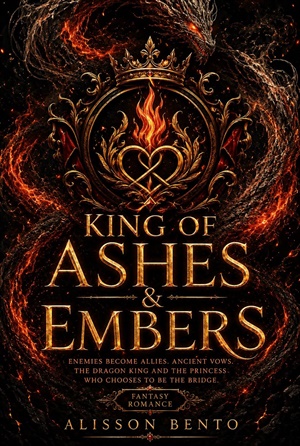
King of Ashes & Embers (Ashes & Crowns)
Chapter 1 — The Crown That Turned to Ash
Elara
I was in the stained glass hall when the first crack became a fracture.
The sound ran across the ceiling like a thread of thunder, and then the colors that had always painted the floor—ruby, sapphire, amber—came crashing down in shards that looked like hardened rain.
Smoke crept in right after, gentle at first, like a timid veil, until it gathered courage and thickened into a curtain.
The palace breathed ash. I breathed with it.
“Elara!” Mira leapt across the hall, the hem of her dress tucked into her belt so she wouldn’t trip.
“The western gates have given way. Drakondar’s messengers are already in the courtyard.
And…” She stopped, trying to swallow words that came faster than breath.
“The lower city… some workshops caught fire.”
My body moved before my mind caught up. I ran down the steps, hands on the cold railing, the smoke following me.
The wind carried burnt steel, oil, and the unmistakable smell of shattered glass. Ariavel had always been music and light.
That night, it sounded like things breaking.
In the courtyard, three figures waited, motionless as stelae. Black armor, capes fastened by brooches shaped like folded wings.
There weren’t many, but they didn’t need to be. Behind them, our remaining guard tried to hold the line.
They weren’t fighting anymore—just keeping chaos from reaching the civilians.
“Princess Elara of Ariavel?” the one in the middle asked. His voice wasn’t harsh. Nor gentle. It was the voice of someone reading the last paragraph of a treaty already decided. “I bring the terms of surrender.”
I swallowed the impulse to respond with a lesson in etiquette. Etiquette doesn’t put out fires.
I walked until I stood two steps away from him. The brooches were finely worked, gold over iron.
Tiny runes outlined the wings—oaths, I thought, remembering the old teachings. In Drakondar, oaths aren’t just words; they’re alloy.
“Speak,” I said.
He opened a long box lined with dark felt. Inside lay a bracelet of grayish metal, lusterless.
It wasn’t silver or steel. It was a sadder mixture, the kind of metal that seems to have forgotten what it came for.
“Cold Ash,” the messenger explained. “It neutralizes harmful magical manifestations. It will be worn by the official representative of Ariavel who enters Drakondar as a political hostage. In exchange, hostilities in the capital cease and we release four hundred captured artisans. We also guarantee water, bread, and bandages for the wounded. The Dragon-King desires order, not carnage.”
The name fell into the courtyard like a stone into a well.
Dragon-King. They said his skin was made of the same basalt that held up the black walls.
They said his eyes saw lies like open wounds. They said many things.
I was only certain of one: our defenses had failed, and people I loved were trapped in workshops, dungeons, temples.
“And if we refuse?” I asked, already knowing.
“We will continue to advance. Your city”—he looked back at the smoke rising from the glassworkers’ street, as if the city were answering for me—“is already tired.”
Mira touched my elbow. A small touch, but whole.
“Elara,” she whispered. “There are children in Dazem’s workshop. He stayed behind trying to douse the furnace.”
I closed the box carefully. The gray metal made no sound.
I did. I sighed.
A sigh that felt much larger than my body.
“I want to see the list of the four hundred,” I said. “Names, trades, ages, where they are.”
“It’s here.” The messenger took a roll of paper from his coat and handed it to me. “Updated an hour ago.”
Mira took the list and ran her finger down the lines, her mouth counting quietly. I followed her eyes, stumbling over familiar names.
Dazem. Gali.
Irven. The young woman who kept accounts better than any notary.
The boy who engraved music in glass. Four hundred was a number.
There, it became people.
The wind shifted and brought a distant roar, deep, that didn’t seem to come from a human throat. Some guards looked up.
The Drakondarian messenger didn’t move.
“Is he here?” I asked, without turning my head.
“The king governs from wherever he must,” he replied. Neither yes nor no. The kind of answer that gives little but doesn’t alter the truth.
I nodded. I removed my right glove.
The night was hot from the fire, but my hand grew hotter when I spoke:
“If I go, you stop at the capital. You send food to the northern shelters and release the artisans held in the makeshift forges on High Street. Today. Now. And no civilian will be touched.”
My palm heated as if an ember were waking beneath the skin. The sensation came sharp and unhurried—and not from the palace fire.
Truth. My nursemaid always said that speaking a whole truth makes the body more alive.
I had never felt like this before.
“The terms are noted,” said the messenger. “You have my word. And when Drakondar gives its word, it keeps it.”
“An oath?” I asked, staring at the winged brooch.
For an instant, something in it—the metal, or the eyes—seemed to glow, as if a rune inside it had drawn breath. He touched the brooch.
“An oath,” he confirmed.
Mira gripped the scroll tight, as if she could bind four hundred names to life with her fist alone.
“You don’t have to do this,” she said, her voice low and scraping. “We can escape through the river stairs. General Varyn still… still holds out in the hills. Maybe…”
I looked at her. Mira had soot on her forehead, a thin line, as if someone had marked her with charcoal so I would never forget.
I didn’t forget.
“Running now would leave those people unprotected,” I replied. “And the city is too big to outrun.”
A local messenger—one of ours—ran into the courtyard, stumbled on a stone, and dropped to his knees with the haste of someone who doesn’t ask his own body for permission.
“Princess! The workshops in the Blue Quarter—the roofs collapsed. They’re taking the glassmakers to the quarries. They said it’s temporary, but…” He choked on the word “temporary,” as if afraid it would bite back.
I reached out with my free hand and touched his shoulder.
“Breathe,” I said. “You did right to come.”
My palm warmed again. Every time I said something I truly believed—breathe, you did right, we’ll get people out of there—the ember inside me responded.
It didn’t burn. It warmed.
“Mira,” I said, without taking my eyes off the messenger. “I want you on the list, cross-checking names against the shelters. If the Drakonians lie, I’ll know. If they tell the truth, all the better for us and ours.”
“And you?” Her eyes shone with rage and unshed tears.
“I’m going with them,” I replied. The words came out clean, like a freshly sharpened blade. “As a political hostage.”
Mira shook her head once. Then again, smaller.
The third came with the resignation of someone who accepts the stone they cannot move but decides to build around it.
“Then you’re not going alone,” she said. “I’m going too. Even if I have to hide in your mule’s saddlebag.”
A laugh almost escaped me. It didn’t.
The night had no room for laughter.
“You come to the gates, then you turn back,” I corrected. “I need you here, with names and eyes. And with courage where I won’t be.”
She clenched her teeth. But she nodded.
Because Mira was never just loyalty. She was always intelligence.
I turned to the Drakonian.
“Bring the bracelet,” I said. “And bring paper. I want to write before I go.”
He raised his hand. A soldier brought a case with ink and a quill.
Another brought the box of Cold Ash. The metal inside caught no reflection from any torch.
It was a solid shadow.
I took the quill. I wrote three letters.
One for the people of Ariavel, simple: “I go so that you may stay.” Another for the Council—or what remained of it—with instructions on water distribution, opening the granaries, stationing musicians in the squares (music organizes fear; I learned that from my mother).
The last, for the artisans and prisoners: “You have not been forgotten. I will return with you, or I will send the whole world after you.”
When I sealed the letters, my hand warmed again. The heat traveled from my wrist to my fingertips.
It didn’t hurt. It was like dipping my fingers in a basin of sunlight.
“Now,” I said.
The messenger took the bracelet from the box. Up close, I saw it wasn’t smooth.
Small, nearly erased runes circled it. I couldn’t read them.
The Ash erases even the alphabet, I thought.
“With your permission,” he said, extending the object.
“With mine,” I replied.
Mira took her place at my side, firm as a pillar.
“If it hurts, you tell me,” she warned, in a tone that would make a king back down.
“If it hurts, it’s because it works,” I replied, and extended my left arm.
The Cold Ash touched my skin. It didn’t burn, didn’t bite.
It only pressed down. As if a thick silence had chosen to live inside me.
The heat in my hands weakened but didn’t die. It was like covering an ember with sand—the fire was still there, just hidden.
“It’s fixed,” said the messenger, locking the clasp with a small key, which he tucked into his belt.
“Tell your king,” I said, facing him, “that I’m going, but I don’t belong to him. I go for my people. For yours too, if you’ll let me. The peace that matters is the one that protects people, not thrones.”
My warm palm answered back. I surveyed the courtyard, the weary guards, the smoke rolling in like a tide.
I wasn't a fire that destroys. I was a kitchen fire: the kind that sustains.
“Your message will be delivered,” he said.
I handed Mira the letters and the list. She strapped everything tight against her chest with a leather band.
“I'll watch every name,” she promised. “If one disappears, I'll raise hell. If two disappear, I'll burn a gate down with my own hands.”
“You don't need to burn anything down,” I replied with a half-smile. “Just count out loud. Sometimes the truth makes more noise than fire.”
My hand warmed. For the first time, I got used to the heat.
We made the final arrangements: a saddled mule, a simple cloak, and a waterskin. I took no court jewels.
I kept only the small milky glass brooch that served as my family's seal, hidden in the cloak's lining. The Cold Ash bracelet was already ornament and insult enough.
Before leaving, I asked for one last thing. Not from the Drakondarians, but from the courtyard, the walls, the wounded ceiling.
“I'll return,” I said in a low voice, so the stones could hear. “With you breathing. With the music back. With the windows painting the floor.”
The stones said nothing. But they didn't collapse.
I walked with the escort to the main gate. The glassmakers and their families had gathered there, huddled among chests and bundles, eyes wide with soot and fear.
I passed slowly among them, touching shoulders, hands, children's heads. With each touch, the warmth grew, subtle, as if my skin were learning the language of courage.
“Trust the fire, not the smoke,” someone whispered, slipping a piece of paper into my hand.
I looked. It was a short note, unsigned.
Firm letters, ink still damp.
Trust the fire, not the smoke.
The words stayed with me. Smoke deceives: it looks like the world ending.
Fire, when tamed, bakes bread. I breathed deep, tucked the note inside my sleeve, and held onto it within me.
“Open the gate,” the messenger said.
The bolts turned, one, two, three times. Ariavel's gate, which had always creaked like an old musician tuning his instrument, opened with a long sigh, as if it too were tired.
Dawn still had no color. The sky was a gray blade waiting for the first drop of light.
We left in silence, boots striking different rhythms on the stones. Behind us, the palace smoldered with fresh wounds; ahead, the road climbed and curved like the spine of an ancient beast.
I walked without looking back for a few steps. Then I looked.
I saw the broken windows, the smoke, the small figures that were my people trying to carry on. I raised my hand.
I don't know if anyone saw. But I saw myself, small on the road and still whole.
The messenger gestured and two riders took the lead. The obsidian bridge would appear after three hills, they said.
I had never crossed it. I'd heard stories that in the middle, you can hear the lava running below, as if the earth had a heart.
“Everything will be fine,” Mira murmured beside me, until she remembered she wasn't coming. She stopped. She gripped my arm hard, then tucked the strength away, like someone sliding a tool back into its sheath. “I'll meet you back on this side, you hear?”
“I hear,” I replied, and the warmth in my hands answered me too. “And I'll hold you to it.”
She hugged me quickly, hard. The smell of smoke and soap.
Then she returned to the city, with the list pressed to her chest like armor.
I continued with the escort. Their silence wasn't a threat now.
It was just duty. I understood duties.
I understood promises.
On the second hill, the wind shifted and brought, once more, the deep roar that had crossed the night. It wasn't close.
But it existed. The sound of something enormous reminding the world it exists.
Dragon-King, I thought, and didn't lower my head.
The road descended a little and climbed again. The sky began to lighten at the edge, a pale thread cutting through the gray.
With my right hand, I touched the note hidden in my sleeve. With my left, I touched the bracelet on my wrist.
Cold on one side. Warm on the other, deep beneath my skin.
I repeated the note's advice until my steps found their rhythm.
Behind me, the city needed me to go. Ahead, Drakondar waited with stone, discipline, and the unknown.
I went.
And dawn, finally, opened its eyes.