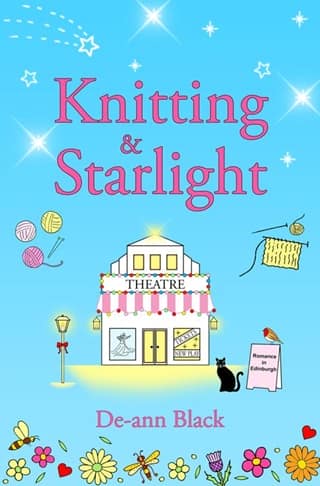
Knitting & Starlight (Music, Dance & Romance #2)
CHAPTER ONE
Edinburgh wore autumn well.
Burnished gold and bronze tones of the trees and greenery in the heart of the Scottish city enhanced the classic architecture. Everything from the historic spires reaching up into the golden glow of the morning sky, to the traditional buildings from past eras, suited the new season.
The city had looked beautiful in the summer, but upped its game in the autumn. The colours were gorgeous.
Mari wore autumn unintentionally.
Dressed in a marigold yellow jumper, that matched the full name she rarely used, and a chestnut cardigan jacket, both garments she’d knitted herself, she’d teamed them with taupe ankle boots and slim–fitting cinnamon cords that flattered her slender but shapely figure.
A strawberry blonde, thirty, with a pale complexion, and green eyes that viewed the world with curiosity, she walked along the narrow cobbled street.
Impressive architecture rose up on both sides of the winding street where an eclectic mix of shops and eateries were nestled into the old–world buildings.
Narrow alleyways, closes and stairways trailed off from the cobbled thoroughfare.
The heart of it interlocked, winding and twirling around until it met up with itself again. It wasn’t giving anyone the runaround, just a tour in shadows and light to intrigue the senses.
Mari had popped out to the nearby grocery shop to buy fresh bread and milk for her breakfast. The world around her had blinked awake an hour before she ventured out of the tiny flat she rented above a craft shop, but was still stretching into life. It was such a lovely autumn morning that she went for a short stroll after buying her groceries, meandering where the cobbled street led her.
Vaguely familiar with the local landscape, a few hidden gems had continued to reveal themselves, like the one she now saw across from her. A theatre?
She frowned against the golden sunlight. There was a theatre hiding in plain sight! She’d never noticed it before, and walked over for a closer look. She spent a fair share of her earnings and time going to shows throughout the city. It was a perk and a privilege of living there.
But this little theatre felt like finding a treasure trove of untapped entertainment, almost on her doorstep. How handy.
It was only when she went over that she saw there was a notice pinned to the inside of the window at the side of the front entrance. The entrance itself could be easily missed as the whole facia blended into the old–fashioned architecture.
Mari read the notice. It was handwritten in an ornate cursive style that just missed being calligraphy. Classy, she thought, and then her heart jolted as she took in the message:
Stage plays wanted. Must be original. Never before performed .
She blinked and reread it. Submissions were wanted! The details of where to send the submissions was nothing more than the theatre’s email address. No person in particular. Just send it and wing it.
Her heart picked up pace. She loved knitting, tholed her aptitude for doing accounts, but what she’d always dreamed of was writing plays and having them performed in the theatre.
Snapping a copy of the notice with her phone, she scurried away before anyone saw her. She needed to think this through. Dare she submit the new play she’d been working on recently? The third and a half one she’d written with a serious view to having them performed.
Maybe.
Her heart still alight with hope and trepidation, she wound her way back to where she was living above a little craft shop, thinking about the theatre and pondering whether to submit her new play, The Shop That Sells Everything , to them.
Since leaving her job at the accountancy firm, she didn’t need to watch the clock, and made her own hours. Working for herself for less than one season, independence still felt shaky, but she was determined to give it a go.
She’d been living in the tiny flat that the craft shop rented out. Accessed via the close at the side of the shop, and then through to an excuse for a garden. Stone steps, where the greenery of potted plants clung on to the metal railings, led to her front door.
Nothing looked straight. Everything from the curve of the steps to the arched close, twisted and wound its way to wherever it was supposed to go.
And Mari was fine with that. It reminded her of her life. She’d taken a bit of an excursion recently from living in one of the quaint coastal towns north of Edinburgh where she’d commuted over the bridge to the city to the accountancy firm, and now lived in the heart of the pretty city. An unexpected small windfall, a handy inheritance from an aunt she barely knew, had allowed her to make the longed–for leap to being self–employed.
In practical terms, she made money from her knitting. Selling items from her website and from the craft shop. She’d started teaching knitting classes at the craft shop too, once a fortnight. Now, by popular demand, once a week. It didn’t pay a lot of money, but it was enough to prevent her dipping into her small savings. And that was fine for now. The ability to manage past clients’ accounts gave her the experience to handle her own finances, frugally, or sensibly as she preferred to think of it.
But the knitting wasn’t her true vocation. Not the one she secretly pinned her hopes and dreams on. Like most dreams, it had remained elusive. However, she’d reached a point in her life when it was sort of now or never.
Wrestling with the door key, jiggling it around until it clicked open, she stepped inside her little bolthole.
Autumn sunlight fought its way through the living room window, cast a glow into the single bedroom across the colourful rugs, and ran out of steam by the time it reached the compact kitchen. Mari flicked the light on.
She’d barely set her groceries down on the kitchen table, when a message came through on her phone from Ivy, the owner of the craft shop:
Do you have the Fair Isle style jumper finished? A customer has ordered it .
Yes, I’ll bring it down .
Grabbing the jumper, along with the hat and scarf she’d knitted, Mari hurried down the stairs, through the close and into the craft shop. The windows looked out on to the busy cobbled street where tourists and local residents went by, many pausing to peer into the pretty shop.
Ivy, fifty and fit, had blond hair shot through with glitter strands, and smiled at Mari.
‘The orders have been coming in for more knitwear now that the summer’s gone. People are thinking about their cosy winter clothes. I’d like to get them posted off today.’
Mari gave Ivy the colourful jumper. ‘And I finished the hat and scarf last night too.’ She handed over the extras.
Evenings spent knitting in the cosy flat were relaxing while being productive. The accommodation was indeed basic, with a living room, bedroom, kitchen and bathroom. The rooms weren’t big enough to swing a squirrel never mind a cat. But the view...the view was magnificent.
In the evenings, the city glittered as if encrusted with fairy diamonds. The architecture was silhouetted against the night skies that Mari loved to gaze at.
And she loved the history of the building. She was living in the present in a property that had changed very little and retained a sense of the past. Crafts had added to the cosy homeliness of the flat, with one of Ivy’s patchwork quilts on the bed, appliqué cushions, ditsy print curtains, a crocheted blanket on the couch, quilted oven mitts, egg cosies and a tea cosy. Ivy’s handiwork was lovely.
Mari had been fortunate to snap up the lease when she’d seen it advertised via the craft shop. As well as selling some of her knitwear in the shop, she helped Ivy with her accounts. It was a win–win for both of them.
Having moved to the city halfway through the summertime, Mari felt she was living her own Midsummer Night’s Dream. Now the chance to submit her new play to the theatre dangled enticingly in her thoughts.
Ivy was delighted with the knitted items, and they had already established a fair share for the garments Mari knitted. Skilled in knitting intricate patterns to a high standard, and working fast, Mari was a valued member of the close–knit crafters supplying Ivy’s shop.
The shop itself was a distraction for Mari. Shelves were stocked with a lovely range of yarn. Rolls of fabric from quilting weight cotton to dressmaking satin, lined part of the shop. There were threads on carousels, embroidery thread to crewel wool. Patterns and kits were popular with customers, along with haberdashery items.
As Ivy carefully folded the jumper to parcel it up for posting, Mari took a moment to chat to her.
‘Do you know anything about the theatre further up the street?’ said Mari. ‘I’ve walked past it numerous times and never even knew it was there.’
‘Oh, it’s easy to walk by without noticing it. I’ve never been to any of their shows. I’m not into the theatre. I like to go to the cinema or watch the telly. But I read about the two businessmen that bought the theatre to restore it back to its former glory. They’re both rich from their wealthy backgrounds and from working in the stock market, and poured their own money into it. That would be a couple of years ago. It’s open now. They had shows on during the summer.’
‘Do the businessmen run the theatre, or do they have a manager for that?’
‘They both run it themselves. They have staff to help. But they’re young men, in their early thirties.’ Ivy smiled. ‘And handsome. I’ve heard that one of them in particular, Huntly. He’s a heartbreaker.’
‘You’ve never met them,’ said Mari.
‘No, but I’ve heard the gossip. The other man, Niall, is a looker too. They’re both single. They date models and actresses. The gossip is they split up with their latest girlfriends earlier this year. Niall’s model girlfriend left to live in New York, and Huntly had a fireworks ending with the actress he was dating outside the theatre.’
‘That sounds so dramatic,’ Mari remarked.
Ivy shrugged. ‘That’s what I heard. But now they’re focused on getting the theatre up and running successfully. I know you love going to the theatre. You should check their website to see what’s on.’
‘I’ll do that,’ Mari confirmed, planning to scour it for any information. ‘Okay, see you later. I’ll pop down around two this afternoon to teach the knitting class.’
‘Great. It’s fully booked. If you continue to draw people in, I’ll have to buy more folding chairs to seat them in the shop.’ Ivy’s comment was half–joking, half earnest.
Smiling, Mari headed out, but felt she was being watched.
Looking across at the shop that was always closed, yet seemed to still be in business, she saw the black cat watching her.
Spindle apparently belonged to the elusive owner, a man who sold curiosities and second–hand specialities, whatever those were. Mari hadn’t an inkling. According to whoever she spoke to, the owner was a tall, thin man, or portly, well–dressed in a three–piece suit complete with a pocket watch, or casual bordering on scruffy. She’d decided it didn’t matter as she’d never seen him. Only his cat. And Spindle had a curious habit of—
She glanced up the street, thinking for a second about the theatre, and when she looked back, the cat had gone.
Shrugging off any thoughts about the cat, she went upstairs to her flat and made herself tea and buttered toast for breakfast. Eating at the comfy seat near the living room window that provided the view she so loved, she mulled over whether to submit her play to the theatre.
She’d had a spark of an idea for a while, brewing in her imagination when she lived in the small coastal town. When she’d moved to Edinburgh, the curious shop opposite had made the sparks ignite into the missing parts of the story, a three–act play, featuring a strange and magical shop, tucked into a cobbled street in a historic part of the city. A shop that sold everything. And a watchful cat with an uncanny knack of disappearing. A fictional story, based mainly on Mari’s imagination with a little intriguing embellishment.
Taking a deep breath, Mari pressed the send button, having decided to take a chance and submit her play to the theatre before heading down to teach the knitting class.
As she sat amid the ladies seated at two long tables, helping them practice everything from how to cast on stitches to knitting in the round, she wondered if anyone at the theatre had opened the attachment and seen her play yet.
The most likely response she told herself was a silent no. Followed by a thanks but no thanks. And she didn’t want to dwell on a reply tearing into her work, though she knew that came with the territory. She’d checked out the theatre’s website that revealed little more than Ivy had told her. They needed to supply more information about their forthcoming shows, pictures from past shows, though they did have a handful.
But there was nothing of note about Huntly or Niall, or any pictures showing how handsome they were. If that was true. But she was inclined to believe Ivy as the craft shop was a hive of gossip as well as creativity.
‘The ladies were hoping you’d demonstrate how you spin your own yarn using a drop spindle,’ Ivy reminded Mari.
‘Oh, yes.’ Mari dug into her knitting bag and pulled out the small wooden drop spindle and a bag filled with soft wool fibres ready for spinning into a strand of yarn.
Fascinated faces circled round as Mari showed them how easy it was to spin their own yarn. ‘You have to practice, to get the feel of it, how to gently tease the wool fibres out so that they spin around the spindle.’
Ivy had ordered in a box of spindles. They were small and inexpensive, intending to let them try using them.
Laughter and smiles filled the craft shop that afternoon as the class members all had a go at spinning yarn. Everyone left with a spindle with their first hand spun piece of yarn around it. Ivy sold the lot. No one wanted to give them back again.
Mari promised to give them another spinning lesson soon. The members promised to practice their new skill in time to then learn how to ply the yarn.
‘That went well,’ Ivy said to Mari as they tidied away the folding tables and chairs.
‘It did. I’m glad they enjoyed it.’
‘You have a knack for teaching knitting. A lot of patience and knowledge to pass on. I think you’ll find you made the right decision to leave your accountancy job to have a go at making a living from knitting and crafts.’
And writing plays, Mari thought, wondering if she’d had a response to her submission. Even an acknowledgement that they’d received it.
Surreptitiously checking her phone for messages, she sighed. Nothing yet.
‘Everything okay, Mari?’ said Ivy.
‘Yes,’ she fibbed.
As customers came into the craft shop, Mari cleared the last of her knitting away, and headed up to her flat.
Filling the kettle for a cup of late afternoon tea before starting to think what she’d make for dinner, she jumped when a message came through on her phone.
And there it was, a reply from Niall at the theatre.
Dear Marigold , it began.
Mari muttered to herself, forgetting that her full name had been on the front page of the play, even though she’d submitted it under Mari. Anyway...
We’d like to discuss your play with you, and would be obliged if you could come to the theatre today. Short notice, but I see you’re living a stone’s throw from the theatre. If you could pop in, we’d like to chat to you .
Mari’s heart thundered like she hadn’t felt in a long time. Not since splitting up with her last boyfriend when he’d ditched her horribly for the new love of his life. That had been over a year now, but the feeling resurfaced. She immediately suppressed it and took a steadying breath.
Grab your bag and go, she urged herself. Forget the tea. Forget everything. Just go.
And so she did.
The relatively short walk up the cobbled street seemed to take ages, and if she hadn’t thought she’d attract unwanted attention, she’d have sprinted there. She could run in these boots. She’d worn the clothes from the morning. They looked tidy, and matched the city, unintentionally.
Her hair hung in soft, silky waves around her shoulders. And she’d refreshed her rose lipstick while locking her front door with the iffy key.
Seeing the theatre now ahead, she tried to calm herself down. They’d sense her nervousness, and it would surely do her no favours in the interview. Or chat. Or whatever they intended.
Come on, she bolstered herself. Don’t waste this chance. And the challenging part of her nature kicked in, like it had done on days when she could’ve cheerfully walked out of the accountancy firm when the pressure was crushing her. But she’d tholed it. Now, she could do this. There had to be something about her play that had piqued their interest. Busy men like them wouldn’t burn their time if they thought it was nonsense.
This thought gave her the steely confidence to walk into the shadowed theatre, leaving the remnants of the fading golden sunlight behind her on the cobbled street.
The atmosphere was a mix of theatres she’d been in. A small foyer and box office where tickets were sold, bookings made, unmanned. The burgundy and gold colour scheme created a rich, traditional decor, with velvet and brocade fabrics adding to the styling. She felt her boots sink into the plush carpeting.
‘Hello,’ she called tentatively through to the office behind the front desk, hoping that someone was there to show her through to meet Niall.
Silence from the foyer area, but then she heard angry voices drifting from the auditorium. Arrows indicated the direction for theatre goers to take, so she followed them, hearing the voices, one man in particular, shouting.
‘On guard!’
And then a clash of swords.