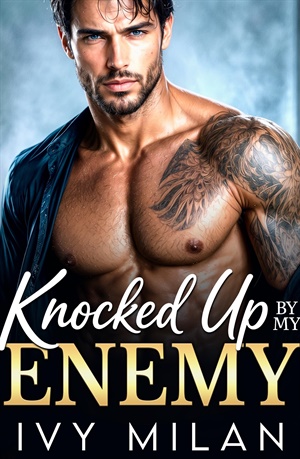
Knocked Up By My Enemy
Chapter 1
Chapter
One
Natasha
Victoria Sterling-Thompson, freshly married, visibly glowing, and currently wielding her new CEO title like a personal weapon, walked into my office three days ago and closed my laptop.
Not figuratively. Not as a metaphor for work-life balance, a concept I, as Chief Financial Officer, have always found theoretically flimsy.
She walked in at four-forty-seven on a Tuesday afternoon, set her very expensive handbag on my conference table, picked up my laptop mid-spreadsheet, and tucked it under her arm with the serene confidence of a woman who has recently been told she is growing a human being and had therefore become entirely untouchable.
"You're turning into furniture, Tasha," she announced. "Very expensive furniture with excellent posture and a hostile relationship with joy, but furniture nonetheless."
"I have seventeen deliverables due Monday," I answer wryly.
"You have seventeen deliverables due Monday and approximately zero social interactions scheduled between now and then.
Which means by Sunday evening you will have cross-referenced those deliverables against each other, finished them all, and begun working on Q3 projections no one has asked you for yet. "
She’d set my laptop on the chair across from me like she was putting a child down for a nap. "There is a charity auction Saturday at the Meridian. You are going. Consider it a medical intervention."
"You're not a doctor, Victoria."
"I'm your best friend and your CEO, and I am currently growing a small person, which I think earns me some latitude." She picked her bag back up, business concluded.
"Wear the black column dress. The one that makes you look like a particularly devastating Russian spy."
I told her I would consider it.
I’m wearing the black column dress.
The Meridian Ballroom at the Chicago Grand is old money doing its most convincing impression of restraint. Said restraint costs approximately four hundred dollars per square foot. The chandeliers wink at each other across the ceiling like they share an inside joke.
I move through the room the way I navigate every boardroom, every gala circuit, every space where wealth arranges itself and calls it culture—cataloging, calibrating, assigning rough net worth to every face.
The woman in Chanel at the east table manages a hedge fund and tips badly at restaurants. The man near the podium owns three professional sports franchises and grips his paddle with the enthusiasm of someone who has never once been told no.
I’m comfortable here the way a soldier is comfortable on a familiar battlefield. The terrain is known; the risks are manageable. I hold my vodka neat and I breathe at a regular rate, trying not to think about Victoria's wedding.
Except that I do, constantly.
Two months ago I stood at the edge of her wedding reception, filled with people who belong to each other in ways I have no filing system for.
Victoria and Alex, orbited each other with the magnetic certainty of newly weds.
Our friends, Melody and Jax, with their daughter Emma in a flower girl dress.
And me, holding champagne I was not tasting, running a quiet internal audit and arriving at an answer I did not request: my carefully constructed life looks, from the outside, remarkably like a very organized prison.
I keep the doors locked; I call it preference.
I have responded the only way my nervous system knows. I work more hours. I sleep fewer. I schedule every minute of every day so the emptiness cannot locate me. So far the strategy is performing adequately.
Victoria's prescription for all of this is apparently one charity auction, so here I stand.
Then the Stradivarius comes up.
The auctioneer's voice shifts register, and the room rearranges its own energy around this single object: a 1713 Stradivarius violin, crafted during what music historians call the golden period.
The years when Stradivari's hands were operating at a frequency the rest of the century could not access. The instrument sits in an open case under one focused light, and something in my chest moves sideways.
I do not play violin. This is genuinely irrelevant.
A Stradivarius exists at the precise intersection of mathematical perfection and emotional surrender.
Every curve of that spruce and maple top is physics.
Every note it can produce is feeling — raw and unscheduled and impossible to contain in a spreadsheet column.
It should not be possible for one object to hold both things simultaneously.
The absolute control of its construction. The absolute freedom of its expression.
I want it with an intensity that bypasses the rational processing center entirely.
The bidding opens at four hundred thousand. My paddle is in the air before I have formally approved the decision.
For three rounds I am alone in this. Then, from the far side of the room, another paddle rises.
I locate him the way you locate a recurring problem in a quarterly report: with irritation, and then with the grudging attention the recurring problem demands.
The first thing I notice about him is that he’s tall. Dark hair with a natural wave. A jaw built on angles that have no business being that well-arranged on one face.
He is wearing a suit constructed for this body - not purchased off a rack anywhere in this zip code - and he has skipped the tie as though he’d wanted to appear careless.
He moves like someone whose body was trained from childhood in something physically demanding. That economical, low-center gravity that competitive athletes carry into adulthood and never fully shake.
He is looking directly at me from across the ballroom, his expression simultaneously entertained and completely serious.
I hate him immediately. I raise my paddle.
He raises his.
I add fifty thousand. He adds fifty thousand. I add a hundred. He matches it without consulting anything, without the faint hesitation most bidders show when the numbers climb past comfortable. When his paddle goes up one final time, he is still looking at me.
The gavel comes down. The Stradivarius belongs to a stranger with exceptional bone structure, and I feel the loss of it in a place I would rather not examine.
I order another vodka at the bar.
"You wanted that violin badly."
His voice arrives at my left shoulder. Low and deliberate, British English with something older underneath it; an accent that surfaces in certain vowels like water showing through ice.
I give it three full seconds before I turn.
That is the correct amount of time to communicate that his arrival has not scrambled my equilibrium.
It has absolutely scrambled my equilibrium.
"I don't discuss auction results with the opposing bidder," I say, keeping my tone perfectly flat.
"That's a remarkably elegant way of not answering." He settles beside me at the bar. I study him at close range and note that he is, unfortunately, significantly more compelling up close, which is the opposite of how this usually works.
He catches the bartender's attention. "Vodka neat. Same as her."
I raised an eyebrow. "Lucky guess."
"Methodical observation," he corrects smoothly, accepting his drink. "You've held the same glass for forty-five minutes. You don't nurse it, you don't mingle, and you only take a sip when the room gets loud enough to bore you."
A small, sharp prickle of irritation flares under my ribs. "You've been watching me."
"Noticing," he says, the corner of his mouth lifting just enough to show a hint of a dimple. "There's a difference."
"Enlighten me."
"Watching implies I had the option to look away." He takes a slow swallow of his drink, his eyes never leaving mine. "I'm not convinced I did."
This is the part where I deploy one of my conversational off-ramps. A polite smile, a murmured excuse, a practiced disappearance into the middle distance. I keep several filed away for exactly this type of scenario.
Instead, I look at his hands. "Do you even play? The violin?"
"No." He turns slightly toward me. "You?"
"Piano."
"But you bid on a Stradivarius." He tilted his head, his gaze dropping to the tight set of my jaw before rising back to my eyes. "Why?"
He asks it without the performative curiosity people usually bring to small talk - the kind where the question is just a vehicle for their own follow-up anecdote. He asks it like he’s genuinely interested in the answer.
I open my mouth. The prepared answer is there—alternative asset acquisition, portfolio diversification, cultural investment. Clean and justifiable and completely false.
"Because some things should exist outside of spreadsheets," I hear myself say instead.
He goes very still. The kind of stillness that is the presence of focused attention, every bit of it trained in my direction.
He looks at me like I have just said the most interesting sentence he has heard in twelve months.
The unguarded quality of that look does something skittering beneath my composure.
"That is the only honest thing anyone has said in this room tonight," he says quietly.
"It's the only honest thing I've said in approximately a month."
"What changed a month ago?"
I swallow a small amount of vodka. "My best friend got married. She's having a baby. She's nauseously happy." I pause. "It's irritating."
He laughs. Not a curated social laugh pitched at the correct volume for a charity event. A real one, low and sudden, surprised out of him. "You're irritated that your best friend is happy."
"I'm irritated that her happiness has made my very efficient life look like a coping mechanism from the outside." I level him a look. "You don't have clearance to analyze that."
"I'm not analyzing." He angles further toward me, his shoulder almost brushing mine. "I'm recognizing."
"That's worse," I say.
"Probably," he agrees, and does not look even slightly sorry about it.
What happens next is the kind of conversation I had stopped believing existed outside of conference rooms. Sharp and recursive and genuinely surprising in its turns.
We disagree about whether mathematical beauty and emotional beauty are fundamentally the same phenomenon.
He argues they are. He is wrong. I explain why he is wrong with the directness I normally reserve for budget reviews, and he listens without flinching and then produces a counter-argument so structurally sound that I am briefly, furiously impressed.
We argue about Shostakovich. He is also wrong about Shostakovich.
"You are wrong," I tell him pleasantly, "and I say that with the full conviction of someone who spent four years at the Royal Conservatoire."
"You spent four years at the Royal Conservatoire and ended up in finance."
"Finance is applied mathematics. Mathematics is the architecture of everything that exists. It is not a consolation prize."
He considers this with his scotch halfway to his mouth. "Fair," he says, and something about the fact that he can simply concede a point without engineering a retreat sends something uncurling low in my chest.
I realize, with a sudden jolt of panic, that I still don’t know his name.
He hasn't offered it, and I haven't asked.
The omission feels intentional now—a shared, unwritten rule.
To exchange names would be to let the real world into this pleasant bubble, and neither of us seems in a hurry to burst it.
At some point past ten o'clock, he leans in and says, "I would like to continue this argument," he murmurs, his gaze dropping to my lips before rising back to my eyes. "Somewhere that isn't a charity auction."
My better judgment scrambles to pull up its usual convincing presentation on why this is a terrible, reckless idea. I ignore it.
"Alright," I say.