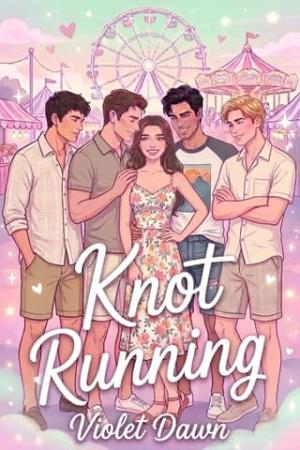
Knot Running (The Sweetwater Valley #1)
Chapter 1
Lola
The highway doesn’t forgive hesitation. I learned that about three states back, somewhere between the moment my name hit the news bulletins and the moment I stopped checking my phone.
Hesitation is how they catch you. Hesitation is how you end up on the side of the road with your hands behind your back and someone else’s story written all over your record.
So I don’t hesitate.
I drive.
The sun is bleeding out slowly across the horizon like it’s in no particular hurry to die.
Golden light smears itself across the cracked dash of my borrowed car—borrowed being a generous word for taken from someone who owed me and wasn’t man enough to pay up—and I’ve got the windows down because the AC gave out somewhere in New Mexico and I’ve stopped being precious about things like comfort.
The air changes when I cross into the valley.
I notice it before I notice anything else. It shifts. It’s not cooler, but softer, like the pressure drops by a fraction and the world exhales. It smells like river water and pine resin and something underneath that I don’t have a word for yet. Something living. Something layered.
I roll my shoulders and tell myself it’s just the elevation.
The road narrows. Two lanes become one and a half, the white line faded to a suggestion, and the trees press in closer on either side before opening suddenly, dramatically, like a curtain being pulled back by someone with a flair for the theatrical. And there it is.
Sweetwater Valley.
It’s ridiculous, is my first thought. A town that looks like someone described quaint to an architect who’d never seen quaint but was really going to give it a go.
Main Street is actual cobblestone—cobblestone, in this century—lined with storefronts that still have hand-painted signs and window boxes full of brightly colored flowers.
There’s a clock tower. An actual clock tower, lit from below, casting warm gold up into the darkening sky.
My second thought is: nobody looks for you in a place like this.
That’s the thought I’m keeping.
I ease off the accelerator without meaning to.
The engine drops from its anxious hum to something quieter, and the car drifts down the main drag at the speed of someone who belongs here, who is in no hurry, who did not spend the last seventy-two hours white-knuckling a steering wheel across four state lines because her supposed best friend decided to torch her life for a payout.
Don’t.
I press the thought flat before it can grow legs.
Amber is a problem I don’t have the bandwidth for right now.
Amber is a locked box on a high shelf, and I will get to her.
I will absolutely, categorically, with great personal satisfaction get to her.
But not tonight. Tonight I need gas, food that isn’t a gas station hot dog, and somewhere to park that isn’t a rest stop with security cameras positioned at the only exit.
The town is… busy?
That surprises me. I’d expected quiet. The deep, blanketed quiet of a place where everyone’s inside by eight and nothing happens after sundown.
But there are people out. A lot of people.
Strung lights arc between buildings down a side street, and I can see the skeletal frames of stalls being assembled in what looks like a park or town square.
There’s scaffolding and canvas and cheerful, organized chaos that means something’s being built. A festival, maybe. A market?
A carnival.
As I roll past the turnoff, I can see it more clearly.
Rides are in various stages of assembly, the skeletal arm of a Ferris wheel is reaching up against the indigo sky, a row of what will clearly be food stalls judging by the industrial equipment being wheeled past by a teenager who looks deeply unimpressed to be doing it.
Strings of globe lights hang between poles, not yet switched on, but catching the last of the dusk in little blank circles of glass.
The whole street smells like fried sugar and sawdust and river water.
I’ve always had a complicated relationship with carnivals. With anything that promises warmth and light and an atmosphere that fosters safety and happiness. I know too much about what holds up the backdrops.
I keep driving.
Past the clock tower, past a café with its lights still on and someone moving behind the glass—the warm amber of it so aggressively home that I look away—past a hardware store and a bookshop and a pub that sounds lived in rather than rowdy.
Past people on porches and people on foot and a dog sitting regally on the steps of what might be a church, judging every passing car with equal disdain.
Past the end of Main Street, where the cobblestones give way to regular asphalt, the buildings thin out, and the river appears again through a break in the trees, dark and glittering.
I should keep going. That’s the logical move.
The smart move. A town this small is a trap of a different kind.
There’s no anonymity, no crowd to dissolve into, everyone knows everyone and a strange woman in a beat-up car with out-of-state plates is the most interesting thing to happen all week.
You don’t hide in a place like Sweetwater Valley.
You get noticed. The police might not come looking in a place like this, but someone could tattle to them.
My gas light comes on. I stare at it for a long moment. The audacity of the orange glow of it in the dimming interior, steady and unimpressed.
“Yeah,” I say out loud, to no one. “I know.”
I turn around.
The unease starts before I’m back on Main Street, which I refuse to give credit to because I’ve been awake for going on thirty hours and my nervous system is running on fumes and unprocessed fury.
It’s nothing. It’s road fatigue and hunger and the crawling alertness that sets in when you’ve been watching your side mirrors for three days straight.
It’s not the town. Except, it’s something about the town, something I can’t put a name to. A pressure in the air that wasn’t there before. It’s like being watched, but not the bad kind. Not the sharp-edged surveillance of someone looking for something. This is different. Layered.
Territorial is the word that surfaces, and I dismiss it immediately because it makes no sense.
I pull into the gas station at the edge of town, the one with two pumps and a hand-written sign that says PAY INSIDE—ELSIE DOESN’T TRUST THE MACHINE ANYMORE. Something about that is so absurd and so homely that the coil of tension behind my sternum loosens a fraction.
Just a fraction.
I fill the tank. I pay inside with cash. Elsie, who is about seventy and has opinions about the weather and offers them freely, turns out to be the proprietor, the cashier, and apparently the self-appointed town greeter.
By the time I’ve bought a bottle of water and a packet of crackers I know about the carnival (the town’s been running it for sixty years), the café down the road (Tristan’s, the best pastries in the county, and Elsie is not being paid to say that), and the fact that the old Harrow place on the edge of town has rooms to let.
Doris Harrow is a reasonable woman if you don’t make noise after ten, so I’m told.
“You passing through?” Elsie asks, not unkindly. Her eyes are sharp behind very round glasses, doing an inventory she’s pretending isn’t an inventory.
“Not sure yet,” I say. It’s the most honest thing I’ve said in four days.
She gives me a look that screams she has thoughts about that and has decided to keep them to herself. “The carnival opens soon. Town gets full fast. You want that room, you should decide tonight.”
I take my change and my crackers and I walk back out into the cooling air.
Here’s the thing about running. Everyone thinks it’s about fear.
They imagine someone running scared. Hunched, desperate, always looking back.
True victim energy. I’ve seen enough true crime shows to know the template they’re building for me right now: young woman, impulsive, brazen, criminal, fled the scene.
The story writes itself, and it writes me small.
Writes me as someone who broke under pressure and bolted.
Fled the scene.
I was set up. There’s a difference, and it is the difference between who I am and who they’ve decided to put in the papers.
Amber walked me through that bank like I was a co-conspirator and I had no idea—absolutely none—and by the time I understood what was happening my face was on three cameras and her voice was in my ear telling me to run, Lola, just run like she was saving me, like she was the one looking out for me.
I have thought, in precise and minute detail, about what I will do to Amber when I find her. It keeps me warm on cold nights.
The point is: I am not running scared. I am running strategically.
There is a difference, and the difference matters here too, because one of those versions of me collapses in a gas station bathroom and cries until she can’t breathe, and the other version gets back in the car, thinks three moves ahead, and chooses the next position deliberately.
I choose deliberately.
I observe the town.
Main Street with its insane cobblestones.
The Ferris wheel skeleton against a sky that’s gone full dark now, the stars coming out twinkly and clear the way they only do far from city lights.
The glow of the carnival stalls in progress.
The lit window of the café across the road, and through it the silhouette of someone moving, easy and unhurried, the way people move when they’re in a space that belongs to them.
That pressure in the air again. That watched-not-watched feeling.
I breathe in. And there it is, that underneath smell, the layered living thing I noticed on the way in. It’s warmer now. More present. Like the town has a pulse and it’s just started to notice mine.
Thirty-six hours, I tell myself. Maybe forty-eight.
Long enough to sleep in a real bed and eat something that requires a fork, and let the noise die down before I work out my next move.
The framing is airtight right now because I don’t have anything to fight it with.
There’s no evidence, no allies, no access to anything useful while I’m burning gas across state lines.
I need to stop moving long enough to think.
In Sweetwater Valley. Nobody looks for you in a place like this.
I pull out my phone—a new burner, bought for cash at a truck stop—and search for the Harrow place. The listing is ancient, clearly made by someone’s nephew, but the address is there.
I type the address into my maps.
Then I put the car in drive.
I’m not staying because I’m out of options.
I’m not staying because I’m scared, or tired, or because some seventy-year-old gas station attendant gave me the eyes.
I’m staying because I’ve looked at the board and this is the best position available, and I’m going to use it.
When I’m done using it I’m going to leave on my own timeline, in my own way, with the next move already in motion.
Those are my terms.
The only terms I’m operating under.
I find the Harrow place. Doris is, indeed, a reasonable woman. The room is small and clean and smells like pine and old paper. There’s a window that looks out over a back garden going gently wild at the edges.
I drop my bag on the floor.
I sit on the bed.
I am going to figure out what Amber did and how she did it and I am going to dismantle it, piece by piece, until my name is clean and hers is the one in the papers where it belongs.
Just…
Not tonight.
Tonight I’m in Sweetwater Valley. Temporarily. Strategically. On my own terms.
And whatever this town is—whatever it’s doing to the air, to the back of my neck, to that low hum behind my sternum—I’m not running from it.
I’m not.
I’m not running from anything anymore.
Do you hear me, universe? I’m done running.
Done.