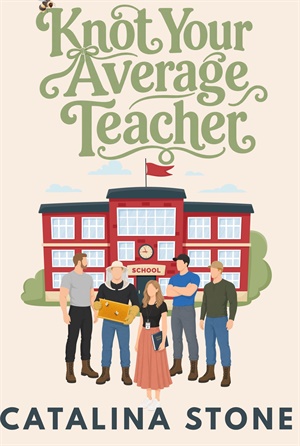
Knot Your Average Teacher (Magnolia Hollow Omegaverse #2)
Chapter 1
Chapter One
WILLA
Here is a thing I know about Family Introduction Night that the rest of the staff has never once believed: it is my favorite evening of the whole school year.
Better than the last day. Better than the holiday concert, where somebody's little brother always cries. Better, even, than the April morning the dogwood outside my window gives up all at once and blooms like it cannot stand to wait through one more cold week.
I love it because for two hours my second-grade classroom fills up with the people who made my second-graders, and I get to watch the math of a child resolve itself in front of me.
Oh, I think, when Davey Pruett's daddy laughs that exact rolling laugh.
There you are. That is where the laugh comes from.
I have taught in this town for nine years, in this same corner room with the reading nook and the good east light, and by now I know the families the way I know the cracks in the parking lot.
I know whose mama is going through it. I know whose daddy coaches and whose daddy means to and doesn't. I know which packs come as four and stand close, the way bonded alphas stand, a quiet wall of shoulders around the small person they have decided is theirs.
I know all of it, and I love all of it, and I have been told by more than one person that I should mind my own business more. I always agree, warmly, and then I never do.
So I am set up and ready by six. Cider on the back table, because the PTA gave me a budget and a cider machine is what I did with it.
Every child's self-portrait taped at exactly child-height along the windows, because the whole point of the night is for a kid to grab a grown-up by the hand and drag them to the wall and say, that one, that's me.
The cursive chart. The class hamster, Sir Reginald, asleep and useless and beloved.
Me in my good cardigan with my hair behaving, more or less, standing by my door the way I always stand: propped wide open with the rubber doorstop I have used since my first year.
A closed classroom door tells a parent to wait.
An open one tells them to come on in, and I have always, always wanted them to come on in.
And they do. The Pruetts. The Hutchins twins and their three exhausted, delighted parents.
Miss Carlisle from the front office, here for her grandbaby, who reports that the new copier is a gift from a vengeful God.
I hug people I am not technically supposed to hug.
I admire forty self-portraits with total sincerity, which is easy, because they are the best art being made anywhere in America right now and nobody can tell me different.
And the whole time, under the cider and the cursive and the noise, I am keeping one eye on the door for a family that is not here yet.
Cooper Mercer turned up in my class three weeks ago, on a Tuesday, holding a brand-new backpack with the tags still on the zipper. Somebody had clearly bought it in a hurry and with love and no idea what an eight-year-old considers cool.
He is quiet in a way that is not shyness.
I know shyness; shyness wears off by the second week, with snacks and patience.
This is something else. This is a child being careful.
He does his work and he does it well and he says please and thank you, and he draws bees in the margins of everything, careful little bees with too many legs, a whole humming swarm of them crowding the edges of his spelling and his subtraction.
When I asked him about the bees he looked at me for a long moment, deciding something, the way you watch a grown person decide whether to tell you the truth. Then he said, "We have a farm now. With hives."
Now. We have a farm now. A word doing the work of a whole story he was not going to tell me, and I did not push, because the first rule of a careful child is you do not go reaching into the careful.
What I know about Cooper Mercer, I know mostly from the form.
He lives with four uncles. He came to live with them recently.
The line for parents is blank, and the line for guardian has four names on it in a small, even hand.
And there is a phrase on the emergency contact sheet, written by whoever filled it out, that I have not been able to stop turning over since: in the event of an emergency, any of us, day or night, it does not matter which.
Any of us. Day or night. It does not matter which. I have read ten thousand emergency forms and I have never read one that sounded like a vow.
So I have been watching that door. And at twenty past six, when the room is full and warm and loud and I have half decided they are not coming, the air changes.
I cannot tell you a better word for it. The air changes.
The way it does before weather, when the pressure drops and the leaves all turn their pale sides up at once and the dog goes and lies down under the porch.
I am mid-sentence with Davey Pruett's daddy about Davey's reading, and I lose the sentence, clean, the back of my neck gone warm.
I turn toward my propped-open door, and there they are.
Four of them, filling the doorway, and Cooper out in front like a small brave figurehead.
The room notices. Of course it does; a bonded pack in a doorway is a thing a Georgia gym full of nosy parents is going to notice.
But I notice differently, the way you catch your own name in another room, and I have one second of total clarity in which I think, with no idea where the thought comes from: oh, there you are.
The same exact thing I think about Davey's daddy's laugh.
There you are. And then I lose the second, because Cooper is walking toward me, and a careful child crossing a room to bring you his people is not a thing you fumble.
“Miss Tate,” Cooper says. “These are my uncles.”
“Well, I have been hoping to meet them,” I say, and I crouch down to his level first, because the night belongs to him, not them, and his self-portrait is two feet to my left and I am not above stagecraft.
“But I think there is somebody at this school you should introduce me to even sooner.” I tip my head at the wall.
Cooper’s whole face does a thing it has not done in three weeks, which is open. “That’s me,” he says, pointing. “I did the bees.”
He has, in fact, done the bees. In a room of forty self-portraits, Cooper Mercer has drawn a small brown-haired boy standing in a yellow field, and the air around the boy is full of his careful crowded bees, dozens of them, and the boy in the picture is smiling, which the boy in my classroom mostly does not, and I have to look at the cursive chart for a second and breathe before I trust my voice.
“That is the finest swarm I have seen all year,” I tell him, and it is true, and when I stand back up the four of them are arranged in front of me and the introductions begin, and I am a professional, and I do my job.
The big one shakes my hand first. “Asa,” he says.
One word, like setting down something heavy.
He is broad and still and he holds himself the way you hold yourself when you have decided that if you stand steady enough nothing else can fall.
His hand is warm and dry and there is a thing coming off him, off all of them but off him most, something I have no business cataloguing during a parent conference, something low and warm, beeswax and the good cold smoke of a fire banked for the night, and my own breath snags on it before I get a hand on myself.
Beekeepers, I tell myself, briskly, internally.
They keep bees. They are going to smell like beeswax.
It is the least mysterious thing in the world.
I believe this for almost a full second.
“Thank you for everything you’ve done for him,” Asa says, and there is nothing behind it I can flatter myself about, only the flat enormous sincerity of a tired man, but his eyes go to Cooper and then to the self-portrait on my wall and then, briefly, somewhere else entirely, somewhere with no door in this room, before he hauls them back.
I know that look. I have watched grief wear a hundred faces in this town and that is one of its quietest, the one that goes looking around an ordinary room for a person who is not in it.
“This is Beau,” Asa says, and the second one steps up, and the second one is a charmer.
I know charmers. I am, on a good day, one myself.
Beau Mercer takes my hand and grins and says, “So you’re the famous Miss Tate.
Coop talks about you. I’m gonna level with you, Miss Tate, ninety percent of what I know about second grade I learned this week from a man who is eight,” and the parents nearest us laugh, and Miss Carlisle laughs, and Beau works the half of my classroom within earshot the way a good musician works a small room, easy, warm, generous with it.
And he is good. He is so good that it takes me a beat to see the seam, and then I see it, because I have sewn that exact seam into myself a thousand times: the smile that arrives a half-second before it is needed and stays a half-second too long.
The charm doing a job. Holding a door shut by standing in front of it and being delightful.
Oh, I think, more quietly this time. You too.
You’re tired too. You’re just better dressed about it.
“And this is Sam,” Beau says, with a hand on the shoulder of the third, and the third one has a folder.