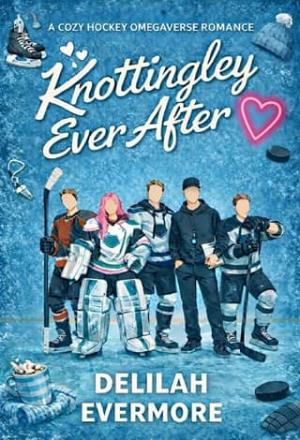
Knottingley Ever After (Pucking Knot League #1)
Prologue
~IRIS~
Five Years Earlier…
The puck rockets toward me like a small black sin, and I drop to my knees.
Pads slam ice. Glove snaps shut. Leather, rubber, and the dull thump of vulcanized whatever-the-hell-pucks-are-made-of biting into the palm of my catcher.
The arena holds its breath.
So do I.
The world narrows to the smell of cold; that scorched, mineral bite of fresh ice that lives in the back of my throat like spearmint and metal, and the burn of frozen sweat plastered to my forehead beneath the helmet.
Then the siren screams.
It detonates above the rink, a shrieking, glorious wail that means overtime is dead, the puck didn’t cross, we did the impossible.
Knottingley.
Tiny, half-frozen, perpetually overlooked Knottingley.
We just took down a bigger league team.
The crowd loses its collective mind. Sound crashes against the glass in a tidal wave I feel through the soles of my skates, vibrating up through my shin pads into my chest cavity, where my heart has decided it’s a snare drum auditioning for a hardcore band.
I stay frozen for a beat longer because if I move, I might cry, and Iris O’Shea does not cry on national broadcasts.
Iris O’Shea cackles, chirps, throws elbows, and occasionally bites if a defenseman gets a little too generous with his stick. She does not weep into her chest protector during a televised game.
I yank my mask up.
Cold air slaps me. Sweet, sharp, beautiful Yorkshire arena cold, with that under-layer of damp concrete and old popcorn grease from the snack stand that I have loved since I was four years old and my dad first dragged me to a peewee scrimmage.
“OFFICIAL!” someone roars from the bench.
Then they hit me.
The whole bloody team.
A wall of pale blue and white jerseys collides with my crease like an avalanche dressed in laundry detergent and adrenaline. I get tackled, hugged, slapped, and very nearly motorboated by Pete, our right wing, who screams “O’SHEA! O’SHEA! O’SHEA!” directly into my helmet vent.
“Pete, your breath smells like the inside of a hockey bag and a bad decision—”
“IRIS, WE’RE GOING TO THE FUCKING SHOW!”
“Not if you give me second-hand chlamydia from your mouth first!”
He cackles, picks me up by the chest protector, and shakes me like a Polaroid.
The smell of him is a full sensory assault: stale Lynx body spray, peppermint Gatorade, the specific dampness of synthetic under jersey baked in his own glory, and that yeasty, sour-sweet locker-room funk that no detergent has ever conquered.
It’s home.
…and also disgusting.
I love it.
God, I fucking love this.
“Put me down before I knee your reproductive future into oblivion,” I warn, half-laughing, my voice cracked from screaming through three periods plus overtime.
Pete obliges, mostly because Lonnie shoves him sideways and slings a sweaty arm around my neck.
“My GOALIE,” Lonnie hollers, ripping his helmet off so his curls explode upward like a startled poodle. “MY OMEGA GOALIE WHO HITS LIKE THE DEVIL HIMSELF.”
“Lonnie, no.”
“Lonnie, yes,” he counters, undeterred. “She caught a slapshot at the buzzer. With her face, basically. There’s a poem in here somewhere—”
“There is not a poem in here, you absolute himbo.”
“I’m gonna write it. In Sharpie. On the locker room ceiling. Ode to the Goalie Who Saved Our Asses.”
I laugh and feel the laugh catch on something in my chest.
Something hot and a little bit terrifying that tastes like everything I’ve ever wanted.
The team rolls toward the bench in a riotous blue-and-white tide, sticks raised, helmets tossed onto the ice like graduation caps thrown by people who hate physics. The puck bunny section, predictably, is shrieking. Somebody’s trying to start a chant. Somebody else is crying.
Coach Daniels—our assistant, balding and beloved—is wiping his eyes with the back of his wrist and pretending he has “arena allergies.”
Sure, Coach Daniels.
I skate slowly toward center ice, helmet tucked under my arm now, the gummy strap dangling.
My braid has come half-loose, and pink-tinted strands stick to my temples in tiny damp commas.
My lip balm has worn off completely; I can taste blood from where my mouth guard nicked the inside of my cheek in the second period.
I run my tongue over it, tasting copper, peppermint gum, and the ghost of the frosted strawberry protein shake I chugged before warmups.
The cameras find me before my coach does.
Naturally.
A bouquet of microphones blossoms in front of me like aggressive flowers, foam tips bobbing six inches from my mouth.
Producer types in headsets, gesticulating from the boards.
Some intern with a clipboard is making a please-talk-to-us face that I have personally perfected on certain professors, so I respect his hustle.
“Iris! Iris, congratulations—how does this feel?”
“Iris, talk us through that last save—”
“Iris, where do you see yourself five years from now?”
I push my glove against the boards to keep from skating off out of sheer self-preservation instinct.
Be charming, I order myself. Be quotable. Be the version of you that gets put on highlight reels and not the version that calls reporters Muppets on live television.
“Uh, hey,” I say, and somewhere in the universe a publicist is already wincing. I clear my throat. “That last save was just—training, I guess. Coach has us doing wall drills until our quads file restraining orders, so. Muscle memory.” I grin. “And a little bit of spite.”
A ripple of laughter.
Spite plays well on camera, apparently.
“As for five years from now,” I continue, twirling my mask’s strap around my finger because my hands need something to do, “honestly? That depends on my coach.”
A few of the reporters exchange glances.
“Look,” I say, shrugging, “Declan—Coach O’Rourke—is the reason any of this happened.
” I tip my chin toward the bench, even though I can’t see him through the throng.
“The man has been engineering this since I was a punk teenager with more attitude than save percentage. So whatever he’s got up his sleeve, I’m wearing it.
” I flash my teeth. “Whether I look good in it or not.”
That gets actual laughter.
The clipboard intern looks personally redeemed.
“So you’re saying we’ll be seeing you in the big leagues soon?”
“I’m saying you’ll be seeing me wherever Declan tells me to be next.” I shrug one shoulder, breezy. “He’s got the map. I just skate the route.”
“Iris, what would you say to all the young Omegas watching tonight who—”
And there it is. The Omega Question.
There’s always an Omega question.
My smile doesn’t move because I’ve been training that smile for as long as I’ve been training my glove side.
“I’d say,” I answer sweetly, “that if some twiggy little Omega from a town nobody can pronounce can stand on her head between two pipes long enough to take down a team three divisions up, you can probably do whatever the hell scary thing you’ve been told you can’t.
” I wink at the camera. “Now, please excuse me. I’m going to go drink something that will horrify my nutritionist.”
The reporters cackle. One of them claps.
Someone behind a camera literally says “print that.”
I drift back toward the bench, my skates dragging little curls of shaved white in their wake, and that’s when I see him.
Declan.
He’s standing at the boards near the tunnel, half in shadow, half in the cold mercury wash of the overhead rigging.
He is not smiling.
The hairs on the back of my neck stand up in a way that has nothing to do with arena temperature.
My coach is six-foot-four of disciplined Irish granite, and on a normal day, post-victory, he wears a small, locked-down smirk—the kind that says, Yes, you did well, do not let it go to your head. He saves the real smile for me, sometimes, when nobody else is looking.
A flicker. A twitch of the jaw.
A particular gleam behind those emerald eyes that I have spent six years cataloguing like an obsessive amateur scientist.
Today: nothing.
His jaw is set. His shoulders are squared.
Every muscle along the long line of his throat is pulled taut as catgut over a violin bridge.
And the man he’s talking to is the reason why.
I don’t recognize him.
That, by itself, is interesting. I know everyone’s coach, scout, agent, and dental hygienist; you spend enough years on a small-town team that punches above its weight, you become a low-grade conspiracy theorist about everyone in the building.
This guy is new.
Pressed charcoal suit. Slate-gray tie. Cufflinks that catch the rink light in cold, surgical little flashes.
He’s older—my dad’s age, maybe—but his hair is razor-cut and dyed an unconvincing shade of midnight.
His mouth is doing a thing that is technically a smile but reads, to anyone with even passable predator-detection skills, as exposed teeth.
His eyes are colorless.
Or rather, they’re a color the language hasn’t named yet. Some uncomfortable midway between gunmetal and seawater under cloud cover.
He smells, even from twenty feet away, wrong.
I can’t place it.
Omega senses are fussy little things, and mine are buried under the layered fug of locker-room stink and adrenaline, but I catch a whiff of something like wet linen left in a basement, copper pennies, and faded expensive cologne attempting to mask both.
A predator scent that someone has tried to dress up in church clothes.
I push off and glide closer.
Declan’s gaze flicks to me. Stop, his look says. Then, smoother, more controlled: Slow down.
I do neither.
Because Iris O’Shea is a goalie, not a golden retriever.
I coast right up to the boards and rest my glove on the railing, helmet still tucked under my arm. “Coach.”
Declan’s mouth opens.
The suit gets there first.
“And here she is,” he says, and his voice is silken and a touch nasal. The kind of voice that sells timeshares to grieving widows. He extends a hand, palm down, in a half-gesture-half-blessing. “Miss O’Shea. A pleasure.”
I don’t take his hand.