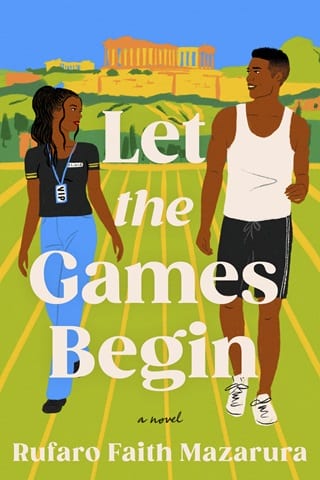
Let the Games Begin
1. Zeke
FOUR DAYS BEFORE THE OPENING CEREMONY
Ezekiel Moyo had never looked more handsome than he did on the front cover of the August edition of GQ. It was their annual sports issue and since Ezekiel (or Zeke as everyone called him) was Great Britain’s surest hope for a gold medal at this summer’s Olympics, it was only right for him to be the face of the magazine.
Zeke had spent the whole photo shoot charming everyone on set. He’d chatted to the hairstylist about his Saturday job at a salon and complimented the caterer on how good the food she’d cooked was. “Auntie,” he’d begun—because he’d been raised to call every older Black woman Auntie—“this is the best oxtail stew I’ve ever had, and my mum makes an incredible oxtail stew.” She’d chuckled and given him another portion. Zeke’s precompetition diet hadn’t allowed him to eat it, but if there was one thing he’d been taught growing up it was that if an auntie gave him a lunch box, he had to take it home.
Zeke had gone back and forth with the security guards about that weekend’s football match before spotting a group of assistants shyly trying to catch glimpses of him from the other side of the room. He’d known they were too professional to ask for a photo, even though they’d so clearly wanted to. So, at the end of the shoot, he’d walked over to them with his outrageously charming smile and said, “This is my first big photo shoot and I’m trying to find a way to remember it all—can I get a picture with you guys?” Their faces had lit up in delight.
The security guards went on to tell everyone they met that he was “the most down-to-earth lad that had ever walked onto the set of a GQ photo shoot.” And one of the production assistants posted the photos they’d taken with the caption: “This is now an Ezekiel Moyo stan account.”
“And are you looking forward to seeing anyone in particular at this year’s Games?” the journalist conducting the cover shoot interview had asked him with a slightly raised eyebrow. Zeke had smiled; he’d known exactly where the journalist was trying to go. But he’d had no intention of following.
“I think I’m just really excited to cheer on all my friends in Team GB,” he’d said.
“And outside of Team GB, is there anyone else you’re looking forward to seeing?” the journalist had said, leaning forward, as if getting closer to Zeke would make him more likely to open up. If anything, it had made him more determined to stay closed off. “Someone from… the other side of the pond perhaps?” he’d added. Zeke had tilted his head to the side as if he had no idea what the journalist was alluding to.
He’d been trying to ask Zeke the same question in different ways all day. But Zeke could spot a trap from a mile away.
“I have no idea what you’re talking about. Shall we move on?” he’d said with polite but firm finality. Zeke had started running for Team GB when he was fourteen, done his first big press interview when he was sixteen, and had his first relationship that garnered public attention when he was twenty-one. So he’d spent years practicing how to share enough to make for a good story while deflecting enough to avoid conversations he didn’t want to have. He’d peppered his answers with funny anecdotes and used his charm to disguise the fact that he approached interviews with the tact of a veteran politician.
And it had worked.
GQ SUMMER 2024
Meet Zeke Moyo: Team GB’s (Almost) Golden Boy
Zeke winced a little at the title. The last thing he needed was another headline reminding him how close he was to winning gold this summer. He was already under enough pressure. But he continued reading anyway.
The thing is, Ezekiel “Zeke” Moyo was always going to become a star. He was born for it. He chose sprinting and has the Olympic silver medal to prove it. But with his natural charisma, easy smile, and effortless, disarming charm, he could have become anything he wanted to.
Zeke could have played the leading man in a Hollywood film and packed the cinemas or modeled for a designer fashion label and had the whole collection sell out overnight. Because Zeke has that rare combination of star power and humanity. He’s the boy you had a crush on at school, the breathtaking stranger you fell for at a party. We overuse the terms “It Girl” and “It Boy,” but as soon as I met Moyo, I knew he had that elusive “It” so many aspiring stars spend years trying to acquire.
The front cover of GQ showed exactly what the journalist was talking about.
They’d taken the photos for the cover at the West London athletics track where Zeke had grown up training. Instead of his Team GB uniform, he was wearing a sleek blue athleisure set custom designed by Zeus Athletics, his biggest sponsor. He was standing on the running track he’d been practicing at since he was eleven and holding his very first pair of running shoes. But nobody who picked up the magazine was looking at the running shoes or thinking about his success story. They were all transfixed by Zeke, who was giving the camera, or the photographer, or anyone who picked up the magazine, the kind of effortlessly charming eye contact, smile, and subtle lip bite that made them feel like the only person in the world. Whatever “It” was, Zeke had it.
“It” opened doors—and eight-figure sponsorship deals—but the people he loved didn’t care about photo shoots, accolades, or the fact that this could be the summer he won his first Olympic gold medal. In fact, it was his family who teased him most relentlessly.
“Not the pout!” said Zeke’s oldest brother, Takunda, before passing the magazine over to his other older brother, Masimba, who took one look at the magazine cover and began to chuckle.
“He’s giving fashion… couture… male model,” said Masimba, laughing.
“Are you seeing these poses?” Takunda said as he imitated Zeke. Masimba joined in, and the two of them began a photo shoot in the canned-food aisle. They loved embarrassing him.
“We’re just trying to be like you, Little Z,” said Masimba as he leaned against the tinned veg shelf. He was thirty, but reverted to age thirteen as Takunda took photos of him and shouted out exaggerated comments to hype him up.
The rest of the world saw Zeke as an Olympic medalist and heartthrob. But they just saw him as their younger brother.
“Mum is going to cry when she sees this,” Masimba said as they got into Zeke’s black Ferrari and drove down the road that would lead them home. Zeke smiled and nodded because he knew his mum would cry when she saw the magazine cover. They were a tight-knit family, and Mai Moyo, the matriarch of the Moyo family, cried at almost everything her sons did. The magazine cover, which symbolized her youngest son going off to his third Olympics, was sure to make her weep.
Zeke had tried to convince his mum to let him buy her a new house when he’d signed his first seven-figure deal, but she’d refused, saying she wanted to live in the house she’d raised her family in. But he knew the real reason was that the house, with its framed photos and peeling paint, held all of her favorite memories of her husband, Zeke’s dad, who’d passed away ten years ago when Zeke was only fourteen. All of his favorite memories of his dad had been made in that house too, so instead of buying her a new house in a shinier part of the city, Zeke and his brothers went home for dinner every Sunday night.
But this Sunday, he knew something was off as soon as he opened the front door. His mum usually blasted old Zimbabwean gospel music as she cooked something delicious, and definitely not Team GB dietitian–approved, for dinner. But as he walked in and called out a hello, the house was silent. Something wasn’t right. He took another step inside and then, all of a sudden, the room burst with sound, colors, and people shouting, “Surprise!”
The crowd of family members who’d been hiding in the corridor and spilling out into the garden threw blue, white, and red balloons at him and shouted in excitement. All of Zeke’s family and friends were congregated in his mum’s living room to celebrate him before he flew out to Athens for the 2024 Olympics. He felt a wash of joy come over him; everyone he loved was right there. Well, everyone except his dad.
He reminded himself to smile as music poured through the speakers and his mum ran over to embrace him.
“Ezekiel!” she called out as she squeezed him. Mai Moyo was double his age and practically half his height, but still tried to pick him up whenever he came home. She hugged him and then looked up with pride before standing back to show off the new shirt she’d had printed out with a baby picture of him on the front and TEAM MOYO 2024 on the back. She had at least twenty shirts with his face printed on.
“This is your best one yet,” Takunda said with a laugh at the photo of Zeke wearing a pair of running shoes ten times bigger than his thirteen-month-old feet.
“Mama, I thought we were just having dinner,” Zeke said, amused, as he looked around at the packed room.
“I only invited a few people, family and friends, chete chete,” she said mischievously as she gestured to a crowd of at least fifty people.
Zeke greeted all of his aunts and uncles, then took photos with his cousins, knowing they’d immediately post them online to remind their friends that they were related to someone famous.
But he didn’t get the same reception from everyone. As he walked out into the garden, a girl with bright blue braids and a denim jacket covered in leftist, feminist, antiestablishment pins walked toward him. As she came closer, Zeke noticed that she’d sewn a bright new patch onto her jacket with the Audre Lorde quote: “The master’s tools will never dismantle the master’s house.” Zeke sighed; he already knew where the conversation was going to go.
“How does it feel to be representing the colonial institution that is Great Britain at the Olympic Games of the corrupt Olympic Organizing Commission?” asked Rumbi, his seventeen-year-old, nonbiological cousin, who’d studied the British Empire for one term’s worth of A-level history and never looked back.
“It doesn’t feel as bad as you think it is, Rumbi,” said Zeke. Rumbi was the daughter of one of his mum’s best friends. He’s known her from the day she was born, and while they weren’t technically related, or the same age, she hounded him about his political affiliations, or lack thereof, with the intensity of a little sister who’d made it her personal responsibility to keep him down to earth. Lately, she’d been sending him weekly articles detailing everything problematic about each of his sponsors, with messages like “this felt important to share.” But he handled Rumbi’s comments about “neocolonialism and the hostile environment you’ve chosen to align yourself with” the same way that he handled the firestorms that erupted in his social media mentions whenever he dared to have an opinion on anything other than sports. He pushed down the anxiety, tried not to let it affect the way he saw himself, and just focused on his next run.
When Zeke first started receiving interest from big-name athletic coaches as a teenager, he’d genuinely considered competing for Team Zimbabwe instead of Team GB. But Team GB had some of the best coaches and training facilities in the world and… well, a lot of money. So, his choice was made—he knew he wouldn’t have to worry about sponsorships or the cost of traveling to competitions ever again.
The divisive politics and anti-immigrant rhetoric that he’d lived through for most of his life had stopped Zeke from actually feeling patriotic about being British beyond football games and his friends who worked in the NHS. But while his family was from Zimbabwe, the UK was the only country he’d ever lived in. So, he chose to represent the people and elements of the country who made him feel at home. He knew that if he tried to explain himself to Rumbi she’d probably lecture him about how British wealth was steeped in colonialism, ask if fancy running shoes were enough to compromise his integrity, and then pack an Afua Hirsch book into his suitcase for “light reading.” But he’d made his decision, and it was too late to change his mind.
She shrugged. “As long as you can live with yourself, and the knowledge that this country only loves people like us as long as we play the role of the good immigrant,” she said with the unshakably clear-cut sense of right and wrong you could only have at seventeen.
“I can, thank you for checking in.” He put a hand over his heart.
“Weakest link,” Rumbi muttered under her breath.
“Oh, and did the reference I wrote you for that Oxbridge summer school help?” he asked, raising an eyebrow.
“Yeah… I got in,” said Rumbi, looking a little bit embarrassed. Rumbi never missed an opportunity to call him out, but she also wasn’t too proud to ask him to write her glowing references for internships and preuniversity courses. She mumbled a thank-you, and then the rest of his cousins, both biological and communal, ushered him into the living room. His aunties sang old Zimbabwean hymns, his uncles gave long speeches, then his mother went into a fifteen-minute-long prayer.
“Jesus Lord! May Ezekiel make good decisions,” she prayed, and a symphony of aunts and uncles chorused “Amen.”
“May he have journey mercies as he travels to Athens,” she prayed, to snaps and claps from around the room. Zeke didn’t really believe in God, but his mother was close personal friends with Jesus. So, he’d long accepted that every birthday dinner, family get-together, and competition send-off for the rest of his life would end just like this. With a drawn-out, not-so-subtle prayer that usually aired out somebody’s dirty laundry.
“May he be the head and not the tails,” she prayed, to an echo of agreement from all the adults in the room. One uncle, who everyone knew had a gambling problem and typically bet a few hundred pounds on Zeke winning a medal, said “Amen” extra loudly.
“May he bring honor to Team GB! To Zimbabwe! And to the Moyo name!” An auntie who never left the house without a tambourine shook it in agreement. Zeke was grateful his mum hadn’t declared that he was going to bring home a gold medal. But he could still feel the pressure to win building up in his chest.
“And may he not be led astray,” she prayed, in the solemn tone his mother reserved for the final act of her prayers. She left a dramatic pause, and then she started to cry. Zeke tried not to roll his eyes; he knew his mum well enough to know exactly where she was going with this.
“Almighty Father, keep Ezekiel away from sin!” she shouted, and the uncles began to clap. “Keep him away from the spirit of wrongdoing!” An auntie whose son was a thirteen-year-old walking headache nodded in agreement and whispered an exhausted “Yes, Lord.” Zeke bit his tongue.
“From pride! From… drunkenness…” she continued. Technically, his mum was praying for Zeke, but the whole room unintentionally moved their heads in the direction of Uncle Isaiah, who was notorious for getting blackout drunk at every family function and was already on his sixth can of the night.
“Lord God, Heavenly Father… keep Zeke’s heart away from promiscuity,” his mother yelled, prompting his aunts to “Yes, Lord!” and “Amen” in agreement. Zeke looked at his brothers, who were trying not to laugh. It was just another regular Moyo family get-together.
Eventually the prayer ended, and he stood in the center of the room as each of his aunties and uncles came over to hug him, give him advice, and leave with at least three lunch boxes of leftovers each. The house emptied until it was just him, his mum, and his brothers.
“Good luck, Little Z,” said Takunda as he picked up his car keys. “You’ll make us proud.”
Zeke didn’t really confide his worries to anyone, not even his brothers. But they knew him better than anyone. He could tell they sensed the way the pressure to win was starting to affect him, because they’d spent the last few weeks reminding him that while they wanted him to win his first Olympic gold medal just as much as the rest of the country, they’d be proud of him no matter what.
“Make sure to have fun with it, all right?” said Masimba.
Zeke nodded.
“I mean it,” said Masimba, looking him in the eye.
“Just one foot in front of the other,” said Zeke.
“But faster than you ever have before,” his brothers said, echoing the words their dad had always said to them when they were growing up. Zeke could feel a rare sting in his eyes, but he blinked back the tears before they could fall. Takunda glanced over at him with the same concerned look he’d been giving Zeke since he was fourteen. But it had been ten years, and Zeke still wasn’t ready to really talk about his dad. Thankfully, Masimba was good at changing the conversation,
“Also, I should probably tell you to be responsible and that, but…” Masimba said with a knowing smile.
“What happens in the Village… stays in the Village,” Zeke said.
“Stop corrupting my sweet son!” said their mum as she walked across the living room to scold them. She had a handy way of forgetting that Zeke was always the one egging his brothers on.
“If only your father could see you now,” Mai Moyo said with tears in her eyes.
Zeke was a solid foot and a half taller than her, but next to his mum he felt small again. Like he was still the fourteen-year-old boy he’d been when his father died, completely helpless in the face of grief. So, he did the only thing he knew how to do, the only thing she ever expected him to do. He put his arm around her shoulder and gave her a hug. For her, that had always been more than enough.
“He would have been so proud of you,” she said quietly.
Zeke nodded, but he could feel the familiar sense of guilt that came back to him now and again. Yes, his father would be proud. But it would be a complicated kind of pride. His father would cheer and celebrate, but there would be a flicker of imperfectly concealed disappointment in his eyes too. He was keenly aware of the small choices that had compromised his integrity and all the ways he’d fallen short of becoming the kind of man his dad would be proud of. But he also knew that a life lived on his own terms would never quite fully line up. So, the one promise he lived by was to always cross the finish line knowing he’d done the very best he could.
As Zeke left the house he’d grown up in and drove back to his apartment, he watched the sunset and began to let himself imagine what the next three weeks of his life would be like. The races he would run, the old friends he would see, and all the memories he knew he was about to make. Getting to compete in the Olympics for the third time was his greatest achievement. He’d spent his childhood dreaming about it and most of his life training for it. He was the bookies’ favorite to come first in the 100-meter final, and everywhere he went people told him they knew he could bring home that gold medal. And Zeke wanted to bring home that gold medal. To hear the crowd erupt into applause as he crossed the finish line and to know that he’d finally reached the pinnacle.
But as he stood in front of his suitcase checking that he had everything he needed, he could no longer deny the sense of dread slowly building up in the center of his chest. Now that he was alone in his room, where there was no one to impress, he could feel his doubts rising to the surface.
There was so much riding on these Games. A gold medal to win, a personal record to break, and a country to make proud. He knew that he could run the race, but he was terrified of what came after he crossed the finish line. When he’d won the medal that hung above his mother’s mantelpiece—a stunning silver reminder of his last Olympic Games—he’d felt more joy than he’d ever experienced before. But once he’d left the stadium, the crowd, and the applause, that joy had quickly faded into something darker, something more difficult to explain. A wave of emotions that had brought him to his knees. For the first time in his life, he’d truly fallen apart.
And Zeke couldn’t fall apart again.