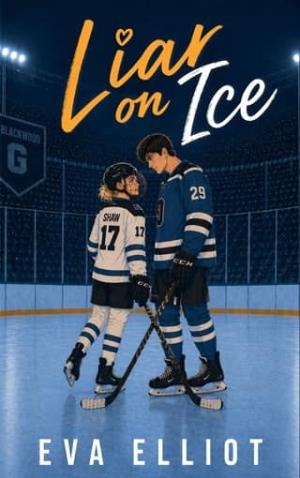
Liar on Ice (Blackwood Giants #1)
Chapter 1
LEONORA
The arena hasn’t changed.
I know it the second I step inside.
Cold air rolls over the concrete corridor, carrying the familiar mix of ice and popcorn.
The sound of skates cuts through the building in quick scrapes, echoing off the metal rafters above the rink.
It’s a sound I grew up with, a sound that used to mean long nights and homework done on the bench behind the glass while my father barked instructions across the ice.
Five years.
Five years since I last sat in these stands as the coach’s daughter.
Now I’m finally enrolled in Blackwood College as a student. But when it comes to this team, I’m just a spectator.
I force myself forward and take a seat halfway down, pulling my scarf tighter around my neck as the Blackwood Giants cycle the puck in the offensive zone.
They’re sloppy – they make basic mistakes. The kind my dad used to stop practice for.
I don’t see hockey the way most people do. I never have. The game unfolds in patterns and timing - in decisions made half a second too early or too late.
And right now?
The Giants are getting it wrong.
On the ice, the puck slides behind the net and comes back out along the boards.
The top line is out.
I recognize the center immediately. Mateo Russo.
His skating isn’t the strongest but he’s confident and thinks quickly. He skates like everything is under control even when it isn’t. Small adjustments. Smart positioning. The kind of player who thinks two moves ahead.
Russo collects the puck and feeds it across the slot to Zane Blake. He’s the star of the team - everyone on campus knows his name. Half the campus wants to date him. And he plays like he knows it.
The crowd reacts the second he touches it.
He’s fast. It kind of makes everyone else look slightly slower. He’s the kind of player who moves like the rules don’t quite apply to him. Stick loose in his hands, shoulders relaxed, like he knows exactly how dangerous he is.
He cuts inside.
For a second, it’s perfect.
Then he shoots too early.
The puck slams straight into the goalie’s pads and rebounds harmlessly into the corner.
He’s too eager.
A good goaltender reads that every time.
The play breaks down and the opposing team clears the zone.
Across the rink, the Giants’ goalie glides through his crease, tapping each post in a steady rhythm.
Miles Chen. The kind of goalie who spends entire games fixing everyone else’s mistakes.
My dad used to say that was the loneliest position in hockey.
A whistle blows. Line change.
My eyes drift automatically to the bench, scanning.
And then I see her.
Tara Lorimer.
Still here.
She’s crouched beside a player, taping something quickly and efficiently. Hair pulled back. Same quiet focus I remember from years ago.
Something tightens in my chest.
Not everything disappeared when my dad did.
My gaze shifts.
And lands on him.
Coach Caden Calloway.
Standing exactly where my dad used to stand.
One hand braced against the boards, watching. Focused in a way that tells me he’s tracking every mistake before it happens.
He’s good.
You don’t bring a struggling program back to this level by accident.
But it’s not enough. There’s a difference between being good and being seasoned, and Calloway hasn’t got the experience.
Whatever he’s trying isn’t enough.
Not yet.
Because I can see it - the gap between what this team is and what it could be.
The puck drops again.
Play accelerates.
The opposing team breaks out fast - three-on-two.
“Step up,” I murmur under my breath.
The defenceman doesn’t.
The pass cuts across the slot.
The shot is low and hard.
Chen drops instantly but it’s too quick and too well placed.
It’s a goal.
The tiny away section of the crowd erupts.
I sink back slightly, pulse still quick.
They reset.
For a few seconds, I let myself just watch. The rhythm of the game is still familiar in a way nothing else is anymore. Not since all the changes - me in college, my brother playing pro and my dad dead.
Back then everyone in the building had known my name. Now no one looks at me twice.
But as the Giants line up for the next faceoff, I can’t stop the quiet thought - they’re not the same team anymore.
My father built something here once - something disciplined and impossible to break down.
I shouldn’t still feel this connected to it.
I don’t play anymore, not since I finished up at the Junior League before starting college.
There’s no team here for me.
No place on the ice.
Blackwood cut the women’s program three years ago.
Quietly. Like it didn’t matter.
So instead, I sit in the stands.
And watch the men’s team lose.
ZANE
The season isn’t supposed to start like this.
I know it the second the puck slides past my stick and skitters harmlessly into the corner instead of the back of the net.
Three weeks ago, that play worked every time.
Pre-season had been tight. Every drill snapping into place the way Coach Calloway wanted it to.
The passes were tight, the transitions fast, and the whole team moved like we actually trusted each other.
For the first time since I came to Blackwood, it felt like we weren’t just hoping to win games - we expected to.
Calloway had that effect on people.
He’d walked into the locker room at the start of camp with that calm, steady confidence that made everyone sit up straighter without quite knowing why.
He didn’t yell much. Didn’t need to. When he talked about the season ahead, about rebuilding the Giants into the team they had been in the past, there was something in his voice that made it sound inevitable.
We believed him.
But then the moment the other team actually pushes back, the whole thing starts to crack.
I circle behind the net. Our winger hesitates, the defense pinches too late, and suddenly the play that should have been simple turns into a scramble.
“Reset!” Russo yells.
Our captain’s voice cuts clean across the ice.
I push hard on my outside edge and swing back into position, but I can feel the tension creeping into the game already. It’s there in the way our passes start landing half a second late, in the way the bench goes quiet whenever the puck leaves our zone.
We’re thinking too much.
Pre-season was easy. Without the crowds or the pressure.
Out here it’s different. Out here the mistakes count.
Miles saves our asses again a few seconds later, dropping low to trap a shot that should never have gotten through the slot in the first place. The whistle blows and the crowd cheers like it’s a highlight play instead of the warning sign it really is.
I skate past the crease and tap his pad with my stick.
“Nice one.”
Miles shrugs. “Try not to make it a habit.”
Fair.
The ref waves us toward the faceoff circle and I glide over beside Russo. He leans down slightly, adjusting his grip on the stick, his body tense the way it always is when he’s thinking five plays ahead.
“You rushed that shot,” he says quietly.
“Yeah,” I mutter.
He’s completely right.
I’d seen the opening and jumped on it too fast, like the goal would disappear if I waited half a second longer. That kind of impatience gets punished in real games.
Across the rink, I glance toward the bench.
Coach Calloway stands exactly where he always does, one hand gripping the top of the boards, eyes locked on the ice like he’s trying to solve a puzzle no one else can see yet. Even from here I can tell he’s reading the same thing I am.
All of the pieces are right.
The execution isn’t.
It’s not panic yet, but it’s getting close.
The puck drops and Russo wins the draw cleanly back to the defense.
For about three seconds everything looks the way it should. The breakout forms properly, the passes land tape to tape, and the whole play opens up in front of me exactly the way we practiced it a hundred times in September.
Then their winger steps into the lane and suddenly the puck is going the other way again.
I turn hard and chase.
The noise in the arena swells as the play rushes toward our end, blades carving deep lines into the ice as we scramble to recover.
First game of the season.
And somehow, it’s already slipping through our fingers.
LEONORA
They’re losing.
It’s not disastrous yet, but it’s wrong in the quiet, creeping way that tells me exactly where this game is heading.
Three-one. Midway through the third.
The Giants are pushing harder now, which almost makes it worse.
Desperation sharpens the speed but blunts the judgment, and I can see it happening shift by shift - the rushed passes and the way everyone tries to fix the game with one big heroic play instead of the small, patient ones that actually win hockey games.
Dad used to call it panic hockey.
The puck moves along the boards and ends up on Zane Blake’s stick again.
The crowd reacts instantly, a ripple of excitement moving through the stands like everyone senses the same thing at once. He’s the player they believe can turn a game on its head.
I watch intently.
Blake cuts across the blue line with that loose, dangerous confidence of his, skating fast enough that the defenceman backing toward him starts to hesitate.
It almost looks good.
Then I see it.
The gap behind him.
The opposing winger is already closing the lane, angling in from the blind side with just enough speed to catch him if he turns toward the boards.
Blake doesn’t see it yet.
He’s focused on the puck, on the defenceman in front of him, on the narrow slice of space he thinks he’s about to exploit.
My body reacts before my brain catches up.
“Behind you!”
I’m already halfway out of my seat when the words leave my mouth.
The shout cuts through the noise louder than I expect.
Blake’s head snaps up.
For one strange, suspended second his gaze lifts toward the stands, scanning automatically for the source of the voice, and somehow - ridiculously - his eyes land on mine.
Dark and focused.
There’s the briefest flicker of something in his expression. Surprise, maybe. Or curiosity.