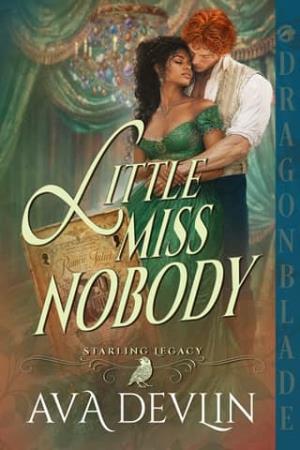
Little Miss Nobody (The Starling Legacy #2)
Prologue
For the first several weeks of her life, she did not have a name.
It was an oversight. Perhaps an understandable one, given that her mother had fallen so ill in the process of delivering her to this world.
With everyone focused on that and their ultimately futile efforts to save the life of the sickly woman, it was to be expected that there had been little time for frivolities for the healthy baby girl.
And what was a name, if not a frivolity?
In the end, it was a mistake that had named her. A well-meaning wet nurse, come to feed her from the bassinet at her ailing mother’s bedside, mistook the name scrawled in chalk on the door for the child’s and not the woman’s.
“You’ve a good appetite, little Miss Elizabeth,” the nurse had said whilst feeding her and in earshot of the doctor.
And so she had become Elizabeth.
She had taken the name, just as her mother had surrendered it, passing into a plane where she wouldn’t need it ever again.
Her father couldn’t stand to call her that. So he would call her all the things people called girls named Elizabeth without saying Elizabeth. Some days she was Bess, others she was Liza, and occasionally she was Betty. Beth, Bess, Lizzie, Lilibet, Betsy, and Ellie, and Libba.
It was the last one her brother liked best. To Malcolm, who was already a grand old age of four when she’d been born, she was always Libba.
So that was the one that had stuck. Or at least, it was the one that had stuck at home.
Out in the world, while her papa worked at his desk at the shipyard, she could try on all the different varieties of her name, and each one had its own story, its own affectations, and its own likes and dislikes.
Eliza had different friends than Bess. Lizzie had a terrible sweet tooth, but Ellie preferred to eat her meat and vegetables to grow up nice and strong.
In the absence of many other children to play with, save for her brother, who was often too grown up and busy and not at all interested in excellent things like dolls and dress up, Libba had found that being so many little girls at once often filled the gap left by the social offerings of a childhood on Brighton wharf.
There were a few other children, of course, but most of them were boys, and the boys all preferred Malcolm.
Libba suspected that was a temporary state of things, based on her observations of the older boys on the docks and where their attentions often went, which was to the pretty women in bright colors and spinning parasols who wandered the coast.
She would have bright colors one day. She would have many parasols. Of that, she was certain.
Of all the shipyard boys, Jasper Townsend was easily her favorite. This was lucky because he was Malcolm’s favorite too, with his bright-red hair and his quick smiles and his boundless knowledge of all things to do with the ocean and its depths.
The three of them would often explore the shingle beach together, looking for shoals of fish or abandoned treasures from the wealthy tourists, or sometimes mystical things that were rumored to hide in the surf.
Often—perhaps always—the mystical things were beautiful women who were partially or occasionally also sea life.
Libba liked that.
She thought she’d be wonderful friends with a selkie or a mermaid, and perhaps they would understand one another in a special way, as she too was often half or occasionally someone else entirely.
She was already just a little bit mystical, anyway, on account of looking very different to most of the other children on the docks. Malcolm and Libba were darker than most everyone else. Their hair was much curlier, and they did not burn so easily on hot summer days.
That was on account of their late mama being from a far-off land.
Faither worked for the East India Company. He was pale and straight-haired and spoke with a Scottish brogue. Mama, however, had been from the West Indies. Libba thought there were some questions that begged to be asked about that, east and west, but she never found the right time to deliver them.
It always made Faither so terribly sad when she asked about her mother.
But that bi-directional quandary always sat right on the edge of her mind and made her wonder. It made her wonder if they had been forbidden lovers, like Romeo and Juliet. East and west, and in love, anyway.
She hoped that was true. Even if she couldn’t ask.
If it was true, it made Faither’s sadness and his tendency to seem very far away, even when right in front of you, somehow magical and romantic and not horrible and mean.
It meant that he was still looking for Mama in the bottoms of his cups and those full days he spent in bed, and not ignoring Libba and Malcolm at all.
And besides, if he hadn’t been ignoring them, things might have turned out very differently.
While Libba was always quietly sure that she was the special one, between herself and her brother, it was Malcolm who discovered what made him truly miraculous first.
That was just because he was older, she reasoned.
He’d had more time, after all.
His favorite toy for as long as Libba could remember had been the old abacus in the nursery.
It had once been part of her father’s office on the wharf, but he had bought a new one and while their mother had still lived, she had painted all the beads different, bright colors for tiny Malcolm to play with, sliding them back and forth on their wires.
So, it wasn’t surprising. It wasn’t surprising at all, she thought, that he held the abacus in his head. And that counting came as naturally to him as breathing.
The surprising part was how much other people seemed to enjoy it. Word spread quickly about the little numbers boy on the beach, and for the first few breaths of it, Libba had thought it unbearable.
It was Jasper who made it all right again.
It was Jasper who whispered ideas in her ear about bringing him to the pavilions and putting a hat out to collect coins. And it was Jasper who had asked for her help and who had recognized her talent for becoming as many people as she needed to be to accomplish a feat, no matter how large.
Betsy whispered loudly about the marvel of the Marvelous Human Abacus in crowded shops and busy street corners.
Lilibet sold tickets for private performances in fancy house parlors.
Lizzie kept an eye on the hat when they did impromptu displays near the pavilions.
And Libba? She was the one who made sure the money was fairly split up and distributed between the three of them.
That was the most important job, after all.
And Faither never once asked how they were buying nicer clothes and better toys. He might have glanced a second time at a pudding on the table that he didn’t remember putting there, but he seemed resigned to believe that he’d simply forgotten.
And so, there was nothing to stop them.
Until the baroness.
Libba noticed her first. She came to the pavilion. She came to some of the parlors too. And worst of all, she also came to the wharf.
Everyone seemed to know who she was, but no one ever said her name. Wherever the tall, auburn-haired woman appeared, Libba would hear her title whispered. Baroness.
Like lioness, Libba thought, privately.
Sometimes she had her other two children with her, a pudgy, dark-haired boy and a slight, brass-colored girl, neither of whom seemed very interested in Malcolm at all. Other times, she would be alone.
But she kept coming. She kept watching.
Until Libba couldn’t stand it anymore.
“We’re not doing anything wrong,” she said, after half a dozen sightings of the tall, auburn-haired baroness had filled her with dread. “I checked. We’re not making any trouble at all!”
The baroness blinked at her in surprise, her eyes warm and brown and also a little bit sharp. “I never said you were, little one.”
“I am not little,” Libba said, though of course she was.
That made the baroness smile. “My apologies. I simply did not know which name to call you. You have so very many, don’t you? Which do you like best?”
Libba pressed her lips together, her cheeks heating with something between panic and fury. “I don’t know what you mean,” she lied.
“Well, for example,” the baroness said, bending down to talk to Libba eye to eye. “I used to be Miss Starling. Now I am Lady Selwyn. Some people simply call me ‘the baroness’ or ‘my lady.’ But I prefer my given name. Willa. So, that is the one I would choose.”
Libba frowned. “My given name is Elizabeth.”
“Yes, I had gathered that much,” the woman said with a chuckle. “Does anyone call you ‘Elizabeth’?”
Libba shook her head, startled to realize that she’d never even considered crafting a fitting sensibility for her name in whole.
Truth be told, Elizabeth didn’t feel like it belonged to her.
It didn’t.
“I like Libba,” she finally admitted. “My brother picked it.”
“Your brother is very special, Libba,” the baroness told her. “I have been hoping to talk to him, to ask him if he has considered studying under a mathematics master and honing his gift. Do you think he might like that?”
For a moment, Libba considered lying. She considered shaking her head and shouting no.
But she didn’t.
“I have already spoken to your papa about it, truth be told,” the baroness continued. “He seemed surprised to learn of his son’s talent.”
“He doesn’t see,” Libba said with a shrug. “He is looking inside, not at us.”
“Is that so?” the baroness said with a little frown. “Well, then I expected he would have trouble delivering your brother to lessons with any regularity, much less keeping up with his studies at home. Perhaps a boarding situation would be more amenable, hm?”
Libba only stared. She didn’t know some of those words.
It made the tall woman smile again. “Would you like to come too, Miss Elizabeth? Little Libba? I couldn’t rightly take your brother away and not offer you the same courtesy.”
Libba hesitated, looking over her shoulder at where Mal and Jasper were currently locked in some sort of game, flipping the red hat that they used to collect tips toward a rock and trying to land it just so. “I can get him,” she said. “You can ask.”
“I will,” said the baroness, putting her hand out and onto Libba’s shoulder. “But right now, I am asking you what you want. Would you like to come live in my house and learn new things alongside your brother? You can still visit your father and the wharf as much as you like, of course.”
“Why?” said Libba, tilting her head. “You already have children. I’ve seen them.”
“That is true,” she said with a little titter.
“I am not seeking to collect children for the sake of it. My own father taught me that talent must be fostered, lest it wither, and that talent will always outweigh pedigree. I suppose in my own way, I am honoring that lesson. Your brother’s talent deserves to be planted in fertile soil; otherwise, we might never know what could blossom from it. ”
“And you want to put me in soil too?” Libba asked, wrinkling up her brow.
“Yes, I think I should,” the baroness answered, straightening. “You’ve a spark to you, my dear. You are a prism, I think, with many facets.”
Again, Libba could only blink.
Her vocabulary, she suspected, would be the first thing this lady would wish to improve.
“Can we still see Jasper?” she asked, pointing to the red-haired boy. “Can we still come to the pavilion and listen to the bands? See the plays?”
“You can do all that and more,” the baroness promised her, “if you decide to come with me.”
Libba took a deep breath, glancing up at the sky, which was bright and blue just now, slashed through with thin wisps of cloudy lines.
“Which girl do you want me to be?” she asked, staring up at the way the clouds moved slowly in the wind, grazing over the sun like someone had thrown crop rows onto the sea. “I can be whichever one is best.”
“Libba,” the baroness said. “You must only be who you wish to be. No one who truly cares for you will ever attempt to fashion you into anything else.”
She shivered, dropping her eyes from the sky down to the toes of her shoes, scuffed and buried in pebbles and grit. “What if I wish to be more than one girl?” she asked quietly.
“Then be all of them,” the baroness answered. “Or be none of them, if it pleases you. It will not change what I am offering to you now.”
“None of them,” Libba repeated, looking up in surprise with a little laugh. “That would really be something, wouldn’t it?”
“Perhaps it would,” the baroness agreed, offering her gloved hand to Libba’s grubby, bare one. “Shall we go ask your brother what he thinks?”
She only considered it for a moment. Only a short little gasp of breath.
And then she took that hand.
And everything that came with it.