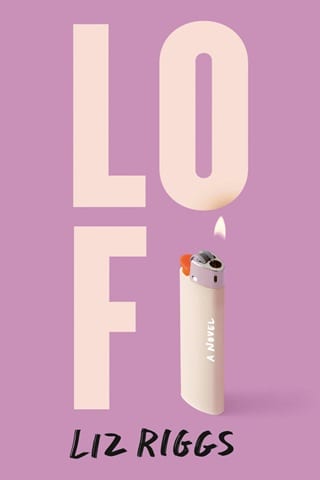
Lo Fi
Chapter 1
1.
I stamp hands at The Venue, off Eighth. I like asking for people’s wrists—the spot where the forearm fades into the joint, where the skin is always smooth, like the reed of a woodwind instrument before it’s been used. Watch the ink sink in there: the familiar shape of a curled-up cat, ruddy red and orange—the color of rust.
I prefer the early part of the week, the open-mic nights on Mondays, the bright-eyed undergrads with long hair and surprisingly sharp vocals, the indie bands with too many members and sleepy refrains who look bored by their own beats, playing to a petered-out crowd on a drizzling Tuesday. No one talks about the kind of grit it takes to play to a mostly empty room, especially here in Nashville, the way the sound reverberates off the corners of the space like it weighs something. I tried it—once. Onstage, playing my own songs. Don’t ask.
But even the bad people who play here are good, making the kind of music you hold your breath to, where you don’t even realize you aren’t breathing until the song ends and you’re suddenly coming up for air.
The rain won’t relent tonight. It falls on the sidewalk in waves, muffling all other sound: heels on concrete, cab doors slamming shut, voices of early arrivers huddling under the overhang outside the doors. A rhythmic, frenzied torrent.
It’s a Saturday in May and I’m working the door with Julien, the skinny guy who’s always sitting somewhere reading. Julien has worked here since before I started. His black hair, normally straight, is slightly wavy from the weather. Black jeans and a dark gray T-shirt with just one sleeve rolled up, as if the other had come undone while we were prepping the doors. His red Chucks squeak on the linoleum. Tonight he’s quiet, drinking tap water out of a plastic cup, thumbing through the Nashville Scene, which is mostly ads for dry-cleaning places and two-for-one bar specials. He carries the same ratty messenger bag every night, as though we’re the kind of workplace that requires work things—a computer or notebooks or files. Tonight there’s a book sticking out of it, one I’ve never heard of.
—If I wanted to work in silence, I tell him, I would have become a writer.
—Didn’t you study poetry? So, technically speaking, aren’t you? he asks, glancing up, long hair in his eyes. A writer, I mean.
A slight chill pricks at the base of my neck.
—Or a librarian, I say.
His eyes fall on me and then back to the page, his irises the color of leaves lingering between summer and fall. He flips a page in the magazine, shifts the stool between his legs. When did I tell him I studied poetry? It’s a fact I mostly don’t bring up, because it’s as useless in conversation as the degree itself—especially when I’m doing absolutely nothing with it.
Outside, the night is black and wet. Hazy, hell-colored brake lights blur in the parking lot; a cluster of guys in pastel polos stub out cigarettes on the patio railing. Upstairs, a last-minute sound check, the lead singer trying to get his guitar in tune for a Barenaked Ladies cover.
Doors are opening soon. A local nineties cover band, the kind that sells out every single time, because people are suckers for nostalgia, for the VH1 days, for getting drunk with a purpose on an otherwise dreary night. The faces tonight will be familiar—some of them, at least—even though Julien says this band brings out the kind of people who don’t normally go to shows. We’ll still see the usuals too—leather jackets and fresh tattoos, sometimes still freshly cling-wrapped. I’ve only been working here a few months, but I’m getting better at guessing: which arms will be inked with Bible verses, ex-girlfriends’ names, which will sport expensive custom line work. Blurs of people wait for us to open the door: drummers in pearl button-downs, guitarists with fingers scarred from years of breaking and changing strings, men with long, wiry beards so thick they could house entire melodies. People who are already fucked up, people who are alone, people who are meeting someone, waiting on someone, trying to forget someone.
—You never showed me the song you wrote, Julien says now.
It comes to me briefly, the two of us on his porch on Music Row the week before, one of the few times I’ve hung out with him after a show. Muted golden starlight, like looking through a screen. A chill in the spring air—too cold, really, one of those nights where you try to bend the weather to your will but you can’t. I’d never seen Julien’s basement apartment, or the porch up above, scattered with ashtrays and guitar picks and a rocking chair as large as a medieval throne, probably left behind by a previous owner who couldn’t be bothered to move it. It was late and I’d had a few, and in my haze I had the nerve to mention a song I’d written in college, back when I was actually coming up with melodies instead of just lyrics. We sat on the porch and climbed into the chair and he played a few chords and we had a few beers, but then his friend Colin showed up and told us a long and offensive story about a date he’d just been on, and the mood or the vibe or the moment—if there’d even been one—dissolved like a bit of dust.
—What song? I say, and ask him for a cigarette.
He shakes his head. It’s after nine—we’re late. The clock in the corner quietly ticks, keeping the rhythm like I can’t.
I’m wary of people who show up at the club right on time. Usually it’s because they don’t go to many shows, or maybe someone told them a Very Precise Set Time, which leaves them standing outside, tapping their feet, looking at their phones and waiting. Or perhaps they’re somebody’s parents, the idea of which always sends a small pang across my chest—not because I so rarely talk to mine, but because if I were performing my poems to a sparse crowd of bored strangers (can they be called songs if you don’t have any melodies?), my parents are the last people on earth I’d want to see in the crowd. The early arrivers don’t know that our schedules are never tight, even on nights when Andy, the owner, swears they will be. Even when the weather is perfect, when cabs aren’t stalled and restless outside.
Julien opens the door and the boys outside shake off the rain like dogs. When somebody asks for a coat check, Julien laughs and then tries to rearrange his face into something more polite, into his usual straight lips and unreadable eyes, eyelashes black black black. He says no, his voice familiar in a way I still can’t place, some uncanny valley of friendship, though we barely qualify as friends.
Flushed cheeks, a stack of tickets damp from the rain, so wet the paper is like cotton. I take their palms, the cold dew on the skin of their wrists, and stamp each one with a rusty cat. Veins, scars, regrettable ink, bequeathed jewelry and young skin, wristbands from other venues, creases where their wrists meet their palms. I hear every type of voice, some saying hello, some talking on a cell phone or into a Bluetooth, others talking among themselves.
Girls in cowboy boots come spilling out of cabs. An assistant at CAA, an intern at Vector—the kind of industry people who are at every show. House music seeping down from upstairs, rain on concrete, on steel, on rubber, on concrete again. A news alert hums through someone’s phone: a flash flood warning. Julien’s reviewing the guest list, written on a bookmark from a bookstore I haven’t heard of. Outside, a line forms beneath our sign. Flickering into the black night, the red lights of The Venue: a bit of Nashville history, I’ve learned. Jane’s Addiction and Katy Perry and Leonard Cohen, just to name a few former headliners. Independently owned since the eighties, capacity around three hundred. Tonight we’ll max it out.
I see his birthday on his ID before I see his face. Leap Day, 1984. It’s not that he’s the only man ever born on February 29, but that tiny face beneath my thumb—tan, no smile—
My arms stretch out from my body like they belong to someone else, shoving him back into the line while my cheeks flame hot. Nick. Long hair, slick from the rain, a shadow of scruff. A T-shirt, perfectly wrinkled. For a second so brief I can barely even pause inside it, I think he’s here to surprise me, to visit—but then I’m back with my feet on the ground, a stamp in my hand that I wish was a drink, and I realize that his appearance here is an accident. His stupid grin, open with whiskey; I can smell the Jameson on him more than the rain. Gray eyes like a winter day; they shouldn’t even be pretty, but that stupid fucking ring of blue around the outer edge. Like someone has circled his iris in cerulean crayon.
—Holy shit, he says. Alison Hunter. What the hell are you doing here?
—Don’t call me that, I say. Nobody calls me that.
Julien glances over at the two of us and mouths Al-i-son to me.
But already Nick’s reaching to pull me into him, the space between us closing, quieting: a vacuum of sound. His hands are at my cheeks now, like he’s here on purpose. Cool and damp, his left fingertips rough, callused.
—Seriously? I live here. Which I’m pretty sure you know. What are you doing here?
His hands are still at my cheeks, his gray eyes on mine. He leans in like he’s going to kiss me with his Jameson breath. Instead, he says quietly into my ear:
—I promise I was going to text you.
—I thought you were on tour.
My arms are crossed, but the muscles are loosening, heat already spreading out across my chest, up between my legs. Over Nick’s shoulder, Julien’s eyes meet mine for a second, a question in the corner of his gaze and then—back to the line.
—I am, Nick says.
A freckle on his upper lip, a memory of a rainy night in Ann Arbor, cheap beer and cheaper weed, the dim light of a Michigan alley. Nick’s hands in mine, his music still shimmering on the soundtrack of the memory. He steps back and tries to explain: he’s just in town for the day, his band had a song they needed to record. Nick—in my city, wandering around just miles away, without me even knowing it. I don’t recognize any of the guys he comes in with, but that’s probably because Nick and I have never existed in a realm where we shared friends, where I’ve known anyone else in his life beyond the two other guys in his band.
—I’m here, he says softly, directly into my ear. His breath hot, his lips grazing the ring of cartilage. He’s a little drunk, my favorite version of Nick.
—You’re full of shit, I say.
—I’m in your city, he says now.
Behind him, the line is antsy. Expectant eyes and wet hair and hands on hips. I try to will myself out of his touch and take the stamp to his wrist.
—Don’t be mad, he says, and I look past him over to Julien, who’s waiting for an older couple to unfold their printed tickets. He’s not paying attention anymore.
—I’m here, Nick says again into my ear.
The timbre of his voice, rich and familiar and melodic, is already edging its way into my memory. I’m always filing Nick away somewhere into the past, where, for nearly a full year now, he has existed.
If I don’t hear Mr. Jones tonight, I’m gonna lose it. Just a vodka tonic. Oh whatever, sure, make it a double. Colt, where are all the goddamn polishing rags? Someone threw up on the balcony. On it, not over it. I think that guy’s doing lights on the Animal Collective tour. No, they got dropped. You want a bump? Don’t text him back. Don’t do it. Where’s the A2 guy? Can you hold my drink? There isn’t a nice way to say this so I’m just going to say it. I sat next to him on a flight back from LA. They gave us a buyout. He knows I live here. Do you know how much money those Christian singers make? It’s criminal. I’m talking about Crush, not Crash. He has an actual perfect penis. Everybody’s “in town recording.” Yeah, of course they’re in a band.
I wasn’t supposed to meet him, really. I wasn’t even supposed to be there that night at the pool bar below the Blind Pig in Ann Arbor. It wasn’t really an undergrad spot, but I was looking for a place where I wouldn’t run into anyone. Where the news that my parents weren’t coming back to the states for Christmas could be quietly drowned in tasteless beer. Where I could be depressed and alone. That night Wilco was playing overhead, and Nick sat down next to me. The hair alone told me he wasn’t a student. The voice that sounded like slipping under sheets, like the moment before you come. He asked me if I was going to the show at the Blind Pig and I said no. When I asked him who was playing tonight, I knew the answer before he responded.
—I am, he said.