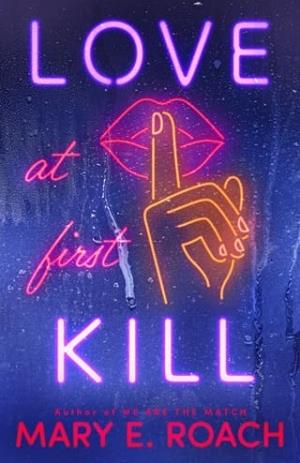
Love at First Kill
Chapter One
Murder was a meticulous business.
Meticulous, and each one was different.
They had to be, if you wanted to live long enough for the next job, and the next after that.
And Jack O’Sullivan very much intended to live.
He stretched out his legs beneath the café table and leaned back against the booth. It was upscale for a café, but he would have expected nothing less from a place Cale Jacobson frequented. Sunlight filtered in through the carefully cleaned glass of the window, spilling light across nearby tables.
This was the most expensive target he had ever acquired, and he had been paid more up front than the other three jobs this year combined.
That fact should have made him nervous: The higher profile the target, the richer the target, the more that could go wrong.
That, and this time Jack had been hired by a small collective.
He was used to working with solo clients, people who wanted somebody gone because they had been hurt or wronged.
Trust a billionaire to go and hurt more than a dozen people, enough for them all to turn to something like this.
Cale Jacobson, of course, didn’t think of himself as a regular billionaire (none of them did, though). Jack had listened to his conversations every time he’d frequented this café, and he had listened to his assistant every time she came in to pick up his order.
Jack had spent days learning the man’s schedule.
His haunts, his security detail, his moments alone.
His schedule, both the regular—like this café in downtown Portland—and the varied, the business meetings that dragged the man all over the city.
All over the country, too, but Portland was his home base—a compound outside the city, closer to the Canadian border, and a high-rise downtown where he spent most of his time.
Jack sipped his tea, an iced matcha with oat milk, a habit he had picked up because a former girlfriend of his had insisted that Big Dairy was destroying the planet. So were most companies, but that wasn’t Jack’s business.
A woman’s voice interrupted his focus. “Can I get you anything else?” The barista had stopped near him, a pitcher of water in her hand.
It was his frequent downfall—he was often too focused on what he was doing to notice the others around him. One ex had told him it made him “hardly human,” but Jack personally thought his profession, not his social skills (or absence of them), was a more likely measure of his humanity.
“I’m good, thanks,” he said. Was this typical of baristas? His experience was that he was on his own once they’d handed off his coffee. “I appreciate it, though.”
“Sure,” she said, bumping him gently with her elbow. “I’m off in an hour.”
It was a clear invitation, though one he had had to be told about more than once when he was a younger man (more evidence from his ex that he was destined to be alone, because who couldn’t read a social cue that obvious?).
And the barista was a good-looking woman. Tasha, her name tag read. He cataloged all that clinically: tall, curvy, dark-brown skin and long lashes, tightly coiled curls and a winning smile. If he were not on a job, he’d take her up on that invitation.
“Sorry,” he said. “I’m working. But if I get off early . . .”
He let the invitation hang there.
Tasha shrugged one shoulder. “Sure,” she repeated. “I’m here Monday through Friday.”
She moved on, hips swinging, and he watched her go, but only for a moment.
When he was on a job, it consumed him. Nothing and no one else existed. It was just him and a target, zeroing in on the end of the job with ruthless efficiency.
And now:
Across the street, Cale stepped out of the private entrance to his office building, one guard holding the door for him. He was a thin white man, late thirties, heir to an empire. Dirty-blond hair, neatly pressed designer suit, recently shined shoes.
That was another step in the routine when Cale was in Portland: Most days, his assistant brought his shoes to be shined at a local place near the river, but every Thursday he went himself.
Maybe he liked sitting up there, a king above men in every way it was possible to be. Maybe he just liked a routine.
Either way, it was another opportunity.
Cale crossed the street at the crosswalk, his pace brisk. He had investors to meet with, beaches to frequent, nineteen-dollar sandwiches to buy from this café, a private jet to take. He walked like he owned the world.
A laugh jarred Jack out of his focus.
Not Tasha the barista this time.
No.
Across the aisle, seated on a wooden stool, sat a woman with olive-toned skin and curly auburn hair. She was wearing a viciously red dress, and she had one hand pressed to her mouth as if covering a laugh.
And she was looking directly at him.
She leaned her elbows on the round, smooth wooden table in front of her and folded her hands. He noticed, vaguely, that the knuckles on her right hand were scabbed, the knuckles on her left only slightly less bruised.
“You have no game,” she told him.
A smile tugged at the corner of Jack’s mouth despite himself. “You don’t think so?” he asked her.
The woman was shorter than him by a good six inches, short and curvy, with sharp hazel eyes that crackled with life.
“I know so,” she said, wrinkling her nose at him. “That was . . . pathetic.”
Jack lowered his mask only to sip his matcha, immediately sliding it back into place as he did.
He had his back to the nearest camera, so he did not have to worry about his face being visible.
Not that they would recognize him if they did see him.
The mask was a habit—good for avoiding infection while traveling as much as he did, and equally good for avoiding detection and making eyewitness descriptions that much more difficult.
But this woman was looking directly at him, eyes traveling up and down his face and his body with an eagerness—and a sharp, nervous energy—that unnerved him. She would be able to pick him out of a lineup. She would be able to give a sketch artist a detailed description.
“I’m not here to flirt,” he told her, turning his shoulders slightly away from her.
Collaboration was the death knell of a job like his. Besides, he liked his work, liked it better than he ever liked people—well, all but one. It made killing them a great deal easier, too.
“That’s clear,” she said. “I’m Ava, by the way.”
“Ava.” He said the word slowly, thoughtfully. “I’m here to work, Ava.”
“Well, it’s a good thing you’re not here to flirt,” Ava said before sipping her smoothie (something pink and probably sweet, not in a to-go cup like his) and continuing to giggle at him. “Since you suck at it.”
“Thanks,” Jack said flatly. He was wearing a suit and tie, not a hoodie, though he generally felt safer in one. It covered more of him than a suit and tie did, but a suit and tie was the uniform that blended best here.
The bell on the café door rang as Cale stepped through.
He didn’t seem to notice the woman who was staring at the menu, considering, or the man waiting for the barista, either.
He certainly didn’t ask whether they were in line.
Instead, he stepped up to the cash register and called for the barista with an impatient wave of his hand.
When Jack’s eyes flicked to Ava, her entire demeanor had changed. Her dark hazel eyes, which had been fierce but warm just moments ago, were crackling dangerously now. Her shoulders were tensed, her jaw set.
It was a clear sign, a social cue that was not hard for him to recognize. One that said Danger. Danger. Danger.
Cale was ordering. A green juice and a turkey club sandwich, his usual.
He was telling Tasha about his recent bike tour, something that had taken him deep into a desert somewhere in Nevada. There was merit to suffering, he was telling Tasha, who smiled politely. Suffering stripped away everything, and you found clarity in its simplicity.
“What do you do?” Ava asked him suddenly. “For work?”
Jack startled, looked at her again. Her skin tone was darker than the ruddy Irish complexion he’d inherited from parents he couldn’t remember. She was Italian, probably, maybe Greek, if he had to guess, but she looked pale in this moment. Almost as if she was about to be sick.
Or as if she was steeling herself for something that terrified her.
“Investment manager,” he said. His laptop was open in front of him, his lie easy.
At the counter, Cale was still telling Tasha about himself while she politely listened.
When he finished paying, he dropped a handful of spare change into the tip jar. He was still talking about suffering, and how good it was, and how more people would have clarity and strength of purpose if they would do something as ascetic as a bike ride in Arizona.
He’d probably write that in a book someday, and a publisher would snap it up, and people would quote that shit on social media. It was meaningless. Cale had never suffered—and he wouldn’t, not even when Jack killed him.
It would be a gunshot, because Jack always did it the same way: a single shot. Quick, clean, as easy as falling asleep. There were a few ways to do it, but this was simple, the gun easy to build, easy to dispose of, and easy to make untraceable.
“That sounds like a bullshit job,” Ava said. “Made up by little sad men in suits who optimize and circle back and think that their emails matter in the grand scheme of the universe.”
“What do you do?” Jack asked, his eyes remaining on Cale, who leaned against the counter, scrolling on his phone.
“I’m a librarian,” Ava said. “Or I was. But my point is that I had a real job.”
He didn’t ask how she lost that job, or what she thought defined a real job, because this was a distraction. And distractions could mean death—or worse, prison.
A few minutes passed.
Jack watched Cale’s subtle movements. He was unaware of the world around him—or maybe he just thought it centered on him.