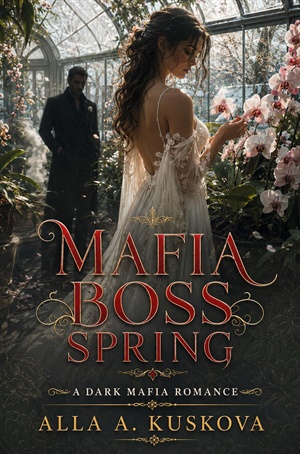
MAFIA BOSS SPRING (4 Seasons #3)
Chapter 1
Cherry Blossoms and Bullets
The gunshot echoed through the conservatory like the crack of spring thunder—premature, violent, and utterly transformative.
Elara Voss did not scream. She had learned, by the age of twenty-four, that screaming was a luxury afforded to women who believed someone would come to save them.
She was not such a woman. She had not been such a girl, either, raised as she was in the suffocating elegance of a family that traded daughters like currency and called it tradition.
Instead, she stood perfectly still among the orchids and gardenias, her white silk dress absorbing the spray of shattered glass from the greenhouse window, her hands—still gloved in ivory lace—clutching a pair of pruning shears she had been using to deadhead the hydrangeas.
The man who had been shot crumpled to the terracotta tiles, the heavy, ungraceful thud of dead weight silencing the room.
Blood pooled beneath him, dark and viscous, soaking into the grout lines with obscene intimacy.
Elara recognized him—one of her father's business associates, a German with predatory eyes and hands that wandered during dinner parties.
She felt nothing at his death except a distant, academic curiosity about whether the blood would stain the tiles permanently.
"Forgive the intrusion."
The voice came from the shattered window, smooth as Russian vodka and twice as dangerous.
Elara turned slowly, the pruning shears still in her hand, and found herself facing a man who seemed to have stepped out of a fever dream—or a nightmare, depending on one's capacity for appreciating beautiful destruction.
He was tall, broad-shouldered, dressed in a charcoal suit that fit him with the precision of a second skin.
His hair was black as obsidian, swept back from a face that might have been carved from marble by a master sculptor who had decided to leave the edges deliberately sharp.
But it was his eyes that arrested her—gray-green, shifting like river water, assessing her with the detached calculation she had seen in collectors examining rare specimens.
He noted the shears in her hand. The absence of fear in her posture. The way her dress clung to curves that had been the subject of too many whispered negotiations between her father and men like the one currently bleeding on the floor.
"I did not expect to find a gardener," he said, his accent clipping the edges of his English into something precise and predatory.
"I did not expect to be murdered in my greenhouse," Elara replied. Her voice surprised her—steady, almost bored. "If you're going to shoot me, I'd prefer you aim for the head. I've always found the concept of surviving as a vegetable philosophically distasteful."
Something flickered in those gray-green eyes. Amusement, perhaps. Or recognition.
"I am not here to kill you, Miss Voss."
"Then you've made a mess for nothing. That was imported Belgian glass. Seventeenth century."
The man—she realized with a jolt of recognition that this must be Viktor Spring, the Pakhan whose name her father whispered with equal parts terror and reverence—stepped over the body with the casual grace of a man for whom death was simply another form of punctuation.
He moved toward her, and Elara became acutely aware of several things simultaneously: the way the afternoon light fractured through the broken window, casting rainbow shards across his face; the smell of gunpowder mixing absurdly with the heavy sweetness of blooming jasmine; and the fact that she was still holding gardening shears as her only defense against one of the most dangerous men in Europe.
"I am here," Spring said, stopping precisely three feet from her—close enough that she could see the faint scar tracing his jawline, far enough to demonstrate that he did not consider her a threat, "to make you an offer."
"I don't negotiate with men who break my windows."
"Then it's fortunate I'm not negotiating." He reached into his jacket, and Elara tensed, but he withdrew only a handkerchief—monogrammed, silk, absurdly elegant—and extended it toward her. "You have blood on your cheek."
Elara did not take the handkerchief. "Whose blood?"
"Does it matter?"
"It matters to me."
Spring studied her for a long moment, and in that silence, Elara heard the distant sounds of the estate—her father's guards being systematically neutralized, she assumed, based on the efficiency with which this man had infiltrated her sanctuary.
She should have been afraid. Any sensible woman would have been terrified, kneeling, begging.
But Elara had spent her life afraid—afraid of her father's temper, afraid of the men he sold her smiles to, afraid of the future that stretched before her like a gilded cage with increasingly narrow bars.
Something about this man, this violation of her last refuge, sparked not fear but a terrible, dangerous anger. An awakening.
"His name was Klaus Henning," Spring said finally. "He owed my organization three million euros. He thought hiding behind your father's diplomatic immunity would protect him."
"And killing him in my greenhouse? Was that necessary?"
"Yes." Spring's gaze traveled over her face with unsettling thoroughness. "Because I wanted to see where you spent your afternoons. I've been told you have a gift for making things grow in unforgiving ground."
Elara's grip tightened on the shears. "You've been watching me."
"I've been studying you." He corrected gently, as if discussing botany rather than stalking. "There is a difference. One implies obsession. The other implies...interest."
"And which do you feel?"
Spring smiled. It was not a comforting expression. It was the smile of a man who had forgotten how to perform kindness and had decided, instead, to offer honesty as a more valuable, if more terrifying, currency.
"I feel," he said, reaching out to brush a stray lock of hair from her face with a gentleness that contradicted everything she knew about him, "that spring has come early this year. And I find myself...unprepared for the thaw."
? ? ?