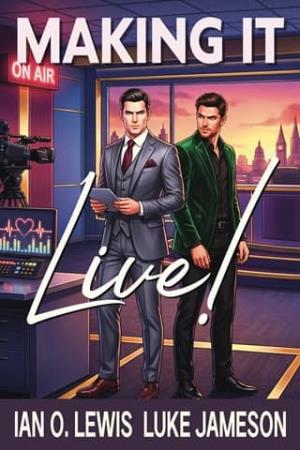
Making It Live! (The Making It #12)
Chapter 1
Chapter One
I knew Nelson was going to be famous before either of us could afford takeout.
This was not a romantic realization. It arrived the way most uncomfortable truths do — quietly, sideways, in the middle of something ordinary — and once it settled, I couldn't unfeel it.
I tried. Believe me, I tried. I told myself it was just confidence and ambition, the particular brand of certainty that some people wore like a second skin.
I told myself a lot of things in the two years I'd been in love with him.
Most of them were wrong.
I was twenty-two years old, hauling a borrowed camera up Broadway on a thick August afternoon, and I was already dreading the next few hours in a way I couldn't entirely explain.
This was the third time that month Nelson had asked me to help with his audition reel.
I'd said yes each time, because I always said yes to Nelson.
He was my boyfriend and that was what you did.
Plus, I wanted to stand behind the camera and see exactly what it was that made every professor at the J-school talk about him the way they did.
Like he was already somebody while the rest of us still had a long way to go.
The broadcast studio was in the basement of the journalism building — fluorescent lights, industrial carpet the color of old mustard, three cameras on tripods that had seen better decades.
Nelson was already there when I arrived. Of course he was. He was always two steps ahead of wherever you'd expect him to be.
He was standing at the makeshift anchor desk in the corner of the room — a folding table the department had dressed up with a length of blue fabric to approximate something professional — running through his notes.
He'd done his own hair in the apartment bathroom that morning while I was still in bed, and he looked like he belonged on a movie screen.
"You're late," he said, without looking up.
"I'm three minutes early."
"I said two-thirty. It's two-thirty-three."
I dropped the camera bag on a chair. "Seriously?"
Nelson sighed and looked up. He was wearing the slate-gray shirt he saved for interviews and a pair of dark trousers that had no business looking that good under fluorescent lights.
His ice-blue eyes were bright in a way that I recognized — the particular brightness that meant he was running on adrenaline and absolute focus and would not be fully present to anything outside the task until it was done.
I'd seen that look a lot lately.
"Thank you for helping me," he said, and he meant it. That was the thing about Nelson that made everything harder — he wasn't oblivious to other people. He truly saw you. And he was very clear about which direction he was moving, and he assumed, without cruelty, that you were moving the same way.
"Tell me about the setup," I said, because that was easier than the other things I wanted to say.
He launched in. The story was about homeless veterans living in Riverside Park — a piece he'd been reporting for three weeks, working sources at the VA hospital up in the Bronx and at a nonprofit called Home Base that ran transitional housing out of a walkup on Amsterdam.
He'd interviewed two veterans already. Today he was filming his stand-up and his closing narration, the pieces that required him to look directly into a camera and make whoever was watching trust him.
"I want to open on the park," he said. "Wide shot, then push in on me. I'll do the intro twice, maybe three times, until we get one I like."
"You've never needed more than one," I murmured while setting up my equipment. This was factually true and I said it like it wasn't a complaint.
He smiled. "Stand by."
I positioned the camera and looked at him through the viewfinder.
This was the part I hadn't figured out how to handle.
Through the lens, Nelson Mackenzie was something I didn't have vocabulary for.
Not handsome, though he was that too — something more specific than handsome.
He had the quality of making you believe that what he was saying mattered, that you were supposed to be paying attention, that the story he was telling was the most important story being told at this particular moment in the world.
I'd watched him do it in class. I'd watched him do it in mock broadcasts, in practice interviews, in the hallway of the J-school when he was explaining something to a professor and the professor gradually forgot that they were the one with the degree.
He did it without trying. That was the part I couldn't get past.
I hit record.
"In Riverside Park," Nelson said, and his voice dropped into a register I thought of as his camera voice — lower than his everyday voice, steadier, carrying the particular weight of someone who had decided that the truth was worth the time it took to tell it — "on the benches and under the trees along the Hudson, there are men and women who wore this country's uniform.
Who came home. And who fell through a gap so wide you could lose a life in it. "
He paused. Let it breathe.
"My name is Nelson Mackenzie. This is their story."
I kept the camera on him for three seconds after he finished, the way he'd taught me — hold on the subject after the words end, because that's where the truth lives. Then I lowered it.
"One take," I said.
He nodded like he'd expected nothing else.
And something in me — something I'd been keeping very carefully below the surface for weeks, maybe months — tipped over.
It wasn't jealousy. I want to be precise about that, because jealousy was something I understood and could manage.
This was different. This was the particular vertigo of standing next to someone who was running full speed toward a future you could see clearly, and realizing that you couldn't find yourself in it no matter how hard you squinted.
Nelson's future was already in motion. Mine was a fog bank I kept telling myself would clear.
I set the camera down and started rewinding the tape. Nelson was making notes on his script. The fluorescent lights hummed. Out in the hallway someone was laughing at something, and the sound floated under the door and died.
"I got a call this morning," Nelson said, not looking up from his notes.
"From who?"
"NY1." He said it carefully, like he was trying to keep the excitement in and couldn't quite manage it. "They want to meet. It's not — I mean, it's local. It's not what I'm aiming for, but it's a real newsroom. They saw the opioid piece I did and they want to sit down."
I kept rewinding the tape. "That's great."
"It's a foot in the door." He looked up.
"Bruce Coleman at Beacon wants to meet with me too.
" He stopped. Nelson was looking at me the way he sometimes looked at me when he was deciding how much of himself to put on the table.
"It's going to happen, Jimmy. I can feel it, the way you feel a story when it's real.
Beacon Broadcasting. The national desk. That's where I'm going. "
He said it without arrogance. That was the thing that broke something open in me — he said it the way you state a fact. The sky is blue. Water runs downhill. I'm going to be the star anchor at Beacon Broadcasting.
I looked at him. At the gray shirt and the blue eyes and the notes in his hand and the absolute, terrifying certainty of him.
And then I heard myself say: "You're turning into a sellout."
The words landed in the room like something dropped from a great height.
Nelson went very still.
"What?"
I knew I should have stopped. The sentence had come from somewhere I hadn't authorized, from the part of me that had been keeping score without admitting it, and it was out now and it was wrong — I knew it was wrong even as I was saying it, knew it the way you know you're going to regret something a half second before you do it anyway.
"Corporate news," I said, because apparently I was committed now. "Cable. Nelson, you used to talk about documentary work. About PBS. About stories that—"
"That what?" His voice had gone quiet. I knew that voice. Quiet Nelson was the dangerous kind. "That matter? You think homeless veterans on a national broadcast don't matter?"
"I think you care more about the camera loving you than you do about the actual story."
Nelson set down his notes and straightened the pages against the desk — a precise, controlled movement — then he looked at me with an expression I'd never seen on his face before.
Not anger. Something that lived behind anger.
Something that looked, for just a second, like I had touched something real.
"Nelson—" I started.
"You don't get to say that to me." His voice was still quiet. "Not you. Not about this."
"I know." The words came out before I'd decided to say them, and they were true, and they were not enough. "I'm sorry. I didn't — I shouldn't have said that. Nelson, that was wrong."
He looked at me for a long moment. Then he picked up his notes again and smoothed them once against the table. "Set up for the closing stand-up," he said. "I want to get it before we lose the light through the window."
I picked up the camera. My hands were steady. His were too.
But something had shifted in the room, and even as I set the camera back on its tripod and Nelson found his mark, I understood, with the quiet certainty of someone watching a door close from the wrong side of it, that I had not said the true thing.
The true thing was worse. The true thing was: I'm afraid you're going to get exactly what you want. And I don't know if there's room for me in it.