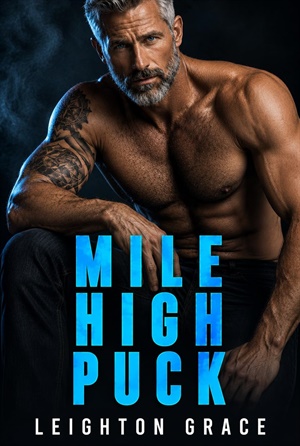
Mile High Puck (Silver Fox Hockey #3)
1. Frankie
Frankie
Last Spring
That’s how I’d write me, if I were writing me.
Third person, present tense, lightly unhinged.
The woman clutches her boarding pass like a subpoena.
The woman has been delayed twice. The woman is aware that narrating herself out loud in a crowded gate area makes her look unwell, and she is doing it anyway, because the alternative is thinking about the part where the plane leaves the ground.
“You’re doing that thing again,” says the teenager in the seat next to mine, not looking up from her phone.
“I’m aware.”
Here’s what you should know about me, in the order it becomes relevant.
My name is Frankie Delaney. I write romance novels under a pen name so airtight my own dentist doesn’t know.
And I am a white-knuckled, pre-medicated, statistically-informed-and-it-doesn’t-help terrified flyer, currently boarding a delayed red-eye home to Denver from a reader convention where I signed exactly four books in three days.
Four.
One of those readers thought I was somebody else, and I signed it anyway, because what’s one more small humiliation between strangers.
For three days I wore a lanyard that said AUTHOR and felt like a fraud in a costume, smiling next to women whose signing lines wrapped around the ballroom while I alphabetized my swag.
My phone buzzes with proof that somebody loves me: the cat sitter has sent a photo of Fabio, my three-legged rescue, sitting dead center in my writing chair like it’s his territory.
Then Cami: four books is four more than zero. drink water. do not spiral.
Too late on the spiral. The water I can do.
At the podium, the gate agent scans my pass and says, “Oh,” in a tone I don’t care for, “you’ve been reseated. 3C.”
“Is 3C bad? It sounds bad. Is it over the wing? Because I’ve read the wing is actually the safest—”
“It’s first class, ma’am.”
Oh. An apology seat. The airline delays your flight twice, changes your gate, and then bumps you to the front like a bouquet sent to a funeral. I take it. Obviously, I take it. I have had the weekend of a woman who has earned a free blanket.
There’s already someone in 3B.
I notice him in stages, because the Dramamine has slowed my processing speed to dial-up.
Stage one: big. Not gym big, built big, a man constructed to a scale where the seat looks like it was installed around him.
Stage two: a ball cap pulled low, gray at the temples underneath it, a jaw that could open bottles.
Stage three: stillness. Most people fidget on planes.
This man sits with his forearms crossed like he’s been carved into the upright and locked position.
“Hi. Sorry. Hi.” I wrestle my tote into the footwell and manage to elbow him only once. “I don’t usually sit up here. They rebooked me, so if I use the wrong fork or whatever, that’s the airline’s fault.”
Nothing. The brim of the cap tips maybe a centimeter, which I choose to interpret as a standing ovation.
“Frankie,” I say, pointing at myself, because apparently the medication has opinions about introductions.
A pause long enough to have a middle. “Would you rather have the window?”
Gravel. His voice is gravelly, but in a good way.
“God, no. I need the aisle. It’s statistically irrational and psychologically load-bearing.”
Something moves at the corner of his mouth and dies before it becomes anything. He goes back to the closed window shade, which he is watching like it might try something.
Fine. Great, actually. I don’t need a talker. What I need is to get home to my cat, my deadline, and a diner booth with my name on it, metaphorically, because the last thing in this world with my actual name on it is my mortgage.
The safety demonstration begins. I watch all of it. Every time. The flight attendants could unionize against my eye contact.
We taxi, and my hands find the armrests and grip like the plane needs my help. Out of the corner of my eye, I catch the cap tilt toward me. Watching. Not saying anything, which somehow makes it worse.
“It’s the takeoff,” I tell him. “And the landing. Also the middle.”
“That’s the whole flight.”
“Yes. I’m consistent.”
“You picked a bad hobby.”
“It’s not a hobby, it’s a homecoming. I live in Denver. Flights keep insisting on being the fastest way there.”
He considers that for longer than the joke deserves. “Drive next time.”
“Through Kansas? I said I was scared, not desperate.”
There it is again, that twitch at his mouth, gone before it can be entered into evidence. The engines spool up. My spine tries to exit through the seat back. And then his voice comes, unhurried, pitched under the roar like he’s done this before.
“Wings are supposed to flex. If they didn’t, they’d snap.”
“That is not soothing.”
“It’s true. True’s better.”
Here’s the humiliating part: it works. Not the physics, the delivery.
He says with no reassurance in it at all, just fact, and my body believes him before my brain has a vote.
We lift. The ground drops away with everything I love on it, and I’m still breathing, mostly because the man in 3B told the truth in a low voice.
The woman survives the takeoff, I narrate, silently this time. The woman would like her medal mailed to her home address.
The seatbelt sign dings off. When the flight attendant leans in to take drink orders, she does a thing I clock immediately, a flicker of a double take at 3B, smoothed over fast. He orders club soda, and she doesn’t push, and I’d wonder about that longer if my brain didn’t wander off to lick its convention wounds instead.
The dinner service arrives. He looks down at the chicken like it owes him something.
“Problem?” I ask.
“The chicken lied to everyone.”
I laugh, a real one, the first in days, and it startles both of us. He returns to his tray, but his shoulders have changed altitude, a fractional drop, and I know settling when I see it. I write settling for a living.
And because I am who I am, my phone comes out under the tray table, angled away, and I type his line into the note where lines like that go.
The note is labeled STOLEN. It’s where other people’s best sentences wait to be laundered into fiction.
Every writer has one. Mine has a title with malice in it because at least I’m honest.
“Did you just write that down?” Not a question. He hasn’t even turned his head.
“No.” My thumbnail goes to my teeth, which is what it does when I lie, a tell so reliable Cami once used it to win money off me at poker.
“You wrote it down.”
“I’m a writer. Everything’s material.” I put the phone away with enormous dignity. “You should be flattered. I only steal from quality.”
He grunts. An actual grunt, textbook, and something in my chest goes traitorously warm, because oh, I know this man.
Not him personally. Him categorically. The monosyllables, the forearms, the tragic jaw, the mouth that keeps almost being amused and refusing on principle.
A walking grumpy-sunshine setup, seat 3B of all places, and I will not be participating.
I’ve written him a dozen times. I know exactly how this goes, which is why it’s not going anywhere.
“So what do you do?” I’m participating already. Damn it.
“Guess.”
“Oh, dangerous. I’m professionally nosy.
” I angle toward him and read him the way I’d read a first page, because that actually is my job.
Knuckles with old scars, the pinky that healed a few degrees off.
A watch that costs serious money on a wrist he keeps rotating, small circles, like it aches. “Contractor.”
“No.”
“Bodyguard.”
“No.”
“Disgraced chef.”
The cap turns toward me one full degree. “Disgraced?”
“You have violent knuckles and you looked at that chicken like it betrayed you personally. The story writes itself.”
“I’m retired,” he says, and the word comes out wrong, the way fine comes out of somebody who isn’t. Like it’s a sentence he’s serving instead of saying.
“From what?”
“Doesn’t matter anymore.”
But it clearly matters more than anything, the way his whole body went quiet around it. He reaches up and rubs the back of his neck, and I let it go. Frankie Delaney, letting a locked door stay locked. Cami would ask who I am and what I’ve done with the body.
He shifts, stretching one leg as far as he can, carefully, and settles again a degree at a time. Whatever he retired from, it left its mark.
Here’s what I notice instead, in the dark of a cabin at cruising altitude, because noticing is the other half of my job.
He got on this plane wearing grief. Not the loud sort.
The pressed sort. There’s a dress shoe peeking out from under the seat in front of him, polished to a shine with a fine line of dried dirt at the welt, the specific dirt of standing on grass in nice shoes, and there is only one occasion where men like him stand on grass in nice shoes.
He’s flying home from something tonight. Not to it.
I don’t say any of that. Even I have a floor.
Instead we drift. That’s the only word for it. The cabin lights go down, and the conversation stops being volleys and starts being something slower, him asking one question for my every nine, but asking nonetheless.
“What do you write?”
“Romance.” I wait for the flinch. Everyone has one, that little recalibration where I go from writer to something cuter. He just waits, so naturally I keep talking. “Love stories. Happy endings, guaranteed. It’s the only genre that comes with a warranty.”
“Guaranteed.”
“Contractually. If the two people don’t end up together, it isn’t romance, it’s just fiction where everyone suffers for nothing. That’s called literary. It wins awards. I want no part of it.”
He turns that over the way he seems to turn over everything, thoroughly and without hurry, while somewhere below us Nebraska’s porch lights look like a night sky.
“So you know how it ends before you start,” he says.
“I know how everything ends before I start. I read the last page of every book first. Have since I was nine.” He raises his eyebrows, and I hold up a hand, swear-on-it. “If I know the ending’s safe, I can survive whatever the middle does to me. It’s a system.”
“It’s cheating.”
“It’s risk management. Some of us weren’t born with” — I gesture at the general calm of him, the crossed arms, the whole granite situation — “the sitting-there-like-the-sky-answers-to-you thing.”
“Sky doesn’t answer to anybody.” He says it to the window shade. “That’s the appeal.”
He asks, a while later, if I’m any good. I say yes before I can stop myself, and instead of the polite laugh I brace for, he nods once, as if I’ve confirmed something he’d already thought.
“Convention was bad, though,” he says.
I blink at him. “I didn’t say anything about the convention.”
“Lanyard’s still in your bag. You keep looking at it like it bit you.”
“Okay, who’s professionally nosy now?” But it comes out softly, and then the whole thing comes out with it, the four books, the wrong name, the ballroom lines that wrapped for everyone else.
Talking to a stranger at night above the middle of the country is confession with better snacks.
“I keep waiting to feel like the real thing. Twelve years in. Any day now.”
“Twelve years is the real thing,” he says. “The line’s got nothing to do with it.”
“That’s easy to say.”
“It’s not,” he says, and doesn’t explain, and rubs the back of his neck again.
The plane drops.
Not a dip. A drop, a floor-gone, stomach-in-the-overhead-bin drop, and the cabin gasps in one voice and the seatbelt sign bongs and I hear myself go somewhere far away and very fast.
“The woman grips the armrest,” I’m saying, out loud, third person, full volume, “the woman regrets the chicken, the woman has a cat, who feeds the cat, the woman never renewed the—”
“Hey.” Low. Close. “Look at me.”
I look. Under the cap brim his eyes are steady and dark and absolutely unbothered, like turbulence is a rookie move the sky is trying and he’s seen better.
“Frankie.” My name in his mouth is a full stop. I had no idea a name could carry so much weight. “Rough air. That’s all it is. The plane’s built for ten times this.”
“You don’t know that.”
“I know exactly that.” The plane bucks again. Someone behind us yelps. He doesn’t blink. “Breathe in. Slow. Good. Again.”
And then his hand covers mine on the armrest.
Here’s the thing I understand later, and only the edge of now: this man doesn’t touch people.
Hours in a shared armrest’s worth of space and he has not so much as brushed my sleeve, has kept himself folded into his own borders like touch is a currency he stopped spending years ago.
So when his hand lands, warm and heavy and rough in a way I can feel scar by scar, it isn’t a gesture.
It’s a decision.
The plane shudders through another fist of air. His hand stays. My heart is still doing something arrhythmic and embarrassing, but it has changed genres, and I genuinely could not tell you the exact sentence where that happened.
“Still with me?” he asks.
“Unfortunately.”
The twitch at his mouth finally, finally gives up and becomes a real thing. Barely. A quarter-smile, there and gone in the dark, and I would trade every signing line in that ballroom to have caused it twice.
The air smooths out. The seatbelt sign dings off like nothing happened. His hand slides back to his own armrest, unhurried, no apology in it, and the place where it was stays warm.
“I don’t know your name,” I say. “Three hours. You know my career trauma and my cat situation and I don’t know your name.”
A pause. Something moves behind his eyes, a door considering itself.
“Nick.”
“Just Nick?”
“Just Nick.”
“Okay, Just Nick.” I settle back into the apology seat, a dollar fifty of gas-station Dramamine finally earning its keep, this stranger solid and quiet beside me, and here is the ridiculous, inadmissible truth: I have never in my life felt safer than I do right now, five miles over Kansas, next to a man whose last name I’ll never know.
Chapter one, I narrate, into the dark, just for me. A woman makes a catastrophic decision at thirty thousand feet. Spoiler — she’d do it again with the seatbelt sign on.