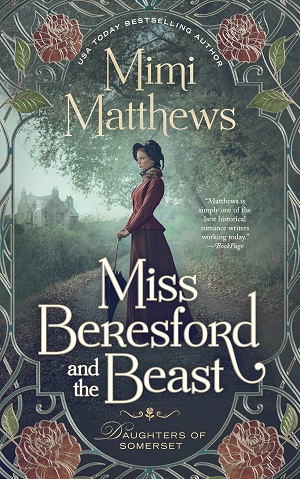
Miss Beresford and the Beast (Daughters of Somerset #1)
Chapter 1
Chapter One
Yorkshire, England
Dearest Agatha,
I am writing to you under separate cover owing to the odd circumstances that have lately befallen me.
Upon pain of death, you are NOT to share any of this with Mama and Papa!
Or with Nick or Arthur, either! If any of them were to hear of my situation, they would fetch me home immediately.
Which wouldn’t do at all. The whole purpose of spending my school holidays with Miss Champion and her widowed mother is to have new experiences.
Strange as these experiences have become, I’m not ready to abandon them for another dull summer in the West Country.
The truth (which you are NEVER to tell) is that I am not, in fact, staying with Miss Champion and her mother.
Or rather, I was, until three days ago when Mrs. Champion received a telegram informing her that her brother was on his death bed.
She departed that very night for Hampshire in a great rush, leaving Miss Champion and I alone here in Yorkshire.
And yes, I know how improper this all must sound.
Two girls of one and twenty, left to their own devices in a great big empty house in the wilds of North Yorkshire.
But I promise you, we’re not completely unchaperoned.
There’s the Champions’ housekeeper, Mrs. Goodenough, and their butler, Mr. Frog (though he is somewhat infirm, I confess, and only gets about with the aid of two sticks).
Which is entirely beside the point.
The point is, the Hall isn’t at all how it was presented to us—a quaint estate in a charming village with a delightful view of the moors.
The house isn’t quaint, for a start. It’s drafty and creaking, with dozens of cold, dark rooms and no dogs or cats to liven the atmosphere.
And the village! It certainly isn’t charming. Indeed, it’s CURSED!
The villagers hate the gentry. They even hate the Champions since they’re not true Yorkshire people but only come on holidays.
According to Mrs. Goodenough, it’s all on account of an evil gentleman—the son of a dissipated old earl, apparently—who once did terrible things.
He was so very bad that it brought a curse down on the village.
The crops failed, the livestock perished, and the villagers lost all their happiness and good cheer.
Even now, all these years later, with the earl and his son gone and never to return, no one dares go near the earl’s great manor house.
It stands abandoned on the edge of the moor, with a great stone wall about it all overgrown with thorny branches and brambles.
Miss Champion made me swear never to go near it, even if it means I must walk a whole quarter mile out of my way when I visit the village.
It’s the silliest superstition, but I abide by it, if only because the stories she and Mrs. Goodenough have told send a shiver down my spine.
I’ve too much imagination, that’s the trouble.
And they’ve left far too much out. My busy mind is quick to fill in the rest, and far more gruesomely too.
Doubtless the truth is much more mundane.
I must close now before the day gets away from me. I’m heading into the village this morning, and then to a very pretty bridge nearby where I mean to sketch and to read. An assignation, as you would say, with the person I like the best.
Please convey my regards to Mr. Aloysius (courtesy of a cuddle and a kiss). Tell him I shall be back with him soon. And do remember to give Artemis an extra bucket of mash when you ride her.
I remain, your loving sister,
Charlotte
P.S. Burn this letter!
Charlotte Beresford clutched her sketchbook, pencil case, dog-eared copy of the latest Jules Verne novel, and just-finished letter to her older sister, Agatha, against her breast as she descended the stairs.
It was half past nine. At home, the servants would have already been up for hours.
The fires lit, the morning meal prepared, and clothing pressed and laid out for the ladies and gentlemen to dress.
Not so here at Sowerby Hall.
The tiled entryway remained dark and silent, with no sign of Mr. Frog or Mrs. Goodenough. No sign even of Miss Champion.
It was no great surprise. During their past three years together at Mrs. Daventry’s Finishing School for Exceptional Young Ladies, Charlotte had never once known Lucinda Champion to rise of her own accord.
It had always taken repeated jostling, sometimes even unladylike shouts and threats, to get Lucy out of bed.
A necessity, then, if they were to be in class on time and avoid the ire of their schoolmistresses. But not a necessity now.
“I shall let her sleep until I return from my errands,” Charlotte resolved to herself as she passed through the door that led down to the kitchens via a narrow servants’ stair. “It won’t be long. Just a quick jaunt to the post office, and perhaps the general store, then a walk along the—”
“What’s that?” an aged voice inquired from below. “Is that Miss Beresford speaking?”
“’Tis I!” Charlotte called back, bounding down the last step.
A sharp turn around the corner and the kitchens opened before her.
Mrs. Goodenough stood at the black iron stove, stirring a steaming pot.
She was a portly woman with a frazzle of gray hair.
Kindly, as it happened, but rather too familiar, Charlotte’s father would have said.
Like a chiding old nurse instead of a proper housekeeper.
“Talking to yourself again, were you?” Mrs. Goodenough asked, still stirring. “Never did know a young lady who liked the sound of her own voice as much as you do.”
“I don’t like the sound of my own voice,” Charlotte replied. “Only my own company. And who else am I to talk to when I am alone?”
“In my day, young ladies were silent.”
“How terrible for you.” Charlotte reached past Mrs. Goodenough to retrieve a wicker basket from the counter by the sink.
She tucked her sketchbook, pencils, novel, and letter to Agatha inside of it, along with a shriveled apple and a dry crust of bread.
“Have we any cheese left from luncheon yesterday?” she asked.
“I thought I might use it to tempt the moor cats.”
“Feeding wild animals and the like.” Mrs. Goodenough clucked her tongue. “Who’d have thought it.”
“It’s only a kindness. There are ever so many strays about.”
“Be careful who you go showing kindness to in this village, miss. You never know when an evil creature might follow you home.”
Charlotte suppressed a laugh. “Come now,” she said. “Cats aren’t evil.”
Mrs. Goodenough flashed her a dour glance. “Who says I was talking about cats?”
Charlotte’s smile dimmed. It was more superstition of course.
This local belief in evil and curses. In her younger days, she might have been influenced by it.
Not now, however. Despite her occasional flutterings of girlish imagination, she flattered herself that she had matured into a woman of relatively good sense.
“The cheese?” she prompted the housekeeper.
With a disgruntled mutter, Mrs. Goodenough at last abandoned her stirring.
Wiping her hands on her dirty apron, she repaired to a cupboard where she retrieved a cloth-covered lump.
“This is all that remains until Frog gets himself to market.” She passed it to Charlotte.
“But give it to wild animals, by all means.”
Charlotte tucked the cheese into the basket.
An ancient coatrack stood by the kitchen door.
She’d hung her soiled outer garments there after her walk yesterday, and there they remained—her hat unbrushed and her cherry-colored wool redingote still sporting dried mud at its hem.
She put them on again without hesitation.
“I’m happy to purchase more cheese,” she said to Mrs. Goodenough. “I shall be stopping at the post office. I can easily stop at the market too.”
Mrs. Goodenough returned to the stove where she promptly resumed her stirring. “You must do as you please, miss.”
Charlotte looped the basket over her arm. “Do you know,” she said cheerfully. “I do believe I shall.”
Exiting the house with a smile, she strode off through the yard and out the gate onto the winding road that led into the village.
It wasn’t freedom like she’d imagined it being.
Not here, in the middle of nowhere, with no one to welcome her and nothing much to do.
But it was freedom of a sort. North Yorkshire was far removed from the stifling control of Mrs. Daventry and her finishing school.
Even farther removed from the control of Charlotte’s mother and father, and the meddling of her overprotective older brothers.
Here, in this abandoned house and cursed village, she could do what she wished. Left alone to wander, to think, and to daydream. To finally come to a decision about what she wanted to happen in the next chapter of her life.
She already knew what her parents wanted.
They’d like her to have a London season.
To make a brilliant match. It was the goal of everything Charlotte had endured thus far.
The governesses, the deportment lessons, the finishing school.
She was the daughter of a viscount. The granddaughter of an earl.
Pretty enough in her own right, and worth a hefty sum upon her marriage.
Yet, her mother had made it clear that it was Charlotte’s wishes that would ultimately prevail.
If only Charlotte knew, beyond all doubt, what those wishes were.
Did she desire to be a spinster, like Agatha? Or did she want a season and all the trappings that came with it—beautiful gowns, dazzling parties, a handsome suitor to win her hand and, if she was lucky, her heart?
“A puzzle,” Charlotte remarked to herself as she walked. “How does one know what one wants in the abstract? Wouldn’t it make more sense to experience it all and then decide? To be on one’s own for a time, and to be in love with a fellow for a time, and to weigh the two as carefully as a judge?”