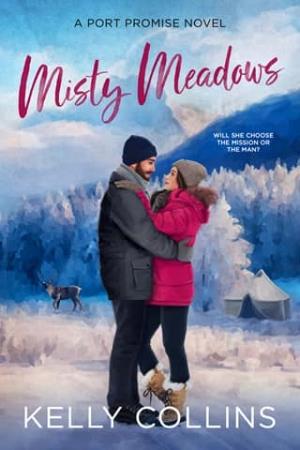
Misty Meadows (Port Promise #3)
Chapter One
ARIS
There are three things I despise in this world: hypocrisy, bad data, and being forced to work with someone whose easy grin makes me forget why I'm angry at him in the first place.
When my late mentor asked me to find the most elusive caribou in Alaska, I didn't expect the job to start with a floatplane free-falling out of the sky and slamming into a freezing harbor.
I didn't expect the forty-minute side-by-side ride up the ridge either, with Reid Hollister at the wheel, delivering an unsolicited sibling-by-sibling assessment of the men I was about to meet, beginning with himself.
And nobody warned me about the front-row seat to the Hollister family hunting empire.
Now I'm standing outside Crystal Creek Lodge in the bitter January cold, watching Nash Hollister run through equipment specifications while Finn and a woman watch from inside, framed by the big bay window.
Nash Hollister, the charming "logistics expert" outlining the payload capacity of his snow machine, is exactly the sort of man I've built a career learning to argue with, and he does it with a confidence that has me clenching my jaw and noticing things I have no business noticing.
"… so the main sled can haul about five hundred pounds of gear, plus another two hundred in the secondary trailer," he's saying, his voice a low, easy baritone that seems designed to soothe panicked tourists and charm wealthy clients.
Which, apparently, includes me now, though I'm neither wealthy nor charmed. Much.
I nod, my eyes drifting past him to the trophies mounted inside the lodge, visible through the window.
They stare back with glassy eyes, a silent reminder of what this place is built on.
I'm here to study caribou, and my guide makes a living helping people kill them.
The irony isn't lost on me, even if the university's funding department seems oblivious to it.
"And the route?" I ask, my voice clipped, professional. I refuse to let him see how much this arrangement bothers me, or how his competent explanation of wilderness logistics is annoyingly impressive.
"Let's head inside where it's warm," Nash says, gesturing toward the lodge with hands that look strong and capable. "I'll show you the route on the topographical maps."
Perfect. Back into the mausoleum of mounted antlers and my own moral contradictions.
We move inside, and I'm immediately hit with the warmth and the oppressive atmosphere of the lodge. Nash moves to the large dining table by the window and spreads out a map, smoothing the edges flat with movements that suggest he's done this hundreds of times.
The woman—Mags, she said with a nod—and Finn step back, giving us space for the technical discussion. "The route to the Black Creek basin runs through here," he says, pointing to a spot marked with elevation lines. "About twelve miles of rough terrain once we leave the main trail."
I study the map, tracing the lines with my finger while trying to ignore the pine-and-motor-oil scent of him, which has absolutely no business registering at all. This hunter somehow makes the route briefing feel like the start of something worth doing.
The university's email had been deceptive: "We've secured the services of Hollister Wilderness Logistics, the best in the region for remote winter access.
" They'd failed to mention that "logistics" was a polite euphemism for a high-end hunting guide service, or that the guide in question would be built like a distraction I hadn't budgeted for.
"My research requires minimal ecosystem disturbance," I say, the words feeling inadequate against his practical competence.
"And my operation requires getting you and your half-ton of expensive gear across twelve miles of frozen wilderness without you ending up at the bottom of a ravine," he says, not looking up from the map but with just enough humor in his voice to take the sting out.
"I disturb the ecosystem as little as possible. It's bad for business."
His matter-of-fact response should irritate me. The corner of my mouth disagrees. His straightforward approach is refreshing, even if his profession still makes me want to lecture him about wildlife conservation.
"I know I was supposed to stay here tonight," I say, "but I'd like to get started right away. Latest sighting reports put Waldo on a direct migration path toward these mountains. Every hour counts."
Nash looks up from the map. One eyebrow goes up. "Three years chasing one animal? That's either dedication or obsession."
"The line between the two gets blurrier every winter," I admit, surprising myself with my honesty. But his direct gaze makes deflection feel pointless.
"Fine," Nash says, straightening to his full height, which I definitely don't notice.
"We can head out. But we still need to inventory your gear properly, make sure everything survived the trip and is calibrated for the conditions we'll face.
We'll stay the night at Misty Meadows, get the process started, and that will put us in position for the real push tomorrow. "
He looks at me with steady eyes that seem to assess everything—my determination, my preparedness, probably my chances of survival. Right now, I'm probably failing the survival half.
"Let's load the gear then," I say, the words feeling like a small victory.
Mags and Finn step forward again as we finish the route discussion.
"There's been a change of plans," I announce. "We're heading out this afternoon instead of staying tonight. The research grant will still cover the room, of course."
Finn shrugs with the easy acceptance of someone accustomed to clients with shifting schedules. "Weather's holding," he says. "It's a good day for travel."
Mags steps forward and, before I can protest, pulls me into a brief, fierce hug. "Stay safe out there," she murmurs. "And don't let this one give you too much trouble." She nods toward Nash with the look of someone who has already decided how this ends, which makes my cheeks burn.
"I'll try to contain my troublemaking to the essentials," Nash says, his infuriating grin spreading across his face.
Six weeks. I'm going to need a much better plan.
I'm not here to make friends. I'm here for Waldo.
Waldo. The name my late mentor, Dr. Thaddeus Brine, had given the magnificent, elusive caribou bull.
For three years, that animal has been my obsession.
He's the lynchpin of my research, the key to understanding the shifting migration patterns that could have devastating consequences for the entire herd.
Thaddeus believed Waldo was genetically unique, a leader whose instincts were adapting to climate change in ways we'd never seen.
Finding him, collaring him, tracking his journey—it was Thaddeus's life's work.
And when he died last year, it became my promise to him.
A promise I intend to keep, even if the man helping me keep it smells like pine trees and motor oil and makes me want to argue about everything.
"This is the last of it," Nash says, securing a large Pelican case to the sled. He moves with the confidence of someone who's done this a thousand times, every motion efficient and sure. He belongs here. I'm the intruder, the fish out of water, dependent on his expertise for survival.
"Ready, Doctor?" he asks, wiping his hands on his jeans. I examine the horizon.
I pull my parka hood up, cinching it tight around my face until only my eyes are visible. "Ready."
He helps me onto the rear of the snow machine, his hand brief but warm on my elbow. The touch lasts half a second. My pulse takes notably longer to agree it was nothing.
"You'll want to hold on tighter than that," he says over his shoulder as I grip the side handles. "The trail to Misty Meadows gets rough."
"I'll be fine," I say through gritted teeth, because admitting I need to hold onto him feels like surrendering something important.
He chuckles, a low sound that I feel through the seat, then guns the engine. The machine lurches forward, throwing me against his solid frame, and suddenly I'm grabbing his waist to keep from falling backward into the snow.
His body is solid beneath the thick jacket, warm through all my layers. I hold on for one breath longer than necessary. Then I let go, which is harder than it should be.
The journey is cold and loud and relentless, and Nash handles the machine like the terrain owes him something.
We fly across open stretches of snow, the engine's roar the only sound in the vast, silent country.
Towering pines, heavy with white, flash past in a blur.
The air is so cold it feels sharp in my lungs, each breath a tiny, crystalline pain.
Through bumpy sections and steep inclines, every jolt pushes me against his back until holding on stops being optional. His strength registers without permission. He leans into the turns before they arrive, reads the terrain with instincts I'm fairly sure weren't taught in any classroom.
After what feels like an eternity, he slows the machine, cutting a wide arc into a clearing sheltered by a dense stand of spruce.
Ahead, nestled against a rocky bluff, is a two-story house of cedar and stone.
The stone chimney stands cold and silent against the piercing blue of the sky.
It looks like it was built by someone who decided permanence was more important than comfort.
Misty Meadows. His cabin. My home for the night.
He kills the engine. The wilderness fills the space immediately—wind, a distant bird call, nothing else. My ears take a moment to accept it.
"Home sweet temporary home," he says, swinging his leg off the machine. "We'll unload, get your gear inside, and then we can go over the route into the basin for tomorrow."
I slide off the back, my legs stiff and cold, and look at the cabin.
It's clearly a place built for function rather than comfort, though there's something undeniably appealing about its solid, no-nonsense construction.
A rack of snowshoes hangs by the door. A stacked cord of firewood stands against one wall.
Through the single front window, I can see into the dim interior.
"I'll get the heavy cases," he says, lifting one with an ease that drags my eyes to his forearms before I can stop them. "You can grab your personal pack."
I nod, shouldering my bag and following him toward the cabin door. He pushes it open, and the faint warmth from a banked fire greets me. The scent of cedar, woodsmoke, and old leather lingers in the air.
And above the stone fireplace, staring down at me with the patient indifference of the dead, is the mounted head of a caribou. The antlers are enormous.
I stop dead in the doorway, my breath catching. The animal is beautiful, even in death. Especially in death. A monument to everything I'm trying to save.
Nash follows my gaze. "That was my grandfather's," he says, quieter than I've heard him. "Took him on this ridge, almost forty years ago. Said it was the smartest, toughest bull he ever tracked."
I stare at the creature and can't look away. Something catches below my ribs and stays there. He sees legacy. I see loss.
"I need to check my equipment." The words come out thin.
"Take the loft," he says, gesturing toward a sturdy ladder leading to a sleeping area above. "There's a cot up there. More privacy."
Privacy. In a loft that overlooks his great room, in the middle of the Alaskan wilderness, privacy is an illusion. There's him, and me, and the dead bull on the wall between us, and weeks of wilderness ahead.
I climb the ladder without another word, my pack feeling heavier with each rung. The loft is small but adequate, enough space for a narrow cot and a small table. A single window looks out over the snow-covered meadow.
I drop my pack and sit on the edge of the cot. Below, Nash moves through the cabin. A drawer opens, the stove clicks on, something metal is set down on a counter. He sounds settled. I sound like the problem.
The mounted head stares up at me from below, visible through the loft slats. It's magnificent, still, exactly where it didn't expect to end up.