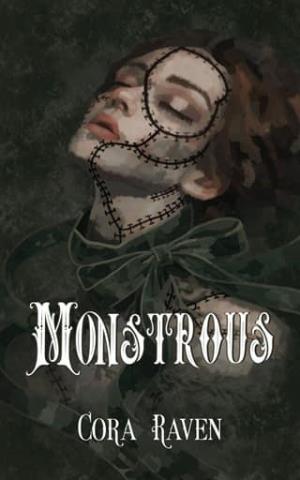
Monstrous
Chapter 1
The human body was such an optimistic arrangement, considering how easily it came apart, and how quickly it began to rot.
Three minutes, perhaps, before the brain began to fail without oxygen. Five, if fortune was feeling generous. After that, there was little worth preserving. Thoughts dissolved first, then awareness itself, until whatever essential quality made a person themselves slipped beyond reach.
Within fifteen minutes, pallor mortis settled over the skin.
Drained of warmth, the flesh paled as the body began to negotiate its surrender to the earth.
Soon after came rigor mortis—the muscles stiffened in orderly progression, beginning with the delicate hinges of eyelids and jaw before working downward through the limbs until the entire form locked itself into its final position.
No longer urged forward by a beating heart, blood sank to the lowest points of the body, pooling there in slow blooms of violet and blue.
I had memorized it all, not out of morbid fascination—though I could hardly deny the inclination of my thoughts toward such darkness these days—but because understanding the stages of death felt, lately, like recognizing some essential part of myself.
I glanced down at my gloved hands.
Even through the leather, the cold bit my skin, familiar and deeply unwelcome.
My fingertips were turning purple again.
It began as it always did, with a pins-and-needles tingling that might have been mistaken for simple cold if one did not know better.
But I knew better.
Beneath my nails, a deep bruised discoloration was already emerging, spreading outward in branching veins, staking its claim on my flesh regardless of every evidence that I remained, technically speaking, alive.
I dug my fingers into my palm, squeezing until my nails bit through the fabric.
For a fleeting instant, I wondered what it might feel like to press hard enough to split the skin, to see if anything beneath it still resembled blood.
Do it, the voice urged, my dark little companion rousing from the back of my mind. See for yourself what you're becoming.
I unfurled my fingers, forcing the thought away before it could fester.
That was the first sign the day intended to betray me.
The second was the realization that I was horribly and unforgivably late for the interview I had rehearsed in my mind a hundred times.
Rain fell in thick, relentless sheets, soaking through my cloak and chilling me down to the bone. My boots slipped on the wet cobblestones, forcing me to concentrate on each step so I would not arrive at Dr. Ambrose's door in a graceless heap of sodden fabric and bruised dignity.
It seemed a peculiar kind of cruelty, that the world continued to demand composure from a body that could barely manage upright.
It had not always been like this.
Not until the day I had died.
I retained no memory of it—no final gasping breath, no brilliant white light, no sense of anything waiting beyond. There was only silence, and then, inexplicably, the ceiling of a hospital ward and a physician using the word fortunate as though it were a gift he was pressing into my hands.
I certainly did not feel fortunate.
I felt like something that had been dragged back from wherever the dead go, only to discover I had returned incomplete.
Some essential part of myself had been left behind in that darkness, misplaced or forgotten.
What came back was a partial rendering of who I might have once been.
Occasionally, I liked to imagine what that woman was like.
Perhaps I had been soft and kind and gentle.
All the things I was not now.
Unfortunately, I did not know. Death had stolen my memories along with my soul.
The last clear recollection I possessed was from childhood.
Everything beyond it existed only in fragments—my young womanhood remained obscured, glimpsed through a fog that never quite cleared, and the months, perhaps years, preceding my collapse were gone entirely.
The physicians had their theories. Oxygen deprivation to the brain during those crucial minutes without breath.
Trauma from the incident itself. The sort of cognitive deterioration that sometimes accompanied severe medical events.
None, however, seemed to have any explanation for the symptoms that remained.
The weakness deepened instead of improving, the discoloration of my flesh followed. My pulse grew more erratic, and my body temperature dropped steadily, until warmth became something I chased but could never quite reach.
Worse than the physical decline, worse even than the gaping absences in my memory, was the melancholy.
It arrived so gradually I had not noticed the light going until it was already gone. A constant thread of gray wound through everything, staining my mind in a wash of inescapable sadness. I longed for something or someone and the aching absence bordered on physical pain.
I was mourning, though I could not name the object to which the grief belonged. Perhaps I mourned myself, for those pieces that had slipped away—the history of a life I no longer remembered.
In the following weeks, the voice had emerged, settling into the darkest corners of my skull. It was faint at first, so much so that I had convinced myself it was simply my own misery turned inward, my grief finding a shape and a register I did not recognize as my own.
Over time, despite my better judgment, I grew accustomed to it.
I became so well acquainted with this uninvited and slightly morbid companion that the odd things it whispered no longer shocked me.
What had once unnerved me now passed with little more than acknowledgment, its presence woven so seamlessly into the edges of my thoughts that I no longer startled at its quiet intrusion.
Rationally, I knew this suggested there was something deeply wrong with me. A person of sound mind would be horrified to hear a voice residing in their head, but I could no longer say I occupied that category with any confidence.
I tried my best to ignore it, just as I ignored all the other gifts death had seen fit to return me with, but honesty forced me to admit the voice had become dangerously close to a friend. Perhaps my only friend.
At least it spoke to me. At least it acknowledged I existed.
In the months since my recovery, I had consulted several physicians regarding my symptoms. I attempted to explain what I was experiencing—the sense that something had broken inside me and would not mend.
They listened with the sort of patience reserved for the fairer sex, their expressions betraying what they would not say aloud.
Each consultation ended the same way—more rest, less stimulation, time and quiet, and the confident assertion that my feminine constitution simply needed opportunity to recover from the shock I had endured.
So I endured, because what else was there to do?
Perhaps the person I was now was simply what I had always been—a foul toxin with rotting flesh and terrible thoughts no one would notice until it was too late.
The deadliest specimens rarely looked dangerous, after all.
They bloomed prettily throughout polite society drawing rooms, admired by so many who had no idea they were leaning in close enough to kiss death as they bent to smell their sweet aroma.
I tried very hard not to dwell on such thoughts.
Hope had nearly abandoned me entirely, ground down by the relentless combination of grief and the void where my memories should have been, until Mr. Finch paid his visit.
He was my father's solicitor, a round-faced man with kind eyes and an unfortunate tendency toward fussing.
He had come to discuss estate matters, though I suspected he had noticed my deteriorating condition and decided intervention was required.
The conversation about property and signatures was mercifully brief. What followed was less expected.
He produced a newspaper from his coat, already folded to display a circled advertisement, and placed it before me with an expression of reserved pity.
"I thought this might interest you," he said simply. "There is a doctor seeking a botanical assistant, and given your expertise and your current circumstances, it seemed worth bringing to your attention."
I stared at the circled text.
Seeking a botanical assistant for research in dementia. Experience with rare and toxic specimens preferred. Live-in position. Privacy and confidentiality required.
Dr. Nicholas Ambrose
My chest squeezed uncomfortably as I read it, though I could not have said why the man’s name stirred such an odd sensation.
"His methods are controversial, by all accounts,” Mr. Finch continued, “but his work is considered brilliant. I thought the position might provide you with meaningful occupation and..." He hesitated delicately. "Access to research that might prove relevant to your own situation."
He had not said cure, but I heard the word anyway, hanging in the space between us, a tempting lure placed neatly in front of a starving animal.
After he left, I remained in my father's study, reading and rereading those few lines until the words blurred together. Hope took root, then grew sharp and insistent, pressing against my ribs with an urgency that bordered on desperation.
Over the following days, I devoured every paper Dr. Ambrose had published—every documented experiment, every theoretical framework he had proposed.
His work was decades ahead of conventional thinking, suggesting that memory might be preserved, perhaps even restored, through application of specific botanical compounds.
His peers dismissed him variously as unorthodox and dangerous, but even his harshest critics could not deny his brilliance.
In truth, I cared nothing for his reputation. I cared only whether he might be right. Regaining the stolen pieces of a life I no longer remembered was all that mattered to me.
I did not mention this hope in my application letter. Instead, I presented myself as qualified, competent, and useful—and omitted, conspicuously, any mention of being a woman in the slow process of dying.
Dr. Ambrose's response arrived the very next day. It was a simple note accepting my request for an interview, the handwriting economical, though the closing line seemed to falter, as if the hand that wrote it had hesitated before finishing.
Which brought me here—late, freezing, and desperately attempting to conceal the postmortem lividity creeping up my hands.
The iron gates materialized through the curtain of falling rain, tall and ornate, flanked by stone pillars bearing intricate carvings.
Even through the onslaught of the storm, I could make out the pattern etched into the metalwork.
Vines curled with botanical perfection, each tendril and leaf rendered with an attention to detail that spoke of genuine knowledge rather than mere decoration.
I forced my attention beyond the gates, to the house itself.
Dark stone rose against the gray sky, ancient and imposing, suffocated in a tangle of impenetrable vines, indifferent to the weather assaulting it.
Long, dew-covered windows reflected nothing but clouds and falling rain.
Chimneys exhaled thin threads of smoke that the wind greedily tore apart.
The architecture was all sharp angles and peaked gables, giving the structure the impression of something unearthed rather than constructed.
The sight made my pulse stutter before resuming its erratic pattern. The manor was disturbingly familiar, though I knew with absolute certainty I had never been here before.
And yet the sensation persisted—that I was returning rather than arriving, coming back to something I had somehow forgotten.
I shoved the notion away and stepped through the gates.
The path stretched before me, lined with skeletal trees whose branches hung heavy with accumulated rain. Soon, I imagined, they would create a lush canopy overhead, but for now they looked like reaching hands, beckoning the unsuspecting victim toward some inevitable end.
I paused halfway along the path, my breath coming harder than the exertion warranted. Dizziness threatened at the edges of my vision, and I watched my breath materialize in pale clouds before dissipating, trying to anchor myself to something immediate.
My hands had gone numb inside my gloves.
I flexed my fingers, but felt only a distant ache, that sense of my flesh belonging to someone else entirely.
The necrosis was spreading, claiming more territory with each passing minute.
What would happen if I simply stopped fighting it and let it consume me entirely?
I think you should find out, the voice said, anticipation curling through the words.
I lifted my chin and resumed walking, forcing my attention forward rather than inward. The voice could whisper all it liked. I would reach Ambrose House, secure the position, and perhaps, find some explanation for what was happening to me—some hope of restoration in Dr. Ambrose's research.
The front door rose before me, heavy wood reinforced with iron bands, the surface aged but well-maintained.
The knocker was shaped like a serpent coiled around what appeared to be sprouting leaves—another merging of the natural and the crafted, a small detail suggesting the house's occupant understood botany on an intimate level.
I raised my hand to knock, then caught sight of my reflection in a window beside the door.
I looked like something the weather had tried and failed to kill.
Auburn hair escaped its pins in wind-tangled strands, and my skin had paled to the point of translucence, making my eyes appear feverishly bright by contrast. The only real color against my dark coat and the gray world around me, was the green velvet ribbon tied at my throat in a neat bow.
I had woken in the hospital wearing it and had worn the ribbon every day since, though what lay beneath was better left unexamined—never to be seen, even by me.
I touched it now, tempted to unfurl the knot and see what gruesome act had been done to pull me back from death, but I could never bring myself to do it.
I turned to the door and knocked. The sound resonated deeply, then was swallowed by the relentless storm.
Doubt began its quiet work as I waited—that familiar, insidious murmur that had followed me for months.
Perhaps Dr. Ambrose had changed his mind, had reviewed my application a second time and decided a woman was unsuitable after all, regardless of her qualifications.
Perhaps this too would amount to nothing, and I would walk home through the rain and sit in my father's empty study, simply waiting for the walls to close in around me.
Then the door opened, and every rational thought fled my mind.