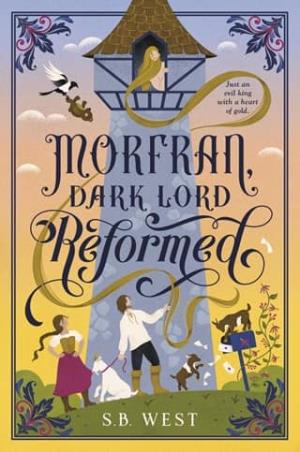
Morfran, Dark Lord Reformed
Chapter 1 An Unwelcome Message
An Unwelcome Message
Dear Diary,
It is day two hundred and forty-eight, and I am still not dead. Progress on the lute has been going melodiously well, and Benjamin has finally given birth to two kids. Their adorable bleats woke me up first thing this morning, and I can already tell it’s going to be a splendid day
A noise that sounded like a cat throwing up arose from the yard.
Morfran the Beheader lowered his quill, glanced out at the soft morning sunlight warming his property, and listened.
From the barn, which he’d painted a quaint, pastoral red with the blood of highwaymen who thought him an easy target when he first moved in, he could hear it: the delicate bleeaat of Benjamin’s kids.
It wasn’t a sound he was used to. No, he was used to dying wails on some battlefield and piteous pleas of de-legged men who’d suctioned themselves to his boots as he tried to walk past, and their grunted oofs as he promptly kicked them off.
But this—this little noise that was barely a noise as the wispy-furred kids curled up beside their mother’s belly—this was welcome music to his ears.
Content that they were well, he picked up a wedge of rye toast he’d topped off with his delightful raspberry jam recipe and savored the warm, sweet moment.
It’d been two weeks since he’d last seen another human face, and it was glorious.
There was no ugly mug coming to tell him that the expected shipment of pikes and halberds was somehow lost in transit near the southeast coast. There was no one coming to tell him soldiers were complaining about having to march through the Marshes of Mush and getting soggy socks (though this was a mostly reasonable complaint).
There was no one coming to tell him about an argument between his two best generals that “involved jealous feelings and a wench and a shiv and oh, we need to appoint two new generals because the argument is now over and neither of them survived the stab-happy wench.”
Here he could just be. The weather in the southlands was relatively mild, the winters were wet and weak, and even during the chilliest of days there was the promise of sun. It provided bounteous opportunity for him to work on his tan, which he’d already indulged in, foil reflector and oils and all.
His farm was perfect as well; a steal of a bargain, it was. It only cost him the lives of the three others vying for the property, and afterwards he buried his sword (again) behind the barn and wiped his hands clean of their blood in the stream at the far end of the yard.
It was in that moment, as he watched the cold water wash the red from his hands, that he officially announced it to Benjamin.
“That’ll be the last of it,” he affirmed as the she-goat gnawed thistle weed by the bank.
“For real this time. No more beheadings. It is unseemly, and I recognize it can be upsetting for some people.” Then, as an afterthought: “And if I am to be just a goat farmer, such things might be an uncommon hobby and raise suspicions.” He paused, shuffled in place, and amended, “I should probably stop killing people.”
After that he felt like a new man. He burned his cloak and bloodstained gloves in the kitchen hearth that night, and the next day at market bought a set of peasant clothes, complete with his own set of ugly peasant hose.
Then he ditched the scissors and grew his hair out and even kept a trimmed beard, which he’d never had permission to do before, because Ravana despised facial hair.
“It’s like kissing the rear end of a sweaty ox,” she’d complain.
(How she knew such a thing, Morfran had always been too afraid to ask.)
He had to look the part of a goat farmer: property, goats, and appearance. And when he gazed into the stream one morning after the makeover to study the man peering back at him—a lean, dark-haired rustic with green eyes—he hardly recognized himself.
Good. It meant his men wouldn’t, either. As for Ravana…she’d recognize him. She had that uncanny ability of stripping down the truth within moments. She’d recognize him for sure. He’d just have to stay out of her sights, if she ever did leave Castle Atrago clear in the northlands.
He finished the last of his raspberry toast and went to check on Benjamin, whose delicate head lay in her bed of straw, her tongue hanging limply out of her agape mouth like a fat pink worm plucked fresh from the garden.
Poor thing is exhausted, he thought with affection, kneeling before her and her two kids, who’d fallen asleep while nursing.
They’d be the first in a pedigreed lineage of goats he intended to establish here.
In just a few years, roaming the green valley of his farm, there’d be hundreds of goats, an army of goats, and, sheltered among them, he’d build an empire on the finest damn raspberry jam the southlands had ever seen.
He’d already envisioned it. His jam would win the first-place blue ribbon in the county fair, and it would continue to win for eleven years strong until a rival jam maker—he imagined it to be a stout woman with massive jowls whose fifteen-year-long title he’d usurped—would come back with a vengeance.
She’d set his farm on fire and steal Benjamin’s kid (kids, he corrected; he hadn’t been expecting two), and everyone would be gutted when he became too distraught to make his jam.
Then he’d find his second wind and go on a rampage searching for Benjamin’s kids and find them stashed away in an old butchery the woman sold them to.
After rescuing them in the nick of time, he’d then unearth his buried sword and go find that jowly woman to deliver quick judgment.
And as he’d raise his sword above her bedside where she slept, he’d maybe shed a tear or two over how desperation had driven him back to a life he’d tried so hard to leave, but these were Benjamin’s kids, and he’d promised to protect them, and—
“Are you Bernard?”
The voice tore him out of his daydream so unexpectedly he leapt to his feet, growling and slashing out with an imaginary sword at the barn’s entrance, where a man stood.
The man didn’t flinch. Instead, his eyes rolled up towards the hayloft, and he muttered something that sounded suspiciously like “drawing the short straw.” In his hands was a letter.
Morfran narrowed his eyes at him. “Did you stay off my lawn?”
“Yes.” The courier glowered. “It was hard to not notice the thirteen signs you posted that read ‘stay off my lawn.’ ”
Morfran nodded briskly, still distrustful. “Good.” He thrust his hand out towards the courier. “Now give it to me.” Peasant, he wanted to add, but he did have a disguise to maintain, so he begrudgingly kept his tongue.
The courier stretched out his hand as if he were reaching towards a particularly slimy slug.
Morfran raised his eyebrow and snatched the envelope, glancing over it.
It was off-white and made of fine parchment, and when he turned it over, he saw something that raised the hairs on the back of his neck: a wine-red wax seal of a magpie eating a marigold.
“Get out,” he muttered, eyes fastened and unblinking on the seal. “I said get out! And don’t walk on my lawn!”
No reply. He looked up. The man was already gone.
He pressed his lips together, looking down at Benjamin. She’d woken at his outburst, blinking sleepy, incurious eyes at him. You doing all right there, Morfran?
I don’t know yet, Beni.
He slid his fingers into the envelope’s slit, breaking the seal. It could be a coincidence. It could be someone other than her, someone who used the same seal. Marigolds and magpies were common enough emblems. Originality was dead, anyways, wasn’t that the saying?
Then he saw the lone words, written in scrawled, feminine handwriting, and all hopeful doubts vanished.
Found you.