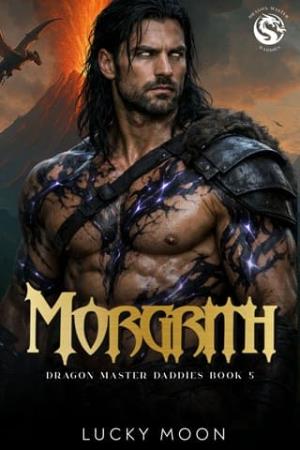
Morgrith (Dragon Master Daddies #6)
Chapter 1
Lena
The boy's hand burned in mine like a coal pulled fresh from the forge. Six years old, maybe less—it was hard to tell with the fever swelling his face, his breath coming in wet rattles that echoed off the cottage's stone walls. Bram, his mother had said when she sent for me. His name is Bram.
I knew that already. I'd watched him chase chickens through the village square last summer, shrieking with laughter while his father pretended to scold him.
The blacksmith's son. The boy everyone smiled at, everyone touched—ruffling his hair, pinching his cheeks, swinging him up onto their shoulders.
Now he lay on a straw pallet in a cottage that smelled of sweat and failed remedies. Herb poultices littered the floor. A bowl of some pungent tea sat cooling on the windowsill, abandoned. Three days, they'd said. Three days of the village healer's best efforts before anyone thought to send for me.
They always wait until there's no other choice.
I didn't take it personally anymore.
In the corner, his mother Dessa wept without sound. Tears carved tracks through the grime on her cheeks, but she kept her hands pressed over her mouth, muffling her grief as if noise might somehow make it more real. Her eyes never left her son's face. She hadn't looked at me once since I'd arrived.
"Bram." I kept my voice soft, gentle. The voice I used for frightened animals and dying men. "Can you hear me? I need you to look at me, sweetheart."
His eyelids fluttered. Underneath, his eyes had gone glassy and distant, pupils too large for the dim firelight. But something in him stirred. Some small part still fighting.
Good. That made the work easier.
"You're very brave," I told him. "The bravest boy in Thornhallow, I'd wager. This is going to feel strange—like falling into a cold stream, maybe. But then you'll be warm again. Then you'll be able to play."
I didn't know if he understood. It didn't matter. The words weren't really for him. They were for me, a ritual to mark the moment before I stopped being Lena and became something else. A vessel. A conduit.
A thing that swallowed pain.
I closed my eyes and opened myself.
The fever poured into me like drinking fire.
It started in my palm where our skin touched—a rush of heat so intense I almost jerked away.
But I held on. I always held on. The infection mapped itself onto my body: his lungs became my lungs, filling with fluid and failing tissue.
His headache split my skull. His aching joints became my aching joints. Every nerve he had, screaming.
I felt myself gasp, distantly. Heard Dessa's sharp inhale from across the room.
The boy's breath was already easing.
The fever had teeth. It clawed at the inside of my chest, trying to find purchase, trying to do to me what it had almost done to him.
For a moment—just a moment—I understood why wound-walkers rarely lived past forty.
Why we burned out and crumbled like autumn leaves.
This wasn't healing. This was war. And I was the battlefield.
I gritted my teeth and began to transmute.
The process was impossible to describe to anyone who hadn't done it.
Like trying to explain color to the blind.
I took the sickness—that writhing, burning thing inside my chest—and I compressed it.
Ground it down between the millstones of my will.
Every breath became an act of violence against the infection. Every heartbeat hammered it smaller.
Time dissolved. There was only the work.
An hour, maybe longer. The fire in my chest became an ember, then a spark, then a wisp of smoke I could finally—finally—push out on a shuddering exhale.
When I opened my eyes, I was on my knees on the hard-packed floor. I didn't remember falling. My hands shook so badly I couldn't have held a cup of water if my life depended on it.
But Bram was sleeping. Real sleep, not the terrible stillness of before. His cheeks held color. His breath came soft and even, a child's breath, peaceful.
I'd saved him.
The thought should have brought satisfaction. Instead, I felt hollow. Scraped clean and left empty.
Dessa finally looked at me. Her eyes held something complicated—gratitude, yes, but also fear. Revulsion, maybe. The look people gave things they didn't understand and didn't want to understand.
"He'll sleep through the night," I said. My voice came out rough, scraped raw. "The fever won't return. You should get him to eat bone broth when he wakes. Small sips at first."
She nodded without speaking. Her hands stayed pressed to her mouth.
I tried to stand. My legs buckled. I caught myself on the edge of the pallet, narrowly avoiding crushing the boy I'd just saved, and for a moment I just knelt there, breathing, waiting for the world to stop spinning.
Dessa's hands were cold where they gripped my elbow—cold and quick, touching me only long enough to guide me to the chair by the hearth before pulling away like I might burn her. Which was funny, really. I was the one still smoldering.
"Sit," she said. Not unkindly, but not warmly either. The voice she might use for a stray dog that had wandered in from the rain. "I'll get you something."
The chair was hard-backed and uncomfortable, positioned too far from the fire to catch any real warmth. I didn't mention it. I didn't mention anything. I just sat and tried to remember how to breathe without the rattle of infected lungs echoing in my chest.
Dessa moved around her small kitchen with the efficiency of a woman who'd rather be doing anything else. She cut bread without looking at it. Sliced cheese the same way. Poured broth from a pot over the fire into a cup she set on the table—not handing it to me, just placing it within reach.
"Thank you," I said.
She nodded once, then retreated to her son's bedside like I was a fire she didn't want to stand too close to.
I ate because I knew I should. The bread tasted like sawdust. The cheese could have been wax for all I registered of it. The broth was good—rich and salty—but my stomach rebelled at the thought of more than a few sips.
I was finishing the bread when the cottage door banged open and the blacksmith filled the frame.
He was a big man, Bram's father. Shoulders like oxen yokes, hands permanently blackened from the forge. The kind of man who could crack another man's skull without meaning to. Right now, those hands were trembling.
"He's well?" His voice came out hoarse. He didn't look at me. "The healer—she said you were coming—he's well?"
"Sleeping." I set down the cup of broth. "He'll recover fully."
The blacksmith's whole body sagged. He crossed to the pallet in three huge strides and knelt beside his son, and the sound that came out of him—something between a sob and a prayer—made me look away.
When I looked back, he was fumbling coins from a pouch at his belt. He counted them onto the table without meeting my eyes, his fingers clumsy with emotion. Twenty pieces of silver, exactly right.
"Thank you," he muttered. The words seemed to cost him something. "We're . . . grateful."
I swept the coins into my palm. "The broth was enough thanks."
It wasn't, of course. But saying so wouldn't change anything.
The blacksmith was already gathering his son into his arms, cradling that small body against his broad chest with such infinite tenderness that something cracked open inside me.
His big, rough hands—hands that bent iron and shaped steel—gentle as silk on the boy's fevered hair.
Bram stirred, murmured something, settled against his father's shoulder like he'd found the safest place in the world.
I stood up too fast. The room tilted.
"I'll show myself out," I said.
Neither of them looked at me as I left.
The walk back to the inn took forever.
Dusk had settled over Thornhallow like a bruise, purple and gray and thickening toward true dark.
The mist that perpetually shrouded this corner of the Eastern Reaches seemed heavier tonight, swallowing the village in cotton-thick silence.
My footsteps sounded muffled, distant, like they belonged to someone else.
The villagers were emerging from their homes for evening tasks—fetching water, checking livestock, calling children in for supper. One by one, they noticed me.
One by one, they stepped aside.
It wasn't dramatic. No gasps, no pointing fingers.
Just a subtle shifting, the way water parts around a stone.
A woman crossing the lane to the well suddenly found a reason to wait until I passed.
A group of men outside the tavern fell silent as I approached, their conversations resuming only when I was safely distant.
A young mother pulled her daughter closer to her skirts. I heard the whisper: "Don't look, sweetheart."
An old man made a warding sign against evil—the same gesture my grandmother used to make against storms. He thought I didn't see. I always saw.
I kept walking.
The guest house sat at the edge of everything, where the village's last proper houses gave way to scrubland and the mountains' perpetual fog.
It was a small place, stone walls and a thatched roof, a door that stuck in wet weather.
The villagers said I could stay here for the week, until I was strong enough to leave.
The hearth was cold when I pushed inside. Of course it was. I hadn’t had time to bank the fire. Bram was the priority. And of course, no one had lit the fire for me while I was gone.
The cottage felt like a held breath. Waiting. Empty.
I found flint and tinder by touch in the darkness, sparked a fire more from habit than desire. The flames caught slowly, illuminating the space: a bed with a single blanket, a table with one chair, herbs drying in the rafters. A kettle. A few old books, their spines cracked from rereading.
No paintings on the walls. No flowers in vases. Nothing soft. Nothing that said someone lived here.