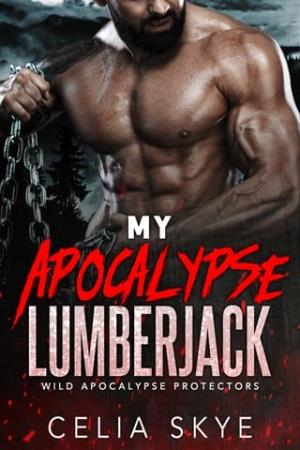
My Apocalypse Lumberjack (Wild Apocalypse Protectors #3)
Chapter 1 Ruby
one
Ruby
The blizzard comes out of nowhere, which is exactly the kind of thing that gets people killed in the post-apocalypse world.
One minute our three-vehicle convoy is making decent time through the mountain roads of what used to be British Columbia, and the next I can't see five feet past the windshield. The radio crackles with confused voices from the other vehicles, then cuts to static as the storm swallows us whole.
"Shit, shit, shit," Dave mutters, white-knuckling the steering wheel as our truck crawls forward. "Where the hell did this come from?"
"Doesn't matter where it came from," I tell him, checking that my rifle is still secure between the seats. "Just keep us on the road and watch for—"
The truck lurches suddenly, sliding on ice. Dave tries to correct, but we're already spinning, the world turning white and chaotic outside the windows. We slam into something—tree, rock, I can't tell—and then we're rolling, the horrible shriek of metal on stone filling my ears.
When everything finally stops, I'm hanging sideways in my seatbelt, my head throbbing from where it hit the window. The windshield is shattered, freezing wind already filling the cab with snow.
"Dave?" I call out, but he's slumped in his seat, not moving. Blood stains the driver's side window where his head connected.
I check for a pulse with shaking fingers. Nothing.
No. No no no.
I cut myself free from the seatbelt, landing hard on what used to be the passenger door. My pack is still wedged behind the seat. Small miracles. I grab it, along with Dave's rifle and what supplies I can quickly reach. The radio is crushed, useless. Our portable GPS is shattered.
I need shelter, and I need it now.
Crawling out through the broken windshield, I realize I have no idea where we are.
The convoy could be miles away or could have crashed just around the bend.
In this whiteout, I'll never find them. But we have protocols for this.
If we get separated, we meet at Dawson Ridge in exactly one week.
Seven days from today, noon, at the old church on the main road.
Seven days. I just have to survive seven days.
Through the driving snow, I spot something that makes my heart leap: a thin line of smoke rising from the forest. Smoke means fire. Fire means someone survived long enough to build shelter.
It could also mean raiders. Or worse, some of those cult freaks who've been moving through the territory. But freezing to death is certain, while whoever made that fire is only potentially deadly.
I check my weapons—pistol on my hip, knife in my boot, Dave's rifle slung across my back. Then I start walking toward that smoke. It’s the only chance I have.
The trek through the snow is brutal. Every step is a fight against knee-deep drifts, and the wind cuts through my winter gear like it's tissue paper. My hands go numb first, then my feet. I keep my eyes on that thin line of smoke, using it as my compass, my lifeline.
By the time I stumble into a clearing, I'm shaking so hard I can barely stand.
The cabin looks like something from a magazine about wilderness living from the old days.
Solid log construction, windows intact and glowing with warm light, smoke curling from a stone chimney.
There's a workshop to one side, stacks of cut lumber covered with tarps, organized tool racks under a lean-to.
Everything about this place screams competence and planning.
Someone's been living here, not just surviving day to day.
My legs give out just as I reach the porch.
The door opens, and I find myself looking up at a mountain of a man. Dark hair, thick beard, flannel shirt that strains across broad shoulders. He's holding an axe with the kind of casual confidence that says he knows exactly how to use it on more than just wood.
"Please," I manage through chattering teeth. "Storm... crashed... need help."
He stares at me for a long moment, and I can see him calculating. Lone woman, obviously from outside his territory, could be bait for an ambush. In his position, I'd be thinking the same thing. Hell, I'd probably already have the gun pointed at my head instead of the axe.
Then he sets down the axe and hauls me to my feet like I weigh nothing.
"Inside," he says, his voice a low rumble. "Now."
The warmth of the cabin hits me like a physical blow.
Real heat, the kind that comes from a properly maintained fire and good insulation, not the barely-adequate fires we huddle around on the road.
He deposits me in a chair by the fireplace, then disappears into what must be a bedroom, returning with blankets and dry clothes.
"Strip," he orders, dumping the clothes in my lap.
"Excuse me?"
"Wet clothes will kill you faster than the cold. Strip, get dry, wrap up in the blankets. I'll make tea."
He turns his back, giving me privacy, and I realize he's right.
My jeans are soaked through, my jacket's more ice than fabric at this point.
I peel off the wet layers with numb fingers, struggling into the dry clothes he provided.
They're men's sizes, hanging off my frame, but they're clean and dry and warm.
"Done," I say, and he turns back, handing me a steaming mug.
It's pine needle tea, bitter but hot. I wrap my frozen fingers around the mug, feeling returning to my extremities in painful prickles.
"Thank you," I whisper.
He's standing by the door, watching me with sharp gray eyes. Not threatening exactly, but clearly ready for trouble. Smart man. In this world, trust gets you killed.
"Where's the rest of your group?" he asks.
"Don't know. The convoy got separated in the storm.
Our truck rolled about a mile back, maybe more.
Hard to judge distance in whiteout conditions.
" I take another sip of tea, using the time to assess him.
Solid build, moves with confidence, place is too well-maintained to be anything but long-term.
This isn't someone squatting in an abandoned building. "My driver's dead."
"Raiders?"
"No. Ice and bad luck." I meet his eyes directly, knowing he needs to see I'm not lying. "I'm alone. I swear it. I just need shelter until the storm passes."
"And then?"
"Then I wait for my convoy at our rendezvous point. We have protocols—if we get separated, we meet at Dawson Ridge in one week. Seven days from today."
He studies me for a moment longer, and I can practically see him weighing options. Let me stay and risk bringing trouble to his door, or throw me back into the storm and live with whatever happens.
"One week," he finally says. "You can stay until your people come get you. That's it."
"Deal," I agree quickly. A week is more than I hoped for. "Thank you."
He moves to the kitchen area, starts pulling food from organized shelves. Everything in this place has a system, I notice. Supplies labeled and dated, tools hung precisely on walls, firewood stacked by size. This isn't just someone surviving—this is someone who's turned survival into an art form.
"When's the last time you ate?" he asks, breaking into my observations.
"Yesterday morning. Maybe. Time gets fuzzy on the road."
"I'll make something. You stay by the fire, get warm."
I want to protest that I don't need coddling, but honestly, I can barely feel my toes.
So I stay put, taking in more details of the cabin.
The furniture is handmade but quality work—real joinery, not just nails and hope.
There's a radio setup in one corner that looks functional, maybe even better than what we had in the convoy.
Books on a shelf, actual books, not just survival manuals. A guitar leaning in the corner.
"You build all this yourself?" I ask.
"Most of it."
"How long have you been here?"
"Two years, give or take."
"Alone?"
He glances at me, something unreadable in his expression. "That a problem?"
"No. Just impressive. Most solo survivors don't last six months out here."
"I'm not most."
That's becoming very obvious. Everything about this place speaks to long-term planning, systematic thinking, the kind of competence that keeps you alive when everyone else is dying.
He brings me a bowl of stew—actual stew with meat and vegetables, not the watery soup most settlements survive on. My stomach growls so loud it's embarrassing.
"Eat slowly," he warns. "Too fast after not eating, you'll just bring it back up."
I force myself to take small bites even though I want to inhale the whole bowl. The food is good, really good. Seasoned properly, cooked with care. When was the last time I had a meal that tasted like someone actually gave a damn?
"I'm Ruby, by the way. Ruby Smith."
"Mayson Clarke."
"Thank you, Mayson. For the shelter, the food. For not shooting me on sight."
"Day's not over yet."
I look up sharply, but there's the tiniest hint of humor in his eyes. "That supposed to be funny?"
"Little bit."
"Well, work on your delivery. It needs help."
This time he definitely almost smiles. "I'll keep that in mind."
We sit in surprisingly comfortable silence while I eat. The storm howls outside, rattling the windows, but in here it's warm and safe and impossibly normal. Like the world didn't end three years ago. Like people still just help each other without calculating the cost.
But I know better. There's always a cost.
"You have questions," I say eventually. "About me, where I come from. It's okay. I'd have questions too."
"Everyone's got a past. Doesn't much matter anymore."
"It does if that past brings trouble to your door."
"You planning on bringing trouble?"
"Not planning on it. But my convoy's been getting tracked by raiders for the last week. Small group, opportunists mostly, but they've been persistent. And now I'm separated from my people."
His expression hardens. "Raiders."
"Yeah. They kept their distance when we were together, but alone.
.." I set down the empty bowl, exhaustion hitting me like a hammer.
"Look, I'll understand if you want me gone as soon as the storm breaks.
Last thing I want is to bring problems to someone who's been smart enough to avoid them for two years. "
"Storm's not breaking anytime soon." He stands, collecting my bowl. "You're dead on your feet. Bathroom's through there—gravity-fed water from a stream, so don't waste it. Get cleaned up, then sleep. We'll figure out the rest tomorrow."
The bathroom is compact but functional, with actual running water—cold, but after three years of apocalypse, I'm not complaining.
I wash the blood and dirt off my face, looking at myself in the small mirror for the first time in days.
I look rough. Exhausted. A bruise blooming on my temple from the crash.
But I'm alive.
The clothes Mayson gave me smell like woodsmoke and pine and something distinctly him. I try not to think about how that makes me feel safer than I've felt in months.
When I emerge, he's banking the fire for the night, adding logs with practiced efficiency.
"You can take the couch," he says without looking at me. "Should be comfortable enough. I'm a light sleeper—you need anything, just call out."
The unspoken message is clear: he'll be watching. Making sure I'm not a threat. I don't blame him. I'd do the same.
"Mayson," I say as he heads for his bedroom. "Why did you let me in? Really?"
He pauses in the doorway, his broad shoulders silhouetted against the dim light from his room. "Because I remember what it's like to be desperate with nowhere to go."
"And?"
"And because turning away someone who needs help is how you stop being human. Even now. Especially now."
He disappears into his room, leaving me alone with the dying fire and the sound of wind against the windows.
I curl up on the couch under the pile of blankets, my body aching from the crash, from the cold, from three years of constant running. But for the first time in months, I'm warm and fed and relatively safe. I think.
I close my eyes and let exhaustion take me.