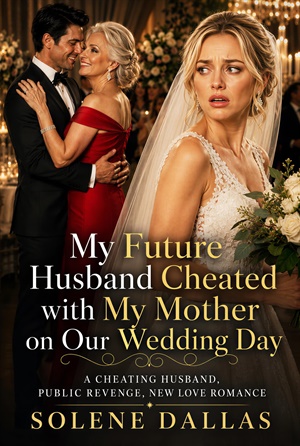
My Future Husband Cheated with My Mother on Our Wedding Day (Wives Who Bite Back #25)
Chapter One
The morning of my wedding, I solved a seating dispute, a delivery mistake, and a scheduling problem with the string quartet, all before ten o’clock.
None of the three problems were mine. My mother had created two of them and handed me the third.
I’d driven myself over at seven that morning, against her stated position that brides arrived and didn’t commute, because somebody had to be there when the vendors started calling.
Solving problems was what I did. I ran operations for a regional hospital network, which meant that when a supplier failed, or a night shift collapsed, or a contractor walked off a job, people came to my office and I fixed it.
Nobody at the hospital asked me twice if I was sure.
Nobody suggested I sat down and let a calmer person handle things.
That version of me stayed at the office. The version who existed around my mother said “thank you” a lot and apologized for things that weren’t my fault.
“Ella, darling, the roses.” My mother came into the bridal suite with two people from the hotel staff behind her, each carrying an arrangement almost as tall as they were.
“Someone put the tall arrangements at the back of the ballroom. At the back! I had them moved to the front, where people can actually see them.”
“The florist put them at the back because I asked her to,” I said. “The tall ones block the view from the side tables.”
“Nobody watches a ceremony from the side tables.” She turned to the staff instead of me. “Front of the room, both sides of the arch. Thank you.”
The staff glanced at me. I nodded, because it was one arrangement of roses on one morning, and because I’d been telling myself some version of that sentence for most of my life.
My mother looked wonderful, and she knew it. Platinum hair, a pale gold dress, diamonds at her ears and wrist. Louisa Tremaine didn’t attend events. She presided over them. Today, she was presiding over mine.
Very little of the wedding downstairs was actually mine. The flowers were hers. Half the guest list was hers, rows of foundation donors I’d met once or never, invited because my mother said a Tremaine wedding was also a Tremaine occasion.
Even the dress was hers, in a way. I’d picked a different one first, a simple column of ivory silk that I loved the second I put it on.
My mother had looked at me in the boutique mirror and said, “It’s lovely, darling.
It’s just so ordinary. You’re a Tremaine.
You don’t get married in ordinary.” The dress I wore instead had a cathedral train and hand-sewn beading, and every person who saw it said it was breathtaking. It had never felt like mine.
I let her have all of it, the way I let her have most things.
Since my father died, she’d been alone in the main house, and somewhere along the way, I’d decided that keeping her from feeling abandoned was my job.
She had no one else. I told myself the interference was love. Most days, I believed it.
My phone buzzed on the vanity. Cormac.
“Are you hiding from your mother yet?” he asked when I picked up.
“She’s standing six feet away, redirecting flowers.” I chuckled.
“Of course she is.” He laughed, warm and easy. “Hold the line. In a few hours, she becomes my problem too, legally. I’ll take shifts.”
“You say that now.”
“I mean it. I’ve survived eleven months of wedding planning with Louisa Tremaine. There are men who came home from wars with less patience than I have now.”
Across the room, my mother was repositioning a fruit tray that nobody had complained about.
I lowered my voice. “She moved the roses.”
“Let her have the roses,” Cormac said. “Tonight, it’s you and me on a plane, and for two weeks, nobody moves anything unless we say so. Then we come home, we get through the move, we get through your birthday, and life finally gets quiet. I promise.”
The move. After the honeymoon, Cormac and I were supposed to leave the Garden Cottage and move into the main house with my mother.
The cottage was small, it was ours, and I loved it.
But my mother had explained many times that the married heir belonged in the family home, that the main house had stood half empty since my father died, and that staying in the cottage would look to everyone like a rejection of her.
When I said I wanted privacy, she went quiet, which was how I knew I’d hurt her, and Cormac took my hand under the table and said the main house made sense.
Later, when we were alone, he told me it was the right decision.
My mother shouldn’t be rattling around that house by herself, and I would want to be close during the trust transition anyway. It would make everything simpler.
The trust transition was the other thing waiting on the far side of the honeymoon.
In six weeks, I would turn thirty. On my birthday, I would automatically replace my mother as family trustee of the Tremaine Family Trust. The trust owned the estate and the investment portfolio my father had left behind.
A corporate trustee handled the custody, the accounting, and the tax filings.
The family trustee made the actual decisions: the investments, the distributions, the advisers, and the estate itself.
My mother had held that role since my father died.
On my birthday, it would pass to me. She would keep a protected right to a home on the estate and a fixed allowance for life.
She would lose the authority and the trustee fee.
My father set it up that way on purpose.
For years, I thought the age requirement meant he doubted me.
Cormac said it only meant I would need help, and that I was lucky to be marrying a private banker.
That after the wedding, he would walk me through every piece of it, so the transition wouldn’t swallow my life.
“You already run a hospital network,” he said once. “You shouldn’t have to come home and run a portfolio too. Let me carry that part.”
It had sounded like love. Everything he said sounded like love.
“I should go,” I told him over the phone. “If I stay on the phone, my mother will start directing the quartet.”
“Ella.” He softened his voice. “I’ll be the one at the end of the aisle. Ignore everybody else.”
I hung up smiling.
There was a knock on the door, and Lucian Ryker stepped in when I answered.
He was the managing director of the hotel and part-owner, and he was the son of my father’s closest friend, which meant I’d known him at a distance since I was a child.
He was tall and blond, with the strong build of a man who still ran marathons.
He wore a dark suit without a wrinkle in it.
“Miss Tremaine,” he said. “I wanted to check that everything is running the way it should.”
“You could ask my mother. She’s the site commander.”
“I could.” His expression didn’t change, but he sounded almost amused. “I’m asking you.”
Nobody else had asked me that all morning.
“The music schedule got confused, but it’s sorted out,” I said. “Otherwise, it’s fine. It’s beautiful, actually. Your staff have been very patient.”
“They’re paid to be patient. They tell me this event has earned it.
” He took one professional look around the room.
“The ceremony corridor is restricted from noon,” he said.
“Staff and wedding party only. If anything goes wrong, anything at all, give my name to any employee. It comes straight to me.”
“That sounds like a system with a single point of failure.”
“It has worked so far.” He gave me a small nod. “My mother sends her love, by the way. She said your father would’ve been proud today.”
He left before I had to answer that, and I was grateful.
Soon after, the suite emptied. My two bridesmaids went downstairs to deal with a bouquet delivery that had arrived wrong, one of the problems my mother had generated and then assigned to someone else.
My mother smoothed her dress in the mirror, kissed the air beside my cheek, and said:
“I’m going to look in on the groom. Someone has to make sure the men are actually dressed. Don’t touch your hair.”
The door closed behind her, and for the first time all day, I was alone.
It didn’t last long. A hotel technician knocked – a polite young man with a rolling case who apologized twice for intruding.
He set a portable receiver and a monitor on the side table by the window, and explained that the bridal suite sat directly over the ceremony floor, so the audio team used it as a quiet room during the final sound check.
The microphones, like most things that day, were my mother’s doing. I hadn’t wanted to be recorded at my own wedding, but she’d insisted on the full package: professional video, professional audio, microphones on the groom and the officiant and, once I was in the dress, on me.
“People will want to hear the vows, Ella. A wedding like this gets documented properly,” she’d said. What she’d meant was that she wanted the ceremony she’d built preserved somewhere she could show it.
The technician clipped a test microphone to his own collar, said “check, check, one, two,” and adjusted a dial until his own voice came out of the monitor’s speaker, clean and close.
“The groom’s mic is live as well,” he said. “We fitted him a few minutes ago for the final check. Yours we’ll fit once you’re dressed. There’s nothing to clip it to until then. After levels are confirmed, everything gets muted until the ceremony.”
A voice on his radio called him down to deal with a speaker in the ballroom, and he winced.
“I have to run,” he said. “Please don’t touch the equipment. I’ll collect it before you’re dressed.”
Then it was quiet again. I sat down at the vanity and looked at myself. At the hair I wasn’t allowed to touch, the dress waiting on its hanger, and the veil my mother had chosen.
Soon, I’d be married. In six weeks, I’d be trustee. Both of those facts had been arranged around me so smoothly that I’d never had to lift anything heavier than a pen.
Then Cormac’s voice came out of the monitor speaker.
It startled me. He was humming, low and tuneless, the way he did when he checked his reflection in the mirror.
I smiled. The technician had said his microphone was already live, while mine wasn’t yet. This was sweet. I was listening to my future husband as he was getting ready a few rooms away from mine.
Then a door opened on his end. I heard it clearly – the click, the swing, and the click again as it shut.
“You shouldn’t be in here,” Cormac said. He didn’t sound alarmed. He sounded amused.
“Everyone thinks I’m checking on the caterers.”
The woman’s voice was low, and so familiar that for a second, I couldn’t place it. Because it didn’t belong in the groom’s room, saying that.
It was my mother.
“Two weeks,” she said. “Two weeks on a beach with her, Cormac. I keep doing the math, and I can’t make it smaller. I cannot stand the thought of you taking her away from me for two weeks.”