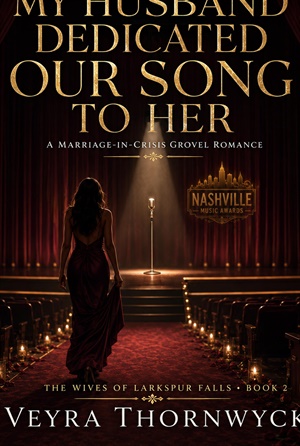
My Husband Dedicated Our Song To Her (The Wives Of Larkspur Falls #2)
Chapter One - The Dedication
CHAPTER ONE
The Dedication
My husband had always needed me most in the thirty seconds before he went onstage.
Not his manager, who could turn a missed flight into a national emergency. Not the vocal coach who traveled with three humidifiers and guarded Eli’s throat like it belonged in a museum. Not the label president waiting beyond the black curtain with both hands wrapped around her phone.
Me. I stood behind him in the wings of the Ashford Theater and pressed two fingers to the inside of his wrist. His pulse kicked beneath them, quick and hard, though his face on the overhead monitor looked calm enough to sell whiskey.
“There you are,” he said.
He didn’t turn. He never did before a performance. He watched the stage manager count down with one raised hand while I counted his heartbeats against the pad of my thumb.
“I’m exactly where you left me,” I said.
The words came out lighter than they felt.
Eli smiled at our reflection in the dark monitor.
At forty-five, he had silver beginning at his temples and the sort of face cameras forgave for anything.
The black suit was new. The boots were not.
He had worn the same pair on the night a radio host in Tulsa played “The Light That Waited” twice in a row and changed the shape of our lives.
“You look beautiful, Junebug.”
“You haven’t looked at me.”
His smile widened. “I looked in the dressing room.”
He had. For four seconds, while Nolan fastened an American Country Honors nominee pin to Eli’s lapel and someone from publicity asked whether Sadie Rowe should stand on his right or left for photographs.
I moved my fingers higher on his wrist. “Slow it down.”
He inhaled for four counts because I tapped four times. Held for four. Released for six.
This was one of the invisible things I did well.
The stage manager lowered two fingers.
On the other side of the curtain, an actress with a bright Southern accent told twelve million viewers that some songs did more than top charts. Some songs became part of the country.
The audience recognized the opening piano notes before she said the title.
The sound reached us as a swell rather than a cheer, thousands of people realizing together that they knew what came next. Eli’s wrist settled beneath my hand. Mine did not.
“Fifteen years,” he murmured.
“Sixteen,” I said.
His eyes met mine in the monitor then. “Sixteen.”
He caught my hand and brought my knuckles to his mouth. It was an old gesture. Once, before arenas and tour buses with marble bathrooms, he had kissed ink stains from those same fingers while I crossed out the second verse at our kitchen table.
The stage manager pointed. Eli walked into the light.
The crowd stood for him before he sang a note.
I remained in the wings while the first verse began, watching the man I loved step into the song I had written at twenty-four.
Back then, our apartment had one window and a radiator that hissed all winter.
Eli had been playing four nights a week for tips.
I had written lyrics in pharmacy receipt margins during lunch breaks and hummed melodies into a cheap recorder on the walk home.
The song had not been about waiting for a famous man.
It had been about the porch bulb Eli left burning when my mother was dying and I never knew which night I would make it home. It was about soup kept warm past midnight, his coat around my shoulders, and the quiet promise that someone would leave a light on without making me earn it.
The first demo had my voice on it.
The world knew his. I had told myself that was enough.
The first time a journalist called Eli the sole writer, we had been sitting in a diner outside Knoxville, sharing one order of fries because the tour had not started paying yet. I opened my mouth. Under the table, Nolan pressed the toe of his shoe against mine.
Let the story stay simple, he told me later.
A singer-songwriter with one great love song was a clean sell.
A husband-and-wife writing team invited questions about who contributed what, and questions made radio programmers nervous.
We could correct the credits when Eli had enough power to survive complexity.
Eli had hated the idea for nearly an hour.
Then a station added the song. Then another did. By the time the label printed his name alone beneath the title, we were standing in a rental house with a working furnace, laughing because there was food in every kitchen cabinet. He promised we knew the truth. I said knowing was what mattered.
It had felt generous then. Almost romantic. I would stay outside the spotlight so the man I loved could stand in it, and because we were married, everything that reached him would somehow reach me.
Years passed. The correction never became safe enough.
There were always more people to disappoint, more contracts to disturb, more versions of Eli’s history already printed. I kept revising songs in hotel rooms and sending notes from accounts no fan would recognize. I accepted thank-you kisses in private and watched him accept awards in public.
Enough was a word that could shrink around a woman until she mistook it for skin.
Sadie Rowe entered for the second verse, and the room erupted again.
She wore white under the stage lights, a clean slash of brightness beside Eli’s black suit.
At twenty-seven, she had already learned how to look directly into a camera without seeming to notice it.
Her voice was smoke over steel—lower than people expected from her delicate face, rough in exactly the places the song needed.
She was talented. That had never been the problem.
The problem was the bridge. The original climbed there, opening one held note until the melody felt too full for a single chest. The new arrangement cut that note in half. A drumbeat entered beneath it, then Sadie sang words I had never written.
New roads. New fire. A light that could choose somebody else.
The audience screamed approval. Every muscle in me locked.
I had heard the rehearsal version. I knew the label wanted a younger tempo and a cleaner duet structure. Nolan had called the changes “a conversation with the original,” which was the kind of sentence he used when he wanted theft to sound expensive.
But the rehearsal file had contained placeholder sounds where the new lyrics would go. Eli had promised the final bridge would preserve the meaning.
It did not. The song no longer said, I will keep the light for you.
It said, The light belongs to whoever makes me burn.
Someone touched my elbow. Maren from publicity leaned close enough for me to smell peppermint over the hot electrical dust backstage.
“We need you in the house for the dedication,” she whispered.
“What dedication?”
Her smile held, though no camera was pointed at us. “Nolan didn’t tell you?”
That was answer enough. She guided me toward the side aisle before I decided whether to resist. I could have stopped. I could have asked one more question. But wives of famous men learned the cost of creating a scene before they knew what scene they were entering.
My reserved seat waited in the front row between Nolan and the label president. Nolan rose just enough to let me pass, his gaze fixed on the stage.
The seat had my married name printed on a card in narrow gold letters. MRS. ELI MERCER. No June. The organizers had used the same wording for years, and each year I had set the card facedown before the broadcast began. That night, someone had fixed it to the chair with double-sided tape.
“Hell of a response,” he said.
“What dedication?”
“After the song. Good television.”
“To whom?” He finally looked at me. Nolan Briggs had managed Eli since before our wedding, and he had perfected concern as a way of calling other people difficult.
“June,” he said quietly, “don’t borrow trouble in the middle of a win.”
Onstage, Eli and Sadie reached the last chorus.
Then a third voice rose beneath them.
Thin. Distant. Almost hidden by the instrumentation.
Mine. Four measures from the home demo I had recorded in our bathroom because the tile gave my voice a little warmth. I heard the catch where I had reached for the high note. Heard the soft click of the recorder button at the end of the phrase.
They had put my twenty-four-year-old voice inside the duet like a ghost and had not asked me. My hands turned cold.
“Nolan.” I did not raise my voice. “Where did you get that recording?”
“Not now.”
“That file was mine.”
The label president shifted in her seat.
Nolan leaned closer. “We cleared the assets.”
“With whom?” He looked back at the stage.
The last chord rang through the theater. Eli and Sadie stood under a single circle of gold light, his hand at the small of her back because that was where the blocking had placed it.
The audience remained on its feet.
Eli laughed, breathless and pleased, and waited for the noise to soften.
I knew every version of that laugh. The surprised one. The tired one. The one he used when an interviewer asked a question he disliked. This was the real one—the boy from a two-bedroom house outside Murfreesboro hearing a room tell him he had become larger than anything he had imagined.
For one foolish second, tenderness moved through me. Then he lifted the microphone.
“Sixteen years ago,” he said, “this song gave me a life I didn’t know how to ask for.”
The camera found him in close-up. Another camera slid toward Sadie. No camera turned toward me.
“A song can get so familiar you stop hearing what it needs,” Eli continued. “Sometimes it takes a new voice to bring the truth back.”
Sadie looked at him, smiling but uncertain. The expression was gone so quickly I might have invented it.
Nolan sat straighter beside me. I stared at Eli and willed him to look into the first row.
He did. His gaze landed on me. Warm. Confident. Asking me to steady him from thirty feet away. Then he turned to Sadie.
“To my muse,” he said, “the woman who brought this song back to life.”
For half a heartbeat, the theater forgot to make noise.
Sadie’s smile vanished. Then the applause hit.
It struck from every side—balconies, floor, people behind me, people whose faces were already turned toward the screens to see the beautiful young woman receiving a love song from my husband. The sound was physical. It pressed against my ribs and filled my mouth.
Eli’s expression changed. He had heard it at last. Not what he meant. What he had said.
His eyes found mine again. I saw the exact instant he understood. He took one step forward.
“June—” The microphone carried my name into the roar, but too late and too softly. The broadcast cut to Sadie. Then to a woman in the audience clasping both hands beneath her chin. Then back to Eli, whose publicist would already be deciding how to turn his mistake into a tender explanation.
Nolan caught my wrist as I stood.
“Sit down,” he said through his smile. “We’ll fix it after the break.”
I looked at his hand until he released me.
For sixteen years, after had been the country where my marriage lived.
After the interview. After the encore. After the tour. After the album. After the crisis nobody remembered creating. My needs were never refused. They were rescheduled until wanting them felt unreasonable.
Onstage, Eli said my name again.
This time the audience heard it. Heads turned toward the front row. A camera began to swing in my direction, hungry for the forgiving-wife shot—the little laugh, the damp eyes, the graceful nod that would tell everyone there was no wound here worth examining.
I knew how to give them that shot.
I had been giving it to them for most of my adult life.
Maren appeared at the end of the row, one hand raised in a calming gesture. Beyond her, the aisle led to the darkened lobby, then the street, then anywhere Eli’s voice could not reach me through a speaker.
The camera’s red tally light blinked on.
I did not smile.
I left before the applause finished.