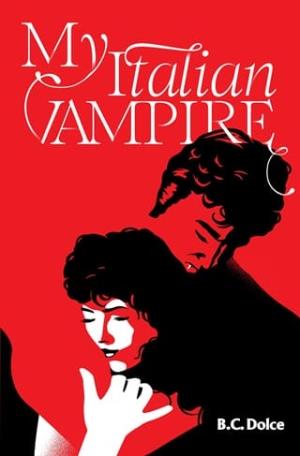
My Italian Vampire (Night School #1)
Chapter 1 Diantha
Diantha
The turrets of the Art History building lance the low, dense clouds that have overtaken campus. A distant thunder crackles as I stare up through the rain at the looming stone building. Etched into the massive keystone above the entrance are the words: FIDE NEMINI.
Trust no one.
The University of Echidna’s Arts & Humanities department slogan—half joke, half reminder. Stay scrupulous. Stay vigilant. Stay curious.
A shiver of excitement corkscrews down my spine.
The first day of my last semester of night school.
I love night school. The quiet of the campus, the stillness in the maple and chestnut trees that shade the stone paths winding from one building to another.
The warm glow of classroom lights through the crown glass windows.
The small class sizes and the way professors tend to treat lectures like a private ritual, a precious secret.
I can barely hide my smile.
Inside, my very yellow, very wet rain jacket squeaks against the old, lacquered wooden chair as I slide into my preferred seat.
The farthest to the left in the front row.
It’s objectively the best seat—the closest to the exit, near enough to a plug that I never have to worry that my ancient MacBook will die in the middle of class and force me to haul my beautiful, albeit large, ass over a few rows to find an outlet.
I can see the screen without straining my eyes and I know, down here, the professor’s voice won’t echo.
Night school. I’m an expert.
Tonight, my dinosaur laptop stays sleeping in my bag, and I instead extract a spiral notebook and my favorite writing utensil––a black gel ink pen with the label rubbed off, stolen from my daytime barista gig and apparently completely irreplaceable.
It’s not just a pen. It’s a talisman. One of many in my life.
The lecture hall is almost entirely silent, except for the ambient buzzing of various lightbulbs and my whispering classmates.
The smell of old paper and extinguished candles and someone’s dinner lingers around us.
For once, I’m not the first one here—thank god.
I can only shrug off the brown-noser allegations for so long.
I push my hood back and take in the room—the climbing rows of seats meant to house at least two hundred students are almost entirely empty.
Across the way, a man with a heart-shaped face and a shock of black hair jams furiously at his laptop’s keyboard.
Ten or so rows up, a woman with overly tanned skin and overly processed hair chews at her lip, fiddling with a chunky, clamorous necklace that looks like it was purchased in an art museum gift shop.
Five or more rows behind me are two women with young faces whispering to each other in…
I strain my ears.
Vietnamese, if I’m not mistaken.
I flip to the first page of my notebook and, in an almost illegible Catholic school scrawl, I write: Diantha Moro - [email protected] - Art History Dept.
Suddenly, the hall door swings open and in walks a man, his thinning hair wet and plastered to his forehead, his nose a painful shade of red from the cold, and a ratty, nylon briefcase shoved under his arm.
He pauses for a few seconds behind his desk, eyes glued to the phone in his hands, then he slams down his bag, extracts his laptop, and connects it to the projector. A PowerPoint slide blinks to life on the screen behind him.
In black font on a white background, the slide reads:
medieval art: saints sinners and their relics
ARTHST401
Our professor smirks, crossing his arms over his chest, observing us with an arched brow. “Incredible. Two hundred seats and you’ve managed to find the most annoying configuration. Any chance I can bother you all to please join your classmate in the front row?”
In an instant, my cheeks heat.
Ass-licker status, confirmed.
Introductions happened at an improbable speed. Our professor is Cormac Bowen, and our ears do not deceive us, we are not experiencing a post-vodka-binge auditory hallucination—he is Irish.
Janet, with her big chunky necklace, is a pharmaceutical CFO’s executive assistant exploring her passion for art history.
Ray, in his fifth year of a bachelor’s degree in early Renaissance philosophy, barely looks up from his laptop screen while admitting he is “desperado” to see the catacombs. He flashes a wet smile, canines glinting, and Bowen grimaces.
The 19th century crypts beneath the University of Echidna campus are, according to U of E’s website and the syllabus Bowen emailed last night, extraordinarily off-limits and only accessible to authorized personnel via private VIP tours.
This class is not so much an exception to that rule, but rather a trial to see if we can handle it.
The criteria for “handling it” have been outlined nowhere. But Ray has quite obviously started us off on the wrong foot.
Laila is a first-year PhD in Art History, focusing on 13th century Chinese art. She’s vaguely curious about what white people were up to at that same time.
Thien—minoring in Art History—is Laila’s best friend.
Their eyes all swivel toward me.
Of course, I’m still wrestling myself out of my very wet, very yellow rain jacket. I pause, one arm in, one arm out. “Um, my name’s Diantha—”
“Like the Pokémon?” Ray interjects.
“What? No.” I grimace. This seems to be the default expression Ray evokes. “It’s a flower, o-or a Greek goddess—”
“But also a Pokémon.”
“I’m not named after a Pokémon.” I try to keep my voice even, unaffected. Jovial even. Who the fuck is this guy?
Ray starts to reply, but the lecture hall door creaks ajar.
Fingers curl around the brown oak and a figure sidles through, dripping into class like a noontime shadow growing over concrete.
His movements are nearly silent, save for the soft click of the door shutting as he presses his back against it.
I take in the man before me.
Ink-black hair cut into a sharp ducktail. A silver hoop through his left ear. Designer sunglasses—maybe Celine or Tom Ford—with completely blackened lenses balancing on the arch of a strong nose, obscuring his gaze. His chin is square, full lips sitting in a heavy pout.
Professor Bowen’s eyes flicker to the figure, and then he does a full double-take.
Why can’t we stop staring?
He’s not impressively tall or unbelievably wide. He’s not a massive brick wall of masculinity. Sure, his shoulders are broad and his waist tapered, but there’s a smoothness to him that stops my breath in my throat. A smoothness to his skin, to his movements.
Like he’s carved from marble.
“My apologies,” the newcomer says. His voice is a deep rumble, vowels inflected with an accent. Russian? Spanish? He pushes a hand through his hair, so dark I only notice that it’s wet when the strands don’t fall back in front of his eyes.
“No worries.” Bowen sounds shocked.
He pushes his sunglasses up into his hairline, and without meaning to, I hold my breath. His eyes sweep upward, and through the diffused classroom light, if I’m not mistaken…
His eyes are yellow.
I blink. Hard. And next thing I know he’s across the front of the room and sliding into the chair next to me. Everyone shifts in their seat. Am I imagining it or has the temperature in here increased significantly?
“Well, you must be…Mr. Orfeo DiPaolo.” Bowen stutters over his last name but keeps his placid tone. Unimpressed.
I don’t lift my eyes from the notebook in front of me.
Orfeo DiPaolo. His name sounds like music—like a threat.
And undeniably, he must be Italian.
“Yes, professor. My lateness is inexcusable. I didn’t want to take my motorcycle, so I had to walk from across town.”
“Motorcycle?” Laila asks, as if he’s just shared that he has a vial of the Ebola virus in the back pocket of his Levi’s.
I can’t help myself anymore. I look up. Orfeo slips out of his leather jacket and begins carefully rolling up the sleeves of a pristine white button-up.
His forearms are thick and corded, his knuckles square.
Not overly muscular. Delicate in their vascularity, almost. Thin lines of ink trace the length of his arm and join together in flourishes around his wrist, like the leaves at the top of a Roman column.
A chunk of hair has dried and escaped the wrangle of his glasses.
It falls in a C shape across his forehead.
His scent invades my personal space. Clean, sharp. Like mint or licorice.
“Mhmmm.” He moves the sound around his mouth. “I know. Quite dangerous and ever more so in the rain.”
Bowen points his pencil at me. He’s regained his composure, but I swear we trade a look of mutual shock. “Diantha, you were saying.”
I clear my throat and straighten my back.
“Right. Not named after a Pokémon. I’m in my last semester of my master’s in Art History with a focus on objects of the occult, specifically European objects of the nineteenth century.
” My mouth has gone dry and I can’t force out the words—can’t bring myself to actually say out loud why I decided to take this class when I’ve never cared much at all for Medieval art.
I want to see the catacombs.
To put it lightly.
Getting into the tunnel system that stretches for three uninterrupted miles beneath U of E’s buildings has been my singular goal since my mother’s prediction that I was destined to study here came true.
The memories of her reading my palm are like a faded photograph now, passed between too many hands.
Maybe we had been sitting at the kitchen table in our apartment in Flatbush—or perhaps it was when we had, briefly, moved to Delaware and had a yard.
A horrible year, though the grass was nice.
Now, when I see my mother, it’s always at the kitchen table in the last apartment we ever lived in together—the third-story walk-up on Ocean Ave. Each time, she sets a cup of coffee down in front of me onto the shiny plastic tablecloth.