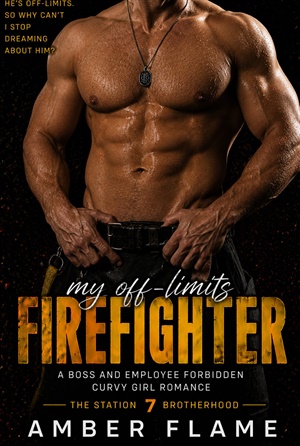
My Off-Limits Firefighter (The Station 7 Brotherhood #9)
Prologue
Dani
Rule one of working in HR for Redwood Falls Emergency Services: do not fall for a firefighter.
I wrote that rule. Not metaphorically — I mean I typed it into a Word document, formatted it in eleven-point Calibri, and had it laminated into the orientation packet.
It lives in the section titled Professional Boundaries and Departmental Conduct, between the paragraph on social media usage and the one about accepting gifts from vendors.
I have presented this section at every new hire onboarding for three years.
I have referenced it in four separate disciplinary conversations.
I have used it to counsel two dispatchers, one EMS supervisor, and a probationary firefighter who all believed, with the particular confidence of people who had not yet been burned, that their situation was different.
Their situation was never different.
I know this because I built the HR program for this department from a skeleton crew and a shared Google Drive, and in the course of doing that I talked to everyone.
The firefighters who had relationships end badly and took whole crews down with them.
The supervisors who had to manage the fallout.
The people caught in the middle who just wanted to do their jobs and couldn't because someone somewhere decided their feelings were the exception to every reasonable guideline.
I catalogued all of it. I built a policy framework from the wreckage of other people's certainty that they were different.
So when I say I wrote Rule One, I mean it in the fullest possible sense. I am its author, its enforcer, and for three years, its most faithful adherent.
Which is why it is particularly inconvenient to be standing in my own office at eight forty-seven on a Tuesday morning with my coffee going cold on my desk and my hand still carrying the specific warmth of a handshake that I should have already filed away under routine professional interaction and moved on from.
I have not moved on from it.
His name is Reid Ashford. The file on my desk — the one I've reviewed three times in two weeks, because I do thorough work and not because I was looking for a reason to read it again — tells me he is forty-one years old, six foot three, and spent fourteen years with Sacramento Fire before a departmental restructuring put him at a crossroads.
He chose Redwood Falls. We were lucky to get him.
That is a direct quote from Fire Chief Bauer, who does not give direct quotes of that variety lightly.
I knew all of this before nine o'clock this morning. What the file did not prepare me for — and this is an oversight I intend to address in my own internal documentation — is the particular way Reid Ashford fills a doorway.
He arrived at eight-thirty for his offer meeting.
I had the paperwork staged. Benefits summary on the left, role overview in the center, signing sheet on the right — color-coded tabs, because I believe in visible organization.
My deputy, Priya, had done the preliminary walkthrough.
I was stepping in for the formal offer and the Q&A, which is standard for any senior hire.
He was already standing when I came in. Not sitting in the chair the way most candidates do, settled in and rehearsing their negotiating points.
Standing near the window with his hands in his jacket pockets, looking out at the view of the training yard, and there was something about the stillness of him that made me hesitate one full second before I spoke.
He didn't startle when I said good morning.
He turned from the window the way people turn when they've heard you coming and were waiting — unhurried, already present.
"Ms. Cruz." He extended his hand.
I have shaken hundreds of hands in this role.
HR is a handshake profession. I have developed an entire private taxonomy: the too-firm grip that's performing confidence, the limp one that's performing deference, the quick pump-and-release of someone who wants the formality over.
Reid Ashford's handshake was none of those things.
It was simply a handshake. Direct, measured, appropriate — and then it was over, and he was sitting down, and I was opening the benefits summary, and everything was completely normal.
Except it wasn't, because I'd already noted the gray at his temples and the specific quality of his attention, which was the focused, unhurried kind that belongs to people who have spent years making critical decisions in loud and chaotic environments and have trained themselves to find the quiet at the center of it.
I noticed the faint scar along his left jaw and decided not to wonder about it.
I noticed that he read the documents I put in front of him rather than waiting for me to summarize them, which meant he was either meticulous or he didn't trust verbal summaries, and either quality struck me as reasonable.
He asked two questions. Both precise. Neither of them the usual jockeying — not about title visibility or chain-of-command positioning, not about promotional trajectory.
He asked about crew retention rates over the last three years and about the department's critical incident support protocol.
Both questions were about his people, before he'd met them. I noted this.
I gave him thorough answers because I had thorough answers and because it was my job.
At the end of the meeting, when the paperwork was signed and filed and we were standing again — he rises the same way he turned from the window, all at once, no readjustment — he said: "I look forward to working with you."
Six words. Standard professional closing.
The problem is the way he said it.
Not with the practiced warmth of someone working through a list of social obligations.
Not with the slightly performative enthusiasm of a new hire wanting to make an impression.
He said it like a statement of fact, like something he'd assessed and landed on, and when he said you he was looking directly at me with the kind of attention that makes a person aware of being specifically seen and not just generally observed.
I said: "Welcome to Redwood Falls."
He left. Priya appeared in the doorway approximately forty-five seconds later with her coffee and an expression that told me she'd seen him in the hallway. She said, "So," in the tone that means she has approximately fifteen things to say and is deciding which one to lead with.
"Don't," I said.
"I wasn't going to say anything."
"You were categorically about to say something."
She smiled into her mug and said, "He starts Monday."
"I know when he starts. I scheduled it."
"He seems very — "
"Priya."
"Qualified," she finished, with the specific innocence of someone who was not talking about qualifications.
I sent her back to her desk. I sat down at mine.
I looked at the signed offer letter, which was in order, and the benefits summary, which was filed, and the color-coded orientation folder I'd prepared for his first week, which was thorough and complete and gave me absolutely no reason to still be thinking about the handshake.
I pulled up the fraternization policy. Not to review it — I wrote it, I have it more or less memorized — but because there is something clarifying about reading a policy in the immediate aftermath of a situation it covers.
It is the professional equivalent of a cold glass of water. It reminds you of the shape of things.
I read the section on departmental relationships.
I read the subsection on supervisory structures and parallel administrative tracks.
I noted, because I am nothing if not precise, that Reid Ashford would report directly to Fire Chief Bauer and not to me, that his role sat within the operational chain of command while mine sat within the administrative one, and that the policy's primary concern was with direct supervisory relationships and their attendant power imbalances.
I also noted that this information was completely irrelevant because nothing was happening and I was simply doing a routine policy review.
I closed the document. I opened my calendar. I had a two o'clock with the EMS scheduling team and a four-thirty budget review and a follow-up email to draft for the benefits provider about the dental coverage gap that three people had flagged last month.
I had, objectively, a full day.
I picked up my coffee. It was cold. I got up to reheat it and stood at the break room microwave watching the mug rotate and thinking about almost nothing in particular, which is what I do when I'm thinking very hard about something I've decided not to think about.
He starts Monday. This is fine. I am the Head of HR for this department.
I have managed complicated interpersonal dynamics, sensitive personnel matters, and leadership transitions for three years without once compromising my professional judgment.
I am excellent at my job. I am a person of considerable self-discipline.
I have kept Rule One intact through two department-wide holiday parties, one very attractive seasonal hire, and a visiting safety inspector from Portland who asked for my number in the elevator and to whom I said, with complete composure, "I appreciate that, but I keep a firewall between work and personal. "
A firewall. That is a thing I said with my actual mouth.
The microwave beeped. I retrieved my coffee. I took a sip and stood at the break room window looking out at the same training yard Reid Ashford had looked at from my office, and I thought: I am going to be completely fine.
I said it the way I say most things I mean. With confidence. With the assurance of a woman who has seen this particular situation from every professional angle and knows precisely where it leads.
Then I went back to my desk, opened a fresh document, and made a note to review the fraternization policy again on Friday. Just to stay current. Just to keep my thinking sharp.
That is entirely what it was for.