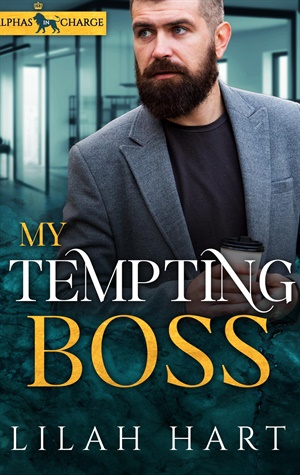
My Tempting Boss (Alphas in Charge #7)
1. Joss
JOSS
Iwas three sentences into my pitch when the door opened behind me.
I didn’t have to turn around to know who’d just walked in.
I could read it on the faces of the people seated at the table.
Mira Patel, my grand-boss and the head of product at Myrror, had been giving me the polite encouraging nod she gave every junior product manager presenting to leadership.
That nod stopped. The head of engineering set down her pen.
The head of design straightened in her chair without realizing she’d done it.
I kept talking. Whatever I was saying about user retention curves, I let my mouth keep saying it while my brain raced ahead.
He was here.
Sutton Randall, the CEO of the company I’d fought my way into for the last fourteen months—the man whose name was on every all-hands email, every press release, and the bottom of my offer letter—had just walked into my Outfit Builder approval meeting.
He hadn’t been on the invite list.
Mira’s eyes flicked to mine for just a second. Keep going, that look said. So I did.
I clicked to the next slide and tried not to think about the fact that I’d dressed for this meeting like it was just another Friday morning.
My sharpest blazer, sure. The blouse I knew worked with my coloring.
But my hair was up because it had been raining when I walked in, and I hadn’t bothered with the lipstick I’d been planning to swipe on in the bathroom because the meeting had been moved up by fifteen minutes and I’d had to sprint here from my desk.
I could feel him behind me. Standing, not sitting. Listening.
“...which is why we’re projecting Outfit Builder will increase session length by an average of forty percent,” I said, sliding into the next beat of my pitch.
My voice sounded normal. My voice sounded great, actually.
Whatever was happening in my chest was not happening in my voice.
“And forty percent more session time means?—”
“More opportunities to convert.”
His voice.
It came from behind me, lower and quieter than I’d been expecting. The kind of voice that didn’t need to be loud because everyone in the room was already listening for it.
I turned.
He was leaning against the wall by the door, hands in the pockets of a charcoal suit that probably cost more than my rent. Dark hair. Dark beard, neatly trimmed. Pale blue eyes that should not have been on a face that intense. Those eyes were not on the screen. Those eyes were not on my slides.
Those eyes were on me.
“Right,” I said. I sounded normal. I was almost positive I sounded normal. “More conversion opportunities.”
“Keep going, Ms. Henning.”
He knew my last name.
Of course he knew my name. I was presenting in front of him. It was on the slide deck. It was even on the invite—except he hadn’t been on the invite. He’d come in late and unannounced…and he knew my name.
I reached for my notebook on the table next to my laptop and set my hand on it. I didn’t open it. I didn’t need to open it. I just needed to know it was there.
Then I clicked to the next slide and kept going.
I made it through the rest of the pitch in five and a half minutes.
I made it through the demo video. I made it through the projected engineering timeline and the licensing tie-in slide and the closing summary.
By the time I clicked back to my title slide, I’d almost convinced myself I hadn’t lost my place once.
Mira was the first to speak. “Thank you, Joss. That was very clear.”
She turned toward Sutton, who’d finally moved from his post against the wall and slid into the empty chair at the head of the table. He hadn’t sat down for the last seven minutes of my presentation. He’d just stood there. Watching.
He didn’t look at Mira when he answered her. He was staring at me.
“I have questions,” he said.
The head of engineering picked up her pen again, like she’d been waiting for permission. The head of design crossed one leg over the other. Mira sat very still.
“Of course,” I said.
I sat down. I’d been standing the entire time, and I sat down now because if I didn’t, my legs were going to take care of the matter for me.
Sutton tilted his head slightly. Like he was considering how to phrase the thing he’d already decided to say.
“You’re asking us to allocate a meaningful chunk of next year’s engineering capacity to a feature whose direct revenue contribution isn’t clear. The deck makes the engagement case. It doesn’t make the dollars case.”
There it was.
My hand was still on my notebook. I could feel my heart in my fingertips.
“That’s fair,” I said.
I hadn’t planned to start my answer with that’s fair. I’d planned to launch into the deck I’d built specifically for this question. But the words came out before I could stop them, and the second they were in the room, I realized they were the right ones.
“It is fair,” he said.
His voice was quiet and not unkind.
“The engagement-to-licensing conversion path isn’t immediate,” I said.
“It’s secondary. But it’s the path that turns Myrror from a tool our partners license into the tool our partners can’t replace.
” I held his eyes. It was harder than I’d expected and easier than I’d expected, both at the same time.
“If a competitor ships Outfit Builder first, our licensing moat doesn’t hold.
Our partners start asking why they’re paying us when someone else has the stickier consumer surface. ”
I stopped. I didn’t add anything. I didn’t oversell. The bible of every product manager I’d ever respected had taught me that you make your case and then you shut up.
Sutton didn’t move. For three full seconds, no one else in the room so much as breathed. The head of engineering looked at Mira. Mira looked at Sutton. Sutton was still looking at me.
Then he nodded once, more to himself than to anyone else, and turned to the head of engineering. “I want to see the engineering estimate before we approve the allocation. Get it on my desk Monday.”
That was all he said.
He stood up. He looked at me one more time as he passed my end of the table.
I couldn’t read what was on his face. It wasn’t approval and it wasn’t dismissal.
It was something I hadn’t seen on a person’s face before, and I knew, with a certainty I had no business having, that I was going to think about it for the rest of the day.
Then he was gone. The door closed behind him, and the head of design exhaled. Audibly.
“Okay,” Mira said. “Let’s wrap up. Joss, nice work. We’ll circle back Monday.”
I gathered my things slowly because my hands didn’t want to behave.
My notebook. My laptop. The clicker. By the time I’d packed everything into my bag and made it out into the hallway, the head of engineering and the head of design were already gone, peeling off toward their respective wings of the floor.
Mira was waiting for me.
She’d stopped about ten feet down the hall, her arms folded, her glasses up on her head, watching me approach.
She let me get all the way to her before she said anything.
Then she looked at me over the rim of her glasses, and the look she gave me was somehow still the most withering stare I’d ever received.
“Well,” she said.
Just that. Just well.
I waited.
She tilted her head about half an inch. “That was something.”
Then she turned and walked away, leaving me standing alone in the hallway with my notebook clutched against my chest and a pale-blue-eyed memory I had no idea what to do with.
It was 9:15 on a Friday morning. I hadn’t yet had my second cup of coffee.
I was, I suspected, in significant trouble.