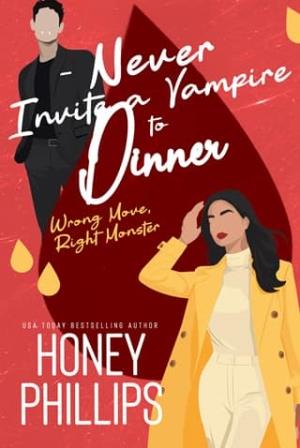
Never Invite a Vampire to Dinner (Wrong Move, Right Monster #4)
Chapter 1
“You’ve named the soup,” Lucy says. “You know that, right? You’ve given soup a name.”
“It’s not just soup.” I hold up the menu card, admiring my own calligraphy. “It’s ‘Widow’s Broth: A Crimson Reduction.’ Say it out loud. It has drama.”
“It has a personality disorder.”
I set the card at the head of the table anyway, right where I want the mayor to sit. He complains every year that I make him eat things that sound weird, and every year he asks for seconds. Men.
The Salt & Sage looks nothing like itself tonight.
My white walls and sea-glass jars have surrendered to something darker.
I’ve draped the two long farmhouse tables in dark crimson linen and lined the beams overhead with tapered black candles I ordered from a supplier who probably thinks I run a coven.
Considering the theme for this party is Transylvanian Twilight, he’s not far off.
Obviously, this is old-school Gothic vampire.
Real vampires, from everything I’ve ever heard, are considerably less interested in velvet curtains and blood-orange tarts.
Lucy leans against the counter with her camera, snapping shots of the black roses I’ve arranged in mismatched silver goblets.
Her red curls catch the last of the light coming off the harbor through the tall windows.
She looks unimpressed. She’s been my best friend since we were twelve, and she always looks unimpressed. I love her for it.
“Twenty-four seats,” she says. “For a Tuesday.”
“The Twilight Feast waits for no calendar.”
“You said that last year.”
“Because it was true last year, too.”
I nudge a goblet half an inch to the left and step back.
There’s always a moment when the dining room I’ve arranged stops being a project and starts becoming a place.
When the candles and the linen and the place cards all come together.
This is that moment. My chest does the warm, ridiculous thing it does, and I grin at my crimson-drenched sail loft like an idiot.
“You’re doing the face,” Lucy says.
“I’m not doing a face.”
“You’re absolutely doing the face. The one you do when a party’s about to work.” She lowers the camera. “Pen. Genuine question. Do you ever want to just… order a pizza? Sit on the couch? Not turn dinner into theater?”
I consider this the way you’d consider whether you’d like to remove your own spleen.
“No,” I say.
“Right. Silly of me.”
The thing is, I could explain it to her, but she already knows.
She’s heard it a hundred times. A dinner party isn’t the food.
The food’s the excuse. You put people around a table, you give them something delicious and a little bit weird to talk about, and something happens that doesn’t happen anywhere else.
Walls come down. The lonely woman from the bookshop laughs at something the lobsterman says.
Somebody who’s been grieving remembers they can still enjoy dessert.
That’s the magic. I feed people because it’s the best way I know to tell them they matter.
I don’t repeat it again, because it’s five o’clock on a work night and Lucy would throw a rose at me.
“Guest list,” I announce instead, grabbing my clipboard.
“You already sent the invitations.”
“Twenty-three of them.” I tap the pen against my teeth. “There’s a gap.”
“There’s always a gap.”
I look at her.
“Every year you leave one,” she says. “Every year you fill it with somebody new, and every year it works.”
Lucy raises the camera again, framing the candle line. “So invite the Bayberry’s cousin. The one who does the whittling.”
“Barry.”
“Barry.”
“Barry brought a duck to the Harvest Supper, Lucy. A live one. In a basket. It got into the pie.”
“So no Barry.”
“No Barry.” I chew the pen. Twenty-four seats. Twenty-three names. My gaze drifts out the window, past the harbor, past the boats knocking gently in their slips, and up the dark shoulder of the bluff to the one thing on the coast that never had a single light in its windows.
Blackthorn House.
It squats up there on the rocks like it’s judging the whole town.
Three stories of black stone and grey cedar, all iron gates and dead gardens, and everybody in Black Harbor has a theory about it.
Haunted. Cursed. Built over a shipwreck or a plague pit or a smuggler’s grave, pick your local legend.
When I was nine, Tommy Alden dared me to touch the front gate and I did, and then I ran so hard I lost a shoe.
For most of my life, Blackthorn House has been dark. The lights came back on four months ago. A man named Julian Volkov owns the house, and apparently he’s come back to it.
“You know nobody’s met him,” I say slowly.
Lucy doesn’t lower the camera this time. “Met who?”
“The man who owns Blackthorn. Julian Volkov.”
She finally looks at me over the top of the camera, and her expression has gone wary, because she knows me. God help her, she knows exactly what my brain is doing.
“Penny.”
“He’s lived up there for months.”
“Penny.”
“Months, Lucy. And nobody’s seen him. Not at the Widow’s Lantern.
Not at the historical society open house.
Not at the fire department pancake breakfast in August, which is attended by every living soul within nine miles and, according to Mabel Libby, several who aren’t.
He gets groceries delivered. Doris at the market says the driver leaves the boxes at the gate and by the time he gets back to his van they’re gone.
” I’m pacing now. I pace when I’m plotting.
“That’s not a person. That’s a rumor with a mailing address. ”
“Which is a great reason to leave him alone—”
“Or…” I spin the pen and do my best to look casual.
“It’s a person who’s been sitting in a giant creepy house with nobody to talk to, eating delivery groceries by himself in the dark, and no one in this entire town has thought to do the single most obvious kind thing you can do for a lonely stranger. ”
Lucy sets the camera down. That’s how I know she’s serious. “And what’s that?”
“Feed him.”
“Oh my God.”
“I have a seat.” I hold up the clipboard like it’s a legal document. “I have a beautiful, empty, twenty-fourth seat. It’s fate, Lucy. It’s practically rude not to.”
“He’s not going to come. Nobody’s even seen the guy.”
“Then no harm done.” I’m already reaching for the good cardstock, the heavy cream-colored one with the deckled edge that I save for the invitations that matter. “I’ll deliver it myself. He can throw it in the sea if he wants. But at least somebody in this town will have knocked.”
Lucy watches me uncap my calligraphy pen. She watches me write his name in my best, blackest ink—Mr. Julian Volkov—like I’m addressing a nineteenth-century count, which, given the theme, tickles me so much I have to bite my lip.
“He’s not going to come,” she repeats.
“Probably not.”
“So why—”
“Because then he’ll have been asked.” My pen pauses over the card. “That’s different from not being asked.”
Lucy looks at me a second longer than she needs to, then picks up her camera again.
“You realize,” she says, “that this is exactly how horror movies start.”
“It’s exactly how dinner parties start.” I blow on the ink. “You should know the difference. You’ve been to enough of mine.”
“Debatable which is scarier.”
I throw a rose at her.
The gate is worse up close than it is from town.
I’ve walked most of Black Harbor a thousand times—the harbor path, the bluff trail, the cemetery shortcut that saves you six minutes if you don’t mind the company—but I’ve never come all the way up here.
Not since I lost that shoe. The road turns to gravel, then to something that isn’t really road at all, just two ruts worn into the grass by tires I’ve never seen.
The wind up here has teeth. It comes straight off the Atlantic and hits the house and the house doesn’t so much as shiver.
For some reason that satisfies me more than I want to admit.
The iron gate is enormous. Black metal twisted into shapes that might be thorns or might be birds or might be the artistic representation of a very bad idea.
Beyond it, a garden gone to seed but not to ruin.
The roses are dead, but they’ve been cut back for the winter.
The paths are mostly clear of fallen leaves.
Arthur Finch’s father did these gardens and now Arthur does, and in ninety years between them not one Finch has ever had a word to say about the inside of that house.
The card feels very small in my hand.
This is insane, I think, for the first time all day. I’m standing at a haunted gate in the wind about to leave a party invitation for a man no one in town has seen. I lost a shoe here. A whole shoe.
I look for a mailbox, but of course there isn’t one. That would be too easy, too normal, too much like a man who wants to receive things.
There is a tarnished brass slot, though, set into the stone pillar beside the gate, the kind of thing they’d have used for calling cards two hundred years ago. It looks like it hasn’t been touched since. I run my thumb over the metal and the metal is as cold as if winter has already arrived.
“Okay,” I say out loud, because the house is too quiet and I hate quiet.
“Okay. Here’s the thing. You don’t know me.
I’m Penny. Penny Harrington, I run the catering place on the harbor, the Salt & Sage.
You’ve probably seen the lights—well. You probably haven’t seen anything, no offense, you don’t seem like a going-out kind of guy.
” I’m talking to a slot. I’m aware I’m talking to a slot.
“I do themed dinner parties. They’re fun and the food is excellent and there’s a soup with a name.
You don’t have to come. You can burn this.
But there’s a seat, and it’s yours if you want it, and—”
The wind drops. All at once, like someone shut a door. The dead roses go still. The whole bluff holds its breath, and for one second I have the absolute, spine-crawling certainty that somewhere behind those dark windows, someone is listening.
I shove the card through the slot so fast I nearly take my knuckle off on the brass.
“—okay bye,” I finish, and I walk back down that hill at a pace I will later describe to Lucy as “dignified” and which is, in fact, a barely controlled scramble. I do not look back at the windows, not once, not even when the skin between my shoulder blades prickles the whole way down.
I don’t lose a shoe.
I count it as a win.
Two days later, I’ve forgotten about it.
Mostly. There’s a wedding tasting on Thursday and the fishmonger’s holding out on me about the halibut.
I’ve burnt an entire tray of blood-orange tarts because I was arguing with Lucy on the phone about whether “spooky elegant” and “just spooky” are meaningfully different aesthetics.
She’s wrong—they are. The Twilight Feast is two days out and my brain is a spinning wheel of borscht, black garlic, and burgundy dahlias.
Julian Volkov and his cold brass slot have slid comfortably to the bottom of the pile.
Then I open the shop in the morning and there’s an envelope in the mail slot with no stamp on it. I stand there holding my keys and staring at it for a good five seconds.
The envelope is cream, heavy and expensive, and my name is on the front in ink so black it looks wet. The handwriting looks like it belongs in a museum—all long confident strokes and a capital P that loops like it’s showing off. Miss Penny Harrington.
My stomach does something complicated.
I pick it up. The paper is thick as a playing card and it smells, faintly, impossibly, of old books and salt. I turn it over. The flap is sealed with actual wax. A deep red wax seal impressed with a signet that shows a thorn branch curled around a single small bird.
“No way,” I whisper, to the empty shop. “No way.”
I slide my thumb under the wax and it cracks clean off in one satisfying piece and I unfold a single sheet. In that same museum handwriting is the most devastating acceptance I have ever received in my life:
Miss Harrington,
I accept with pleasure.
You should know that I do not dine. This is a longstanding arrangement, and I would not wish it to disrupt your table. If my presence on those terms is unwelcome, you have only to say so, and I will understand completely.
You should also know that no one has invited me anywhere in a very long time.
J. Volkov
I read it once. I read it twice. I make a sound that no dignified thirty-two-year-old woman should ever make about a piece of stationery, and I press the sheet to my chest with both hands.
Lucy comes in twenty minutes later and finds me standing in exactly the same spot.
“What?” she asks immediately.
I hold it out, and she reads it. Her eyebrows climb at the second paragraph and stay up through the third.
“Okay,” she says slowly, handing it back. “So he’s coming.”
“He’s coming.”
“What does I do not dine mean?”
I look at the letter again. At that sloping, absurd, hundred-year-old handwriting and that last line. It’s either the saddest thing I’ve read all year—or a very elegant, very polite way of telling me to lower my expectations.
“I have no idea,” I say.