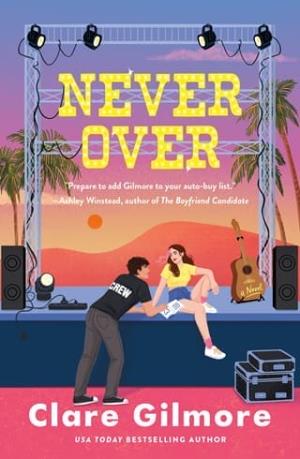
Never Over
Chapter 1
June, Now
I grew up the youngest of five girls and my childhood best friend was Maisy Morgan.
This is all anyone from my hometown knows about me.
One more time, for emphasis: this is all anyone from my tiny, gossipy hometown in rural East Tennessee knows about me.
They could advise you on the latest drama between Earl’s Mowing Service (the incumbent) and Merle’s Mowers (the new biz in town).
They could inform you of Mr. Dalrymple’s medical ailments even though I’m pretty sure that gossip is illegal.
They could tell you who last checked out an obscure library book about the best closing arguments in American legal history.
Because if you aren’t bribing the librarian for a list of who’s reading what, how else do you stay informed?
But when it comes to me, nobody inquired much. If someone did, an easy sound bite was on the tip of the tongue:
Oh, Paige Lancaster? Well, you know, she’s the youngest of five girls, and her best friend growing up was Maisy Morgan.
I’m not being hyperbolic. I overheard this exact sentence when I was seventeen, while hidden behind a booth at the Tri-Cities Spring Market.
But my ears didn’t even have time to burn; the gossips immediately moved on to juicier topics, like Mr. Dalrymple’s insurance plan and the lawsuit Earl filed against Merle, which he promised the whole town would have the best closing argument in American legal history.
Nothing more to say on Paige Lancaster, apparently. It’s almost like my older sisters and Maisy Morgan had enough personality between the five of them that I was never asked to develop one. I certainly never had an identifier like they each did.
When it comes to my sisters, there’s Maren, the oldest daughter, and Candice, the aloof one, then Folly, the wild child, and Zara, the book nerd.
And of course, my childhood best friend Maisy, a copper-haired, wide-grinned literal pageant queen.
There were plenty of popular kids at our high school, but nobody held a candle to Maisy when it came to attention.
She gathered every drop of it by disarming you in an instant and endearing her to you the next.
So yeah. When people say I grew up the youngest of five girls and best friends with Maisy Morgan, what they’re really saying is this:
I was invisible.
I still feel that way most of the time, even as a twenty-five-year-old with my fair share of stick-and-poke tattoos and one pink stripe in my otherwise wavy dark brown hair. My voice, too, is naturally soft, which I’ll admit isn’t conducive to waitressing during the lunch rush.
“Can you repeat that?” the woman at table six asks me.
I clear my pathetic throat and do my best to project. “Our specials today are a fennel sausage and white bean soup—”
“Sorry.” The woman frowns. Her presumable daughter glares like I’m a bona fide supervillain. “We still can’t hear you.”
You’d think that after four years of a collegiate music education I’d have projection nailed by this point, but alas.
“OUR SPECIALS TODAY ARE A FENNEL SAUSAGE AND WHITE BEAN SOUP AND A SQUID INK RISOTTO UNDER—”
I’m interrupted by the shatter of a cocktail glass near the bar.
The woman closes her eyes and points her nose at the ceiling, as if cycling through an internal calming mechanism.
The younger one’s eyes narrow into slits with the insinuation that I caused that glass to shatter.
That I’m personally thwarting her from hearing about the lunch specials, and sure, maybe I would have if today were the defrosted shrimp puffs, but that would’ve been a kindness anyway.
“—under a pan-seared halibut with a white wine reduction,” I finish, blushing.
“Can we start with a couple of mimosas?” the woman asks.
I nod, inching away from their table. “Of course.”
“Sorry, what was that?” She strains toward me.
I just nod again, my smile pained, and dart in the direction of the bar.
It’s twelve thirty at Oyster Diver, the too-bright seafood restaurant where I waitress downtown, on the Friday of Nashville’s CMA Fest weekend. The room is stuffed to the gills, the volume of voices jumping up every sixty seconds like a fever about to reach its highest point.
I knew today would be busy. But I didn’t anticipate my already faint voice all but vanishing after shrieking the lyrics to Kelsea Ballerini songs at her show last night while simultaneously inhaling the rancid fumes of what I swear to God was a peanut-butter-flavored vape somewhere in the crowd.
Near the bar, my sister Folly is kneeling on the floor, piling shards of glass onto a serving tray while amber liquid inches toward her shoes. I grab a handheld broom, dustpan, and wad of paper towels and stoop beside her.
“Wasn’t my fault,” she grumbles. Which means it was definitely her fault.
“You’re bleeding.” I nod at her hands, ripping off towel sheets to soak up the spillage.
“I asked Vinny if I could borrow his shucking gloves to clean this up.” A corner of her mouth lifts as she glances at the oyster guy she’s currently fucking, who winks at her salaciously from behind the icy oyster tray and a pane of glass. “But he wanted me to hurt.”
“Ew! Folly, it was free to say nothing.”
“I’m joking, Paige.” She rolls her eyes with heavy exaggeration. “This pregnant woman isn’t allowed to have a pain kink for at least four more months.”
“Go get bandaged up,” I mutter, sweeping the glass into a pile and shooing her bare hands away from the mess. “There’s a first aid kit in the bathroom.”
Folly’s gaze moves over me. Her eyes are misty green, her curly brown hair pulled back in a messy bun. A full smile catches on her face. “Your voice sounds weird.”
“Words every musician dreams of hearing.”
“I should record you singing at home later. I bet you’d sound smoky and moody and just like Amy Winehouse.”
I tsk. “There’s only one Amy Winehouse.”
“Folly!” Our gazes cut up to our manager. “That’s the second time this week.” His thick unibrow wrinkles with anger. “Quit gossiping with your sister and put in a fresh drink order.”
As Folly rises with an unbothered smirk and waltzes off, my eyes linger on the baby bump just beginning to show around her lower stomach.
Folly can’t afford to lose this job. The clientele here tips better than most other restaurants in the area (mainly thanks to the hot oyster guys, who offer incredibly flirtatious shucking tutorials), and she needs all the money she can get for newborn expenses.
Problem is, Folly doesn’t think like that.
She’s forgetful and impulsive and flighty—which means I’m the one booking her doctor’s appointments, making lists of foods she isn’t supposed to eat, researching when she needs to stop having sex (never, apparently?), and shooing her hands away from broken glass.
I clean up the mess and put in the mimosa order for table six. My courage to head back over with a written specials menu is still being mustered when my phone pings.
Not just any ping!
The ping. The sound I set up for my songwriting email address. The sound I hardly ever hear.
My muscles stiffen, my brain going numb. Woodenly, I walk toward the hallway near the bathrooms and yank my phone out of my jeans.
It’s a reply to an email I sent months ago. I quickly skim my original note.
Dear Mr. Friedman,
My name is Paige Lancaster, and I’m a soon-to-be twenty-five-year-old Nashville-based songwriter looking to sign with a music publisher.
I majored in Songwriting at Belmont University and will graduate next month.
At the link below, you’ll find two recorded demos highlighting my work.
I’ve also included a reference from a mutual connection of ours.
It would be an honor to partner with a music publisher as prestigious as Stillwater.
All my best,
Paige Lancaster
A shudder rolls through me as I reread. It never gets less awkward pitching myself no matter how many times I’ve had to do it.
I learned halfway through college it’s a painful but necessary part of the job—a realization that came after I lost out on the best internships because I’d been too shy to promote myself, to demand to be heard. Now, I bear it as a necessary evil.
The reply from Paul Friedman is only one line: Is now a good time to call?
No, Paul Friedman! Now is not a good time to call!
Absolutely, I type back, my fingers shaking, and hit send before I can overthink it.
Folly comes out of the bathroom then, fiddling with the bandage over her thumb. When our eyes lock, her sisterly intuition cranks.
“What is it?”
I bite my lip and mutter, “Stillwater Music.”
Her eyes widen. “No fucking shit.”
Stillwater is a boutique music publishing company with offices in Nashville, Los Angeles, and New York City. It’s far smaller than Sony or Universal but has a much better reputation when it comes to artist development.
Between us, face up, my phone screen lights with an incoming call.
My blood has been zapped with electricity. Now it’s racing through my veins, sending tiny shocks to each extremity. My heart is clanging, but my mind slows to a crawl.
I sent inquiries to a handful of music publishers just before I graduated. If I sign with one of them, it’ll put my songs, my words and melodies, into the hands of performing artists and record labels.
Paul Friedman is the first person who’s even deigned to acknowledge me.
“Answer it!” Folly shrieks.
“I have tables—”
“I’ll cover your tables.” She grabs my shoulders and points me toward the emergency exit at the far end of the hallway. We march toward it. My phone keeps vibrating. Folly pushes the door open and shoves me into the greasy alleyway behind the restaurant.
I turn back to her, stunned with fear. Her gaze softens from bright optimism to a soft knowing.
“Act now, think later,” she says. It’s always been Folly’s motto. Her way of living. But it’s never been mine.
I nod. Folly lets the door fall closed, and I swipe to answer the call.
“Hello?”
“Paige Lancaster?”
“This is she.”