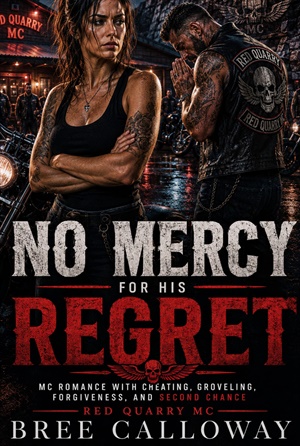
No Mercy for His Regret
PROLOGUE
There's a particular silence that comes before that kind of call.
Not quiet, exactly. My apartment in Butte was never quiet, not with the heat clicking on and off all night and a neighbor who kept parakeets.
But there's a stillness that settles over a room in the seconds before the worst news arrives, like the air itself is bracing.
I answer on the second ring. Nan's voice on the other end is steady in the way people get steady when they've already done their crying in the truck on the way to the hospital and back.
"He went easy, honey," she says. "In his sleep. The nurse said he wasn't in pain."
I say all the things you say. I ask when. I ask if Birdie knows. I do not cry, not yet, because crying is a thing I do later, alone, in places where nobody can watch me do it and decide what it means.
What I do instead is get up, put coffee on, and stand at my kitchen window looking at a parking lot in a town I chose specifically because it was eleven hours from Blackmoor, Minnesota, and everyone in it.
My uncle Hollis Halvorsen ran blast crews at the Red Quarry pit for thirty-one years before his lungs gave out on him the way lungs do to men who spend three decades breathing rock dust and telling themselves it's fine.
He taught me how to read a bench face for weakness before he taught me how to drive.
He taught me the difference between a controlled fracture and a catastrophe, which turned out to be a distinction that mattered in more than one part of my life.
He was the reason I got my blaster's license at twenty-three, the youngest woman in the state to hold one, and he was the last person who called me on my birthday every single year without fail, including the year I left Blackmoor and didn't leave a forwarding address.
I owe him a great many things. Driving eleven hours back to bury him is the smallest of them, and it is still the hardest thing I've been asked to do in fourteen months.
? ? ?
The last time I stood in Blackmoor, it was June, and I was wearing a promise ring made from a scrap of iron ore Micah Rourke had cast himself in the monument shed, hammered thin and cool and heavier than it looked, the way most things about him turned out to be.
We stood at the Mercy Stone that day. Everyone in Blackmoor knows the Mercy Stone, even people who've never set foot near the quarry — it's the slab of red granite at the gate that Hollis put up the year a rockfall took two of his crew, engraved with every name of every worker the pit has claimed since 1958.
It isn't cheerful. It was never meant to be.
But Hollis used to say a place ought to remember what it costs to run it, and so the stone stands there at the entrance, weathering, growing longer by a name every few years, tended by whoever in the club has steady enough hands to cut granite without shaking.
For the last decade, that's been Micah.
He'd carved a border into the base of the stone that summer, a pattern of interlocking rings, and he'd cast me a small iron pendant in the same pattern to wear on a chain, because he said if the stone remembered the dead, somebody ought to make something that remembered the living too.
I wore it every day after that. I'm wearing it now, this morning in Butte, four hundred miles into a fourteen-month silence, because I never once managed to take it off.
Fourteen months ago I found out that Micah Rourke, road captain of the Red Quarry Motorcycle Club, monument carver, keeper of the stone that remembers the dead, had spent one night with my closest friend in the world while I sat in a hospital hallway three towns over holding Hollis's oxygen bag and calling Micah's phone eleven times.
He didn't lie about it. I'll give him that much, though on the worst nights it hasn't felt like enough to give him anything.
I've replayed that conversation more times than any healthy person probably should, turning it over in the small hours, trying to locate the exact sentence where my old life ended and this new, wearier one began.
There wasn't a single sentence, I've decided.
There was a whole cascade of them, each one a small additional weight, until the sum of it was simply too heavy to carry inside the shape of the life I'd been building with him.
He told me himself, two days later, sitting across from me at Nan's kitchen table with his hands flat on the wood like he was bracing for the table itself to buck him off.
Talia. My Talia, who'd braided my hair for my middle school graduation, who'd sat with me the night my mother left and never came back, who I'd have called first if anything ever happened to me, before I called my own sister.
I didn't ask him why. I've thought about that a lot since. I think some part of me was afraid that whatever answer he gave would make sense, and I did not want anything about it to make sense.
There's a version of that week I've never told anyone in full, not even Nan, who I suspect has pieced most of it together anyway through the particular intuition of a woman who's spent decades reading grief off other people's faces for a living.
The version where I sat in Nan's driveway for forty-five minutes after Micah finished talking, engine running, unable to make myself either drive away or go back inside and ask the questions I actually wanted answered.
What did her hair smell like. Did he think about me the whole time or only after.
Was there a moment, even one, where he could have stopped and chose not to.
I never asked any of it. I told myself the not-asking was strength.
Looking back, I think it might have just been fear, dressed up in strength's clothing, the same way most of my worst decisions that year liked to dress themselves.
I packed a bag inside of an hour. I left before the club even finished hearing about it, before Dutch could pull his son into some smoke-filled room and tell him how to survive it, before Talia could show up on my porch with whatever explanation she'd built for herself in the two days it took Micah to tell me the truth.
I left the ring on Nan's table, next to his hands.
I did not leave the pendant. I've turned that fact over more times than I can count and I still don't fully understand my own reasons for it.
? ? ?
The drive to Blackmoor takes eleven hours if you don't stop, longer if you do, and I stop three times, not because I need to but because some animal part of me is negotiating for more road between myself and the town limits.
The first stop is a gas station outside Fargo, fluorescent-lit and nearly empty at that hour, where I buy coffee I don't need and stand in the parking lot for ten minutes just breathing cold air, watching a semi truck idle two pumps over, its driver asleep behind the wheel with his cap pulled low.
I think about all the people out on this same stretch of highway at this same hour, each one carrying some version of dread or grief or hope toward a destination they haven't reached yet, and the thought is oddly comforting, a reminder that grief doesn't require a person to be special or singled out, only human, only moving through the ordinary machinery of loss the way everyone eventually has to.
The second stop is unplanned, a rest area with a historical marker about the region's mining history that I don't bother reading, though I sit at the picnic table beside it for a long while, phone in my lap, thumb hovering over Micah's contact information before I lock the screen again without calling.
I tell myself I'm not ready. I tell myself a lot of things on that drive that turn out, in the fullness of time, not to be entirely true.
The third stop is for gas again, this one deliberate, forty minutes outside Blackmoor, because I need the extra time more than I need the fuel, need a few more minutes where I'm still just a woman driving toward grief instead of a woman who's arrived at it.
Somewhere past Fargo, the land goes from flat to rolling to the first dark hint of pine, and the light changes the way it always does this far north in October, gray and low and edged, like the sky is bracing for something too.
I drive with the radio off. I drive thinking about Hollis's hands, thick-knuckled and sure, showing me at nine years old how to pack a small charge into a test hole in the yard behind his house, saying, *respect it and it'll respect you back, Wrenny.
Everything worth doing is dangerous if you're careless with it. *
I think about other hands too, on that long stretch of empty highway, because grief has a way of making a person take inventory of every loss at once instead of the one currently sitting on your chest. My mother's hands, which I remember less clearly than I'd like, pale and quick and always a little cold, the hands of a woman who left Blackmoor when I was seven and Birdie wasn't born yet, and never once came back to explain herself.
My father's hands, which I don't remember at all, because he died in a logging accident before I turned two, leaving Hollis to raise a niece who wasn't strictly his to raise, and doing it anyway, without complaint, without ever once making either Birdie or me feel like an obligation instead of a choice.